AAC is a community of persons helping each other and sharing ideas and information. It is not about just helping yourself.
Post what you have accomplished so that others may benefit from it.
Before putting everything on a PCB, I realized there's something else I can do in my circuit. Right now, I'm using a diode bridge to rectify AC to DC. But I have a bunch of 12X4 full wave rectifiers that I can use instead.
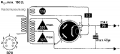
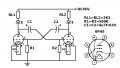
I found this schematic on the internet:
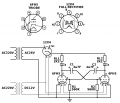
However, my transformer has only two output pins. This is how I believe I should connect it:
The heaters of the two triodes are connected in series, and the heaters of the rectifier are connected in parallel. Pin 6 of the 12X4 I'm not connecting anywhere, and I'm using the same ground for AC and DC. But I believe that his is doing the same as a half wave rectifier tube. Do I have this right or am I wrong?
Right now, I'm using a full-wave semiconductor bridge rectifier. I was using a 2200uF/50V smoothing capacitor, but it made my circuit go bogus (ie. one of the two LEDs would stay on twice as long as the other). Without the smoothing capacitor, the circuit works fine (ie. both LEDs stay on as long as the other).
As for the 12X4 running as a half-wave rectifier, that's what I thought. But I don't know how to connect it as a full-wave rectifier. The datasheet says it's a full-wave rectifier. 12x4
As for the 12X4 running as a half-wave rectifier, that's what I thought. But I don't know how to connect it as a full-wave rectifier. The datasheet says it's a full-wave rectifier.
Alright. Thanks. I'll try to find a cheap center tapped transformer, otherwise I'll stick to the bridge. I'm not doing this to build the ultimate high-end, perfect cost-efficiency vacuum tube oscillator. I'm doing this to have fun and learn (and to use the dozens of tubes that I have). It's alright if I lose some supply voltage. Thanks for your help.
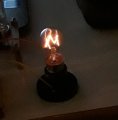
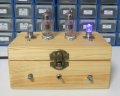
Before soldering everything, I wanted to try the same circuit, but using lamp bulbs instead of LEDs. I have some E-14 tubular lamps that look pretty good next to the tubes. They're 220V 15W bulbs. They won't turn completely on, the filaments glow slightly, as seen in the picture, but that looks actually better imo.
Anyway, if I replace the LEDs+Resistors with the bulbs, they won't do anything. I imagine there's not enough current. How can I modify the circuit to get the lamps to work? Thanks!
Before soldering everything, I wanted to try the same circuit, but using lamp bulbs instead of LEDs. I have some E-14 tubular lamps that look pretty good next to the tubes. They're 220V 15W bulbs. They won't turn completely on, the filaments glow slightly, as seen in the picture, but that looks actually better imo.
Anyway, if I replace the LEDs+Resistors with the bulbs, they won't do anything. I imagine there's not enough current. How can I modify the circuit to get the lamps to work? Thanks!
The lamp filaments have a much lower resistance when they are not up to full temperature so you are overloading the anodes of the tubes. Lower wattage lamps (sewing machine or night light bulbs?) with series resistors might work.
The lamp filaments have a much lower resistance when they are not up to full temperature so you are overloading the anodes of the tubes. Lower wattage lamps (sewing machine or night light bulbs?) with series resistors might work.
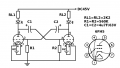
I tested a similar circuit with whatever components I had on hand.
The tube I used is a twin triode, 6DJ8/ECC88.
I started out with HV = +200V.
R = 100kΩ
C = 0.01μF
R1 = R2 = 1MΩ
f = 16Hz
Then I reduced the HV to +24V.
R = 10kΩ
C = 0.47μF
R1 = R2 = 1MΩ
f = 1Hz
Works ok with LEDs.
Surprisingly, the circuit oscillated with supply voltage as low as 1V, though there is not enough voltage to drive the LED.
The LED was visibly flashing with supply voltage at 5V.
Mr Chips, thanks for your report. It's good to know that the circuit works at low voltages. I was using a 24V transformer for the plates, and a 6V transformer for the heaters. I will try using the 6V transformer for both. If it's to dim, I'll try a 12V transformer and will connect the heaters in series. Did you try using bulbs? I ordered some 24V bulbs, since the 220V ones I have won't work with the circuit at such low voltages.
Mr Chips, thanks for your report. It's good to know that the circuit works at low voltages. I was using a 24V transformer for the plates, and a 6V transformer for the heaters. I will try using the 6V transformer for both. If it's to dim, I'll try a 12V transformer and will connect the heaters in series. Did you try using bulbs? I ordered some 24V bulbs, since the 220V ones I have won't work with the circuit at such low voltages.
No point in using bulbs. There is not enough current through the tubes to light up bulbs unless it is a 2mA @ 1.5V bulb.
Think current, not voltage.
With 24V into 10kΩ the most you will get is 2mA.

 Facebook
 Google
 GitHub
 Linkedin