Mosfet open discussion

dl324

Joined Mar 30, 2015
18,329
I see your point now.
In my professional life, I've had so many people steal my ideas that I've lost track of the number of times. Once I catch them doing it, they get on my "shit list". The only way to get off of it is to die. One particularly nasty time was when my boss' boyfriend was trying to pump me for ideas and get me to do his work. That was an uncomfortable situation. Fortunately, his games caught up with him and he left, or was forced to leave.
Also thanks for the aliexpress screenshot - I still dont get it
I'll post the next time I get one of those offers.
I mean, if you are referring to this
1721887914081.png
, that's a marketing trick that is literally everywhere on aliexpress.
I have over $150 in coins, because I play their game and collect 40 most days, and rarely save any significant amount of money. I make more from my Capital One card that monitors my online purchases and offers me "rewards" even if I don't use their card (sometimes, they're giving me 8-12% cash back). Which I don't because I have a card for online purchases that gives me 5% rewards. That card pays me about $50/month (I also use it to pay some bills).
 

Thread Starter

q12x

Joined Sep 25, 2015
2,227
If you're referring to this thing, in my country, or at least for me personally, it is throwing an error. Now I can't find it, but I remember I tried multiple times this "deal" and the jist was that they are not available to romania, or probably any other county outside america. Is what I remember, but it was an error in some form that didnt let me finish the deal.
1721889058262.png
I have over $150 in coins,
I collect them too for awhile and they are not that helpful. They are "helping" the price 1 or 2% rarely 5%, and the price difference is infinitesimal, to the concurrence. Like 1cent difference. I do use them but the amount of these coins I have collected here will "help" me and other 100 accounts to get those 'cheaper' deals, for 10000years period. Its just a joke from aliexpress in my opinion, they dont help sh*t. At least for me, but I bet in america is another story and you do get real help from these, like you mentioned something already. Yah, my sh*t country... what can I do.
1721889468651.png
I make more from my Capital One card
we dont have such thing here.
even if I don't use their card (sometimes, they're giving me 8-12% cash back).Which I don't because I have a card for online purchases that gives me 5% rewards. That card pays me about $50/month (I also use it to pay some bills).
WOW - now I want one ! haha ---eeh, its impossible here and is fine.
I know america with its funky presidents in the late years, they do take care of its people and their monetary problems very seriously. Its not letting them down. While here...they keep you in the dirt financially and tax you and absolutely no help whatsoever, only stealing as much as its possible or legal. But im complaining to much and divulge too much hush-hush reality.
 

dl324

Joined Mar 30, 2015
18,329
I bet in america is another story and you do get real help from these
They don't help much. I have a few more than you...
1721918003257.png
WOW - now I want one !
Capital One is just a MasterCard. I got that one for the 3% rewards for dining out. Everything else is 1%, except for the offers they give me for on-line shopping. They also gave me a $200 welcome bonus for charging $500 in the first 90 days. That was easy to do because I used it for hotels and meals on a vacation with my siblings last year.
 

dl324

Joined Mar 30, 2015
18,329
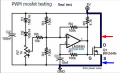
Now is exactly as in the picture (with no Load resistor as in your original cct)
20240710_mosfet testing v2.jpg
20240722_033337.jpg
I just noticed that you changed the supply in my circuit from 12V to 5V. 5V isn't very useful for testing IRFZ44N because the threshold voltage can be 2-4V. At that voltage, they only conduct 250uA. The datasheet specifies Vgs=10V for the current tests.
 

dl324

Joined Mar 30, 2015
18,329
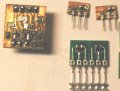
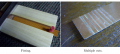
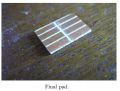
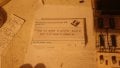
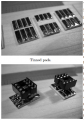
TPAD stands for Transistor Pads that Im making manually for my SMD tr's for many years, probably before appearing on the market. Im using them very rarely, but when I need one, I always have it, or I can easily make one in 5 minutes.
Are you making these from copper clad board?

My homemade versions weren't very pretty. The one on the left was etched.
smtAdapters.jpg
 

Thread Starter

q12x

Joined Sep 25, 2015
2,227
Are you making these from copper clad board?
yes, I bought one, and cut it to these small sizes. Actually I cut it in long strip lines that I store them and THEN Im cutting them into small squares when needed. One important thing is the versatility of my design. I can solder on it transistors, right?
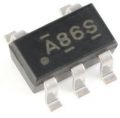
But remember those SMD 5 legs 1 single gate components? 1721977935383.png
Well, I can use the same TPAD, cut another line, like a +, basically having 4 squares islands, and I can solder this unplanned component too. So not only transistors. Very handy, I tell you. Is a bit hard to scratch by hand all those lines, is not one pass and the gap is formed, oh no, its 20-30 passes, and cleaning deburring as well. Also the middle line is a bit tricky, not to eat from the other side because there is the middle pin of the transistor and if its a gap there, its a bad TPAD. So that must be addressed with careful scratching. But it is doable. I think it take me like 10min to make 1 TPAD. A bit slow for my liking but is doable. I got used to it already. And the design is very simple and practical and most of all, versatile. I think I converted once, a blank square for a 555 SMD IC. That was very hard to make the scratches - again, manually. Because they were too many scratches to make and is hard to be precise and your hand will hurt very quickly from pressing. THats a little bit of history, hope it will help someone.
1721977246181.png
 

dl324

Joined Mar 30, 2015
18,329
cut it in long strip lines
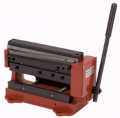
What did you cut them with? I bought a metal shear from Harbor Freight to cut copper clad board. It was one of the best purchases I've made:
1722005288432.png
Original posted in this thread on metal working tools.
Is a bit hard to scratch by hand all those lines, is not one pass and the gap is formed, oh no, its 20-30 passes, and cleaning deburring as well.
What are you using to make the gaps? I used a Dremel with a small engraving cutter for my messy ones:
1722005027248.png
I converted once, a blank square for a 555 SMD IC
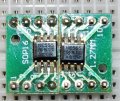
I use SOIC16 to DIP adapters cut in half:
SOP8From16Adapter.jpg

K7Q0 documented using a miter saw and a jig to make pads for DIP packages:
1722005107589.png
1722005127501.png
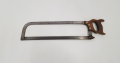
I bought several thin kerf saws on AliExpress for doing this. They were recent purchases, and I haven't used them yet.
 

Attachments

Thread Starter

q12x

Joined Sep 25, 2015
2,227
What did you cut them with?
1722087322795.png
I am aware I am cutting 1mm off with every cut, but... its what I have.
metal shear from Harbor Freigh
this is indeed IDEAL to have ... but I never had the courage to buy one, because my pockets have holes and Romanian capitalism.
What are you using to make the gaps? I used a Dremel with a small engraving cutter for my messy ones:
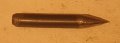
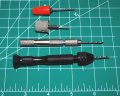
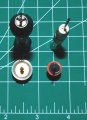
WOW! very fancy! I am using end pieces of drills that long past broken and I (me and my father) converted them into little punchers or scribers especially for metal. 20240727_044037.jpgThe problem with them is for scribing, they are very short and your fingers must exert way more force and muscle strain than when holding a long crayon for example. So your fingers and hand gets tired and hurts very quickly after 1 or 2 TPADS. The trick is to make 1 and take a break of 30 min or 1h. Then come back and make another one and in 1 day you can make 5 or even 10. I know I concentrated and make a lot of them at once, but I couldn't make anymore for a couple of days after that.
After trying the SOT8 for my 555, which I dont remember even finishing it, or did I? but I remember I tried to make one. So after this experience, I decided to buy those sot8 to DIP8 adapter boards and I used them 2 or 3 times. They are indeed from another world and another level.
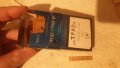
I made a cardboard box for them. They came in a bag I think.
20240727_045356.jpg20240727_045411.jpg
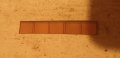
Here is how is looking a blank strip for TPADs. I integrated from the very beginning, when the full board was uncut, that 1mm tolerance for cutting saw. And it helped, compared to a simple line, when you mindlessly cut away from your final size.
20240727_045516.jpg20240727_045525.jpg
Very interesting is that your pdf book is using the same naming as "PADs" as I did. Wow. Very surprising. I thought this was my naming invention. I would not be shocked if I find the name of TPADs also existing out there. But I assure you, this was my inventive naming for them. Sometime Im trying to think like an american too much... then Im open my eyes and I wake up in Romania.... wa wa waaaa.
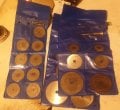
thin kerf saws
Here are mine from 2010 probably. They are 0.7mm thick and the bigger ones are 1mm thick. I used the 0.7 thick ones with a DC motor from toys, and because I couldnt center the disk perfectly, is wabling a bit, and the final cut is 1mm to 1.2mm sometimes. Bleah. I know I tested them and never used them after that.
The diamond ones are 0.8mm and the same wabbling problem so no happy results either.
But here is my tooling Im using so my mistake. The disks are ok. I promised myself I will make a finer sawing support but it remained in the "todo" list buried in a corner of my memory.
20240727_051925.jpg

In your book there, he is using these pads for DIP8 and TH (Through Hole) components. Its interesting when Im seeing these pads made by somebody else than me. My reason is to practically use them on my cardboard circuits. But he is experimenting with them, not actively using like me.
Very important detail is that I am making them for SOT8 SMD's, and not TH ! Which is another ball game. Size matters ! Is what she said.
1722091238187.png
 
Last edited:

Thread Starter

q12x

Joined Sep 25, 2015
2,227
Did a quick test with the PWM supply at 5.0V and 14.3V (adjusted to give 10V on the gate). With the MOSFET supply at 3V.
Vpwm=5V, current reading=0.9A, Vdmin=1.25V (minimum drain voltage)
Vpwm=14.3V, current reading=1.6A, Vdmin=0.5V
Couldn't get more accurate reading for Vdmin because cheap digital scope doesn't like the input being overdriven and I didn't feel like powering on the analog scope.
EDIT: Took the on voltage measurements with an analog scope. A bit surprised the digital scope was even close. Both measurements were taken on the 5V/div range. On the analog scope, it was 0.5V/div.
I'll take measurements with a load resistor or current probe so I can do resistance calculations.
And this is all your data you collected that is in // with my data:
1722105875525.png
 
Last edited:

Thread Starter

q12x

Joined Sep 25, 2015
2,227
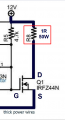
I just made another test today 27.07.2024. I inserted 1R 50W on the Drain.
here is the data I collected (last line):
1722107510803.png
I noticed something very-very strange.
When Im changing the Vertical knob of my FNIRSI oscilloscope, Im getting different VDS voltages ! For example if I rotate it down, I got 1.50V, if I rotate it up, I got up to 18V !!!! But the PSU is delivering a constant 5V. VERY strange! It looks like it is behaving as a boost converter a little bit.
So for that VDS =3.82V, the Vertical knob is set for 500mV/div.
In other words, it matters where you set your Vertical knob, because the Vmax,Vmin,Vpp will change dramatically. Will jump in value.
Here is how I linked everything. I will slap ma face not using the other more thicker power cable, but for now it should be good enough this cable.
Is very thin for this experiment !
The problem is that I dont see any improvement. I mean... right now, for 1min or so and with a lot of interruptions, only very short contacts for testing and rapid reading, everything stay very cool ! Nothing heat up. Which is good news. But the actual power is dissipated in that 1R 50W more efficiently than inside the naked transistor and put in direct like before. So this coolness is very deceptive. The strength of the power is still there.
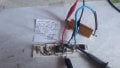
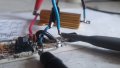
The circuit I have now on the table is exactly as in that sketch with that 1R on the Drain. - I didnt use a secondary PSU.
1722108326162.jpeg20240727_102441.jpg
 
Last edited:

dl324

Joined Mar 30, 2015
18,329
The problem with them is for scribing, they are very short and your fingers must exert way more force and muscle strain than when holding a long crayon for example. So your fingers and hand gets tired and hurts very quickly after 1 or 2 TPADS.
Use something to make them longer. One of my recent "hot picks" from AliExpress was a pin vice with 60 bits for under $4.
1722093501411.png
I haven't used it yet, but I've used various bit holders for decades:
bitHolders1.jpg
bitHolders2.jpg
But he is experimenting with them, not actively using like me.
He's a ham radio operator. I can assure you that he has made many RF boards using all of the techniques he documented.

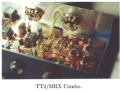
This is an example of his work from the document I posted.
1722094039809.png
 

dl324

Joined Mar 30, 2015
18,329
When Im changing the Vertical knob of my FNIRSI osciloscope, Im getting different VDS voltages ! For example if I rotate it down, I got 1.50V,
What was measuring 1.5V and what was the vertical resolution on the scope?
if I rotate it up, I got up to 18V !!!!
Same question.
But the PSU is delivering a constant 5V. VERY strange! It looks like it is behaving as a buck converter a little bit.
I think it's inductance in the wires
In other words, it matters where you set your Vertical knob, because the Vmax,Vmin,Vpp will change dramatically. Will jump in value.
I like the convenience of the min/max, duty cycle, frequency display on digital scopes, but I prefer the unmodified simplicity of an analog scope.

When I was trying to measure on resistance for IRFZ44N, the cheap DSO gave erroneous readings when the input was overdriven. Don't have that problem on my analog scope. I mentioned this in your LM317 thread.

The circuit I have now on the table is exactly as in that sketch with that 1R on the Drain. - I didnt use a secondary PSU.
You're not going to get meaningful data using a 5V power supply. If you want to make current capacity or on resistance measurements, you need to do them at Vgs=10V; as specified in the datasheet.
 

dl324

Joined Mar 30, 2015
18,329
Also you can add your own data points, but update me to modify my sheet too. To truly work in // !
If you're going to use colors, could you use colors that have good contrast with the white background. It's hard for my old eyes to look at combinations with little contrast.

The data fields you have don't make much sense.

As I've mentioned before, the whole point of using a PWM circuit to test current capacity is that, with a low duty cycle, you can test at relatively high currents and not need to worry about power dissipation being so high that you need a heat sink.

Most of the data you're collecting isn't meaningful.
  1. Unless duty cycle is 100%, PSU amps and watts are meaningless. Even more meaningless when you're using a load resistor.

  2. Transistor temperature shouldn't matter when driving with PWM.
  3. Why do you mention BJT parameters? We're testing MOSFETs.
  4. How are you doing the power calculation? Are you averaging over the pulse width (as you should)?

  5. Ambient temperature doesn't matter because the intent is to operate the MOSFETs at an average power that doesn't require a heat sink.
What you need is Vgs, supply voltage for the MOSFET, load resistance, transistor type, duty cycle

I did a measurement with IRFZ44N. Vgs=10V, 15% duty cycle (did something and couldn't get to 10%), 1 ohm load resistor, 5V MOSFET supply, Vload=4.5V (Vds=0.5V), current=4.5A.

Something I noticed with my FNIRSI Pro is that if the waveform goes off of the screen, the readings are garbage. To get sane readings, I move the 0V level to the bottom major grid and set the sensitivity to 2V/div. I don't care if I get incorrect readings on the data display. I take them from the waveform. For the supply voltage, I ignore the maximum the scope gives me. I use what I set the power supply to (I don't depend on its display, I measure output voltage with a meter). I only use the data displayed for duty cycle (since that seems correct even if other data is garbage). I read the minimum voltage from the waveform, and I ignore negative going spikes.

Here's the table I created:
1722102963834.png
Load voltage/current, on resistance, and device power dissipation are calculated.

When using PWM, the power supply display current and power readings aren't useful. In your case, it includes current used by everything; and the load resistor is dissipating most of the power.
 

Attachments

dl324

Joined Mar 30, 2015
18,329
The website isn't letting me modify my post...

The data order could be better, with the calculated fields after entered fields. DevSup, Vgs, Drain, On R, and DevPwr should be together. I just created columns as I thought of what was important.

I saved in Excel 2010 format. There wasn't an option for 2007, so maybe they're the same.

Updated the formulas in the spreadsheet so it works correctly as you're entering data.

Figured out why I couldn't get down to a 10% duty cycle. I needed to make R6 smaller to be able to get down to 10%. At some point, I removed a connection for the resistor I added in parallel. Put it back and the readings were the same, except calculated dissipation was lower.
1722107965053.png

One other thing. My FNIRSI Pro can't calculate duty cycle correctly when the waveform goes off the screen.
 

Attachments

Last edited:

dl324

Joined Mar 30, 2015
18,329
I can open your xlsx file just fine in my 2007 excel !
I added data for IRLZ44N and noticed that the output from the PWM circuit varies with duty cycle due to the voltage divider composed of all of the resistors except R1. The difference between 10% and 15% is only 0.1V, so not a very significant change.
1722111029525.png
 

dl324

Joined Mar 30, 2015
18,329
I was doing an experiment with some CD4049 inverters on the output of the PWM to address the gate voltage changing with duty cycle. While I was doing that, I discovered another quirk of the FNIRSI Pro. Those peaks I'm seeing are affecting the duty cycle calculation. To see how bad it was, I measured the duty cycle on my analog scope. I got 4%. When I adjusted the vertical sensitivity on the DSO so the input didn't exceed the range, it calculated DC correctly (4%). Once the input started being overdriven, the calculated DC was wrong.

I don't know if this will affect your scope.

The cheap DSO was showing a voltage change on the output of the CMOS inverter as duty cycle changed. That doesn't make sense. I can't tell on my analog scope because it doesn't have enough resolution. I guess I could put a voltage divider on the signal and use a more sensitive range, but don't feel like doing that at the moment.

EDIT: Checked the output with my 7D20 (70MHz Tektronix DSO from the 1980's) and it showed that the output from the CMOS inverter didn't change with duty cycle. Another thing to dislike about that cheap DSO.
 
Last edited:

dl324

Joined Mar 30, 2015
18,329
Thanks to the limitations of the FNIRSI Pro, I decided to look for driver updates for the Hantek 6022BE trigger instability problem (again). After Googling specifically for trigger instability, I found that the original driver doesn't work.

I found a reference to OpenHantek6022. Downloaded, installed, and the trigger problem is fixed!!! Now I have a DSO I can use for tests and not have to use my Tek scope.

When I overdrive the vertical amplifier, the program can still display accurate duty cycle.
 

Thread Starter

q12x

Joined Sep 25, 2015
2,227
When I probed VDS, I put the probes like in this -image-.
1722138395545.png
Doing it like this, Im actually probing the PSU. But because of rapid interruptions of the VDS, my FNIRSI, on its vertical scale set to 500mV read 18V (sometimes 13V) fluctuating. But Very high voltage reading from a supposedly constant 5V.
So thats the reading.
My explanation, is that it might be a voltage boost converter happening. This means somewhere is a coil and a ferite core to concentrate the electromagnetic field a little bit until it jumps to that 18V seen. My -GUESS- is that internally to my PSU, on it's Output circuit, must have this coil or something that behaves like one. I dont think its the power wires alone. But my idea and my explanation it must interfere with the cct inside my PSU !
And this morning, I just play a little bit more with this cct, with the one that has the 1R 50W on the Drain to 5V connected.1722140373390.png
And I can hear a very distinct squickly frequency sound. And yesterday I hear it but I didnt pay attention from where, and today I move my ear everywhere to pinpoint where is the source of that sound. And guess where it comes from? from inside my PSU !!!! So this is confirming that high voltage of 18V is an intersection with my PSU output circuitry. Very interesting ! This sound and the osc reading, is also warning me that this is a serious error and I should not keep it in function too long, or something from my PSU might blow up. I hope not, but Im a bit suspicious it might be. The output of my PSU is most certainly not designed for such pulsing in direct like Im doing now. Very interesting. And this is with the 1R 50W in series but it is not limiting much current anyway, so it is like its not there. That big resistor is helping my testing mosfet from overheating but is not protecting the output circuit of my PSU. THats my point.
Another observation! At the maximum pot travel, I get that squickly frequency noise and the osc is showing 90% DUCY.
I back down the POT at ~90% and the osc is 80% DUCY.
I back down the POT at ~80% and the osc is 60% DUCY.
I back down the POT at ~70% and the osc is 10or13or15% DUCY not really a stable reading but somewhere in this range.
Originally I thought maybe my pot must be in the other way, but the PSU showed me 2A moving through the cct so I turn it back as it was. All that 2A must have disipated over the 50W 1R. And the fan of the PSU started to blow, so I got the point very quickly and back it as it was.
Now.... the osc reading, the oscilogram itself, was showing exactly this 80-60 PWM oscilation, visually, when is more positive on top and spikes to negative rail. And it was in accordance to the numbers of PWM meter. So both are reading this waveform correctly. Is my conclusion.
So, to actually run this cct correctly, I must reset the POT a bit back and not to the maximum travel, until I read on the osc that 15% PWM on the meter and on the oscilogram. Then, it is functioning correctly. I believe the circuit got unbalanced from adding this 1R 50W ???? It may be. Or simply I wasnt aware of these details, when I made the first tests yesterday.
 
Last edited:

Thread Starter

q12x

Joined Sep 25, 2015
2,227
Ok, so Im preparing for the secondary PSU. But this new one doesnt tell me anything. Is just quiet. If something will overheat, will certainly blow up and I will not know why or when.
So the logial way was to still use my variable PSU but this time at 12V. And things got even weirder. The mosfet overheated very quick and very hot, I could smell it (or the cardboard underneath it). My osc PWM reading was 70% at the maximum POT travel, and when I back it down a bit like 90% Pot travel, I managed to get some sort of 38% PWM but it was VERY jumpy, to 100% to 90%, all over the place. Mostly, at 50% but with hickups of 90%. What a hell !!!!
Also my PSU reading was 12V and hickups of 2A when it was 100% or 90% PWM. At around ~50% PWM was giving ~800mA. At 38% PWM something like 700 or 600mA. And it was very unstable reading. I couldnt reach under this 38%, and most importantly to remain stable and not jump around.
The squicky noise was very loud this time and I keep it alive for a fraction of a second, as quick as I could in all these tests. Basically when I was hearing it, I was backing down to previous POT rotation. Also the POT travel is very limited right now, between these squicky frequncy noises from my PSU.
So..... ha...ha...ha...
It might be that this particular variable PSU is not really good for this kind of tests ? Maybe? Hmmmm.
But I like it because It is giving me a good ammount of informations and hardware hints especially when overpowering stuff. Thats why I love it.
I start to think the mosfets (in general) might need special power supply, for VDS alone, only because it is switched.
In conclusion, I couldnt make the 12V test on the Gate with a secondary PSU. Yet....
 
Last edited:
Top