this discuttion started from this point at #375 where I said: "...From what I know, a mosfet when is driven continuously it will not be as good as a BJT. But it will excel when is driven in pulses...."
this discuttion started from this point at #375 where I said: "...From what I know, a mosfet when is driven continuously it will not be as good as a BJT. But it will excel when is driven in pulses...."
Okay. But I think you are misstating the problem. It is not whether it is driven continuously or pulsed. It is whether it is used as a switch, or used to drop a voltage. In the case of a continuous current source, it must drop a voltage.
Just to make things confusing, that mode of operation is called the linear region on a BJT and the saturated region on a MOSFET. The two names are reversed in meaning!
There are MOSFETs that work well in saturated mode and others that do not.
I'm going to try to disabuse you (gently) of your notion that MOSFETs can't be driven continuously.
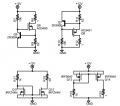
Because the threshold voltage of discrete MOSFETs isn't well controlled, the accuracy of current mirrors isn't as good as with BJTs. In addition to the Z/L of the MOSFETs mattering, the threshold voltages also affect the circuit.
Since BE junctions are more well behaved, the two circuits on the top are more repeatable.
this discuttion started from this point at #375 where I said: "...From what I know, a mosfet when is driven continuously it will not be as good as a BJT. But it will excel when is driven in pulses...."
Just because you said something, doesn't make it true.
What do you even mean by "will not be as good as a BJT"? What is your metric for goodness?
MOSFETs are used in lots of linear applications. As with everything, including every type of transistor, they have their advantages and disadvantages. You design circuits around each type that leverages it's advantages while mitigating its disadvantages. Taking a circuit that has been designed this way for one type of transistor and then expecting it to behave as well if you substitute another type is unrealistic.
Consider taking a BJT current mirror and using the reference to drive multiple reflections. After just a few, the finite beta (and resulting base current) results in the reflections deviating significantly from the reference. But with a CMOS current mirror, you can use a single reference to generate literally millions of faithful reflections -- it's done all the time on CMOS imager arrays.
I'm going to try to disabuse you (gently) of your notion that MOSFETs can't be driven continuously.
Because the threshold voltage of discrete MOSFETs isn't well controlled, the accuracy of current mirrors isn't as good as with BJTs. In addition to the Z/L of the MOSFETs mattering, the threshold voltages also affect the circuit.
Since BE junctions are more well behaved, the two circuits on the top are more repeatable.
In fairness, it's not so much the difference between transistor types as it's the difference between the basic topologies (top versus bottom). Use discrete BJTs in the bottom circuits and Vbe mismatches will result in pretty poor performance, and for either type of transistor, this can be improved using ballast resistors. But those bottom circuits, on an IC, work just fine with MOSFETs because device parameter matching is much better, while the top circuits suffer, on an IC, because they rely on accurate resistor values to set the current and that's difficult to achieve on most IC processes. The reference current for the bottoms ones would typically be established with the aid of something like a bandgap reference (though those are typically centered around BJT devices). Also, IC current sources frequently don't aim to achieve an accurate current, but rather a set of accurately scaled currents, which is something that BJT current sources can struggle with because of finite beta effects.
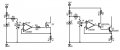
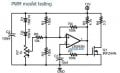
An example of where a MOSFET is better than BJTs, is this circuit we were discussing in your other thread:
If you were trying to sink 4A, the circuit using BJTs would draw significant current through Q2. You were using the current display on your power supply to calculate power dissipation in Q3. The base current coming from Q2 affects that calculation. That's why I was encouraging you to measure the voltage drop across R6 but, even that, has limitations because the emitter current and collector current in Q3 aren't the same.
The MOSFET version of the current sink doesn't have that problem. The disadvantage is that using a MOSFET like IRFZ44, the threshold voltage can be as high as 4V. At one point, you were trying to use a 5V supply for the current sink. That could have caused problems because the output of LM358 can't get higher than several volts below the supply voltage (worst case).
With a supply voltage of 9V, either circuit should work.
I think we had a discussion about whether a base resistor was required for Q2. It isn't. But the gate resistor on Q1 is used to prevent the opamp from oscillating due to the capacitive load.
An odd note that certainly applies to this line of discussion .........
There is another "basic-type" of MOSFET,
that don't really seem to have a common set of adjectives to separate them from each other.
Probably ~80 or ~90% of MOSFETs are specifically designed around increasing "Switching-Efficiency",
the other versions are usually better suited to operation as a "Controlled-Resistor".
There is sometimes found vague sales blather in the Spec-Sheet as to the suitability of a
particular line of FET models to one type of usage or the other.
When using a FET as a "Controlled-Resistor"
always consult the SOA-Graph in the Spec-Sheet.
Switching-prioritized FETs may handle absolutely stupid amounts of Peak-Current,
but only in very short pulses.
Whereas the "DC" line, in the SOA-Graph, in the Spec-Sheet, tells the real story.
And, don't forget to accurately calculate the Heat-Dissipation.
.
.
.
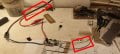
Not too much progress, because of this damn summer heat 37*C. I barely could think these days. So Im working night when is a bit cooler air, and progress is very slow. So.. this is my progress so far.
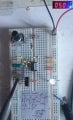
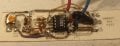
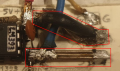
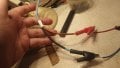
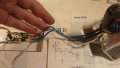
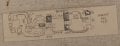
First I made that breadboard test and it worked fine, then I put everything on cardboard. I osciloscope it and is exactly the same as the breadboard version. So its a success story so far.
I specifically used stupid thick power links to D and S of the mosfet to be tested. That S link is 6 wires on top of eachother. To be very sure not having power losses in the wires like the 1st time.
So until right now, I only managed to make the board.
But I didnt power stress test any mosfet yet.
---
Oh, some data:
1.3kHz for 10% duty cycle _|_|_|_
2.9kHz for 70% duty cycle ¯|¯|¯|¯
all this data is true on breadboard and on cardboard circuits.
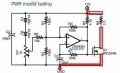
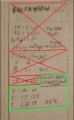
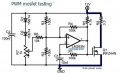
The high current path is indicated by the red boxes. All of the other wiring can be something like #30. The high current path can be #22 (0.65mm). #22 can carry 7A for short-ish distances.
R8 limits current to 3.6A
Hmmm...good idea to mark thicker wires in the diagram !!!! mister @dl324
The path you show is exactly what I made there, on my cardboard.
- And this is the big difference between my cardboard ccts and breadboarding. On breadboard I am limited to 1A@5V=5W max, or even less to safely test anything and not melt the plastic by overheating the metal tracks. While on cardboard, I can test as high power my heart desires, the limit being the big size heat disipation aluminium heatsinks that is a discussion beyond cardboard testing.
- As a reminder, when I -first- tested this power cct with the BJT NPN tran, I got erroneous current reading over Load resistor and over trans in test ! Remember? I thought I was having 40W over BD681 in test, the maximum he can support, and it was staying almost hot, until you said "something is not right" and then I realized there must be losses in the wiring.
And after remaking the tracks with thicker ones, and adding thicker power cable, I was getting half , 19W at 55*C limit.
But this was the experiment that told me the power consumed from my PSU ! Very important too.
Later I made a proper testing and I collect over the transistor it's actual power which was way less than 19W.
anyway....
This is all just a reminder how important are thick tracks AND power cables for power testing !
All this will be a big discussion for mosfet testing soon enough.
Here is your cct with thicker wires added to it. More interesting when you look at it now, right?
Beauty is in the eye of the beholder. When you get used to analyzing circuits, you'll be able to determine where you have high currents without needing to resort to marking up schematics.
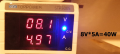
Don't forget that the 3.3 ohm resistor will dissipate over 40W. You could omit the load resistor and let the MOSFET dissipate the power. You can reduce power in the MOSFET by lowering supply voltage, but you need to keep the voltage high enough for the MOSFET to be turned on hard.
EDIT: The power will be averaged over the pulse width. At a 10% duty cycle, 5W will be sufficient. If you operate at higher duty cycles, power dissipation will increase.
Yes, I already did that.
You can see a 1ohm marking from Vcc to Drain but I put thick wires in the final cct.
See? Here on this final cardboard I marked the thick wiring to clearly represent this very important detail ! Even if is covered by the actual wiring.
While on cardboard, I can test as high power my heart desires, the limit being the big size heat disipation aluminium heatsinks that is a discussion beyond cardboard testing.
Do you have any PCB manufacturers in your area that might give you some copper clad scraps? Or sell them cheaply? I buy most of mine on eBay from abcfab. He only sells for half of the year and has nothing listed now.
Cutting copper clad boards was problematic until I bought a small (8") metal shear.
No money ! I live in capitalism.
I also got used to my cardboard manufacturing and prototyping process. I think the copper layer is way inferior in wattage strength than my chunky metal pads !
" cardboard testing. " I should have said testing on cardboard. Im not actually testing the cardboard strength. Its just a medium Im working onto.
To respond to a couple of people posts in this thread in one shot:
Some years ago, I was not clearly differentiate between BJT and Mosfet. I understood they are different technology construction, that they work with different principles of operation, that one is current and the other is voltage driven, and some other details I cant remember now. What I was not "clearly" differentiate was their purpose or necessity or birth place context or specificity they made for.
So after a couple of answers from AAC guys, accumulated in time, I start to realize that the major difference and direction of use is continuous for BJT and pulsed for MOS. Now, that you can drive a BJT with pulse instead of continuous, or inverse, that you can drive a MOS with continuous instead of pulsed, is like mister WBahn explain it:
... As with everything, including every type of transistor, they have their advantages and disadvantages. You design circuits around each type that leverages it's advantages while mitigating its disadvantages...
I personally, know a certain direction of USE for BJTs and that is strongly continuous driving. Unfortunately I am not that used to drive mosfets and again, the highest suggestion rate was to drive them with pulse. So thats my basis. I hope it makes sense now.
The fact that I can pulse a BJT or continuous drive a Mosfet, they are curiosities for my basic driving knowledge I have and operate with (in most of cases) when I build something for very practical reasons.
- On a simplified note, when I see BJT, I know I must continuous drive them; when I see Mosfet, I know I must pulse drive them. This is the little rule in the back of my head, and is automatic now.
Again, not that much experience with mosfets, thats why this new thread !

 Facebook
 Google
 GitHub
 Linkedin