Mosfet open discussion

BobTPH

Joined Jun 5, 2013
11,516
- On a simplified note, when I see BJT, I know I must continuous drive them; when I see Mosfet, I know I must pulse drive them
Simple yes, simple and wrong. But apparently you will not be swayed. Do what you want,
a properly chosen BJT or MOSFET will work either way. But asking a question and the rejecting the answers seems rather pointless to me.
 

dl324

Joined Mar 30, 2015
18,329
No money ! I live in capitalism.
One of these days I'm going to send you a care package. Will you be assessed a VAT?

Take a look at the items I have listed in the barter thread and make a wish list.
I also got used to my cardboard manufacturing and prototyping process. I think the copper layer is way inferior in wattage strength than my chunky metal pads !
You can do what I did when I was doing power dissipation tests on LM317 - make high current connections to the leads. Or you can solder wire on top of the copper to increase current capacity.

EDIT: A 150mil trace with 1 ounce (1.37mil thickness) cladding will carry 6A. Temp will rise 10C.
 
Last edited:

Thread Starter

q12x

Joined Sep 25, 2015
2,227
But asking a question and the rejecting the answers seems rather pointless to me.
Its not rejecting, it's clarification. It's a difference.
Im happy that my clarification of how I see things was understood. That is the way I see things. But with more concepts and circuits for mosfets I will broaden my view. I hope. Like I said already, I didnt work too much with mosfets in my life. Too few ccts in my experience.
Probably ~80 or ~90% of MOSFETs are specifically designed around increasing "Switching-Efficiency",
the other versions are usually better suited to operation as a "Controlled-Resistor".
My friend here, said it better than I ever could. When he is saying it, is fine, but when I'm saying it, its by default wrong. Not cool. I believe the right term is "biased".
One of these days I'm going to send you a care package. Will you be assessed a VAT?
Take a look at the items I have listed in the barter thread and make a wish list.
Why do you presume Im asking for something? Im not. Im just laying down how I see the current things (for 11 years). Some people are meant to be dead financially and its not a shame. Im a shameless poor guy. Haha. It bothered me when I was young and with energy, but now... it's just another way of living. I suggest to stick to the mosfet problems. Haha. Accepting people as they are is the best thing to do, and moving forward. Thats my motto.
----
Right now, in this particular period, is the middle of the summer and its HOT. Here we had 38*C and now it got down to ~35*C-ish. I know this truth from little: "1 degree heat matters!". But... it is still hot weather and for serious testing a power circuit is just very inproper to do it now. My base for power experiments is when I have 25*C in my room and is relatively constant for the rest of the year at this datasheet standard temperature. Im a lucky guy in this sense.
- So, until weather will cool down, I suggest to concentrate on other mosfet circuits, like people already said, with different usage and mentality than my default I have. I will probably try your current sinks/sources cct from #2 . Something that does not involve overheating for the moment.
 
Last edited:

BobTPH

Joined Jun 5, 2013
11,516
You asked our experience with MOSFET. My experience is that they can be driven continuously or pulsed. There is no reason they cannot be driven continuously. There is no reason BJTs cannot be pulsed. Neither is used preferentially for pulsed or continuous operation. I wonder where you got that very odd idea. Can you show us where you read that?

Again, I believe you are confusing use as a switch vs in a linear application with continuous vs pulsed. MOSFETS are generally preferred for switching over a wide range of voltages and currents, IGBTs are preferred for some higher power applications.
 

Thread Starter

q12x

Joined Sep 25, 2015
2,227
My experience is that they can be driven continuously or pulsed. There is no reason they cannot be driven continuously.
Yes there is a very important reason. Efficiency and power loss.
Neither is used preferentially for pulsed or continuous operation.
I originally thought the same as you saying here.
I wonder where you got that very odd idea.
Here:
Probably ~80 or ~90% of MOSFETs are specifically designed around increasing "Switching-Efficiency",
the other versions are usually better suited to operation as a "Controlled-Resistor".
Also from diverse discussions in my AAC threads. For a simple example, a motor driver using a mosfet, will be more efficient and less power loss when pulsed, than continuously driven. I remember I had such project some years ago, now is impossible to find that project thread, but the majority of the suggestions was to PWM pulse the mosfet. I believe I tried to drive it continuously originally, but I got corrected. I know from my experience, that very small loads, very small motors, those 1cm length used for mobile phones or pagers, can be driven with continuous drive. I did it and nothing warm up. But for bigger motors, or solenoids, or coils, like 9V or 12V ones, the mosfets will get hot if driven continuously. If pulsed, they will remain and drive cool. Thats my very limited experience.
I understand you're not asking for anything. I'm saying I want to give you some stuff for free.
With all my respect, I thank you, but no. You are an invaluable friend to me and the fact you thought is more than sufficient for me.
I can MAKE something and send it for FREE for you ! some of my cardboard adventures. I actually made and send to an american a LM3914 in DIP package with SMD leds on top. Very handy for testing. Like this one here:
20240719_003306.jpg He receive it and is still using today. Do you want one too? It will be my pleasure to make one for you.
I believe you are confusing use as a switch vs in a linear application with continuous vs pulsed.
You are right here, for me "use as a switch" is the same as saying is "pulsed".
And "linear application" is the same as saying is "continuous".
Am I that wrong? Please exemplify and make me understand how you see it. If you want, ofcourse.
 
Last edited:

WBahn

Joined Mar 31, 2012
32,848
Yes there is a very important reason. Efficiency and power loss.
You are still falling into the fallacy that because, in one particular application, there are reasons to pulse drive MOSFETs, that that means that MOSFETs can only be pulse-driven. Similarly, you still seem to be drawing the very strange conclusion that, even if it were true the MOSFETs can only be pulse-driven, that it then somehow follows that BJTs cannot.


Also from diverse discussions in my AAC threads. For a simple example, a motor driver using a mosfet, will be more efficient and less power loss when pulsed, than continuously driven.
And the same is true when BJTs are used for that application.
 

Thread Starter

q12x

Joined Sep 25, 2015
2,227
You are still falling into the fallacy that because, in one particular application, there are reasons to pulse drive MOSFETs, that that means that MOSFETs can only be pulse-driven
I believe I start to see your point. So you say, there are specific situations when you pulse drive a mosfet and other situations when you continuously drive the mosfet. Correct? What are those conditions? I believe is purely power related. I might be wrong, but this is my first thought.
I was believing the same thing before adhering to "pulsed vs continuous". But I was seriously corrected towards pulsed instead 'either' modes. So I bend towards pulsed mosfets.
After so many corrections in this thread that is "either" mode to drive, I believe you and I will start to walk as you say. You know Im believing everything you say. Ok then. Thread is closed, mistake is corrected, lesson learned. Heh, this was a quick one.
 

WBahn

Joined Mar 31, 2012
32,848
I believe I start to see your point. So you say, there are specific situations when you pulse drive a mosfet and other situations when you continuously drive the mosfet. Correct? What are those conditions? I believe is purely power related. I might be wrong, but this is my first thought.
Power is only one consideration in an application. There are LOTS of applications where power is either a non-issue, or it is a secondary issue and other considerations drive design decisions. For instance, you generally try real hard to not pulse things around noise-sensitive circuits.
 

Thread Starter

q12x

Joined Sep 25, 2015
2,227
There are LOTS of applications where power is either a non-issue, or it is a secondary issue and other considerations drive design decisions.
Yes... like LOGIC cct's. And there you HAVE to continuous drive them, well, when clock pulse is slow speed.
-
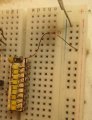
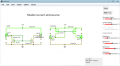
mr @dl324 - I made your mosfet current sink/source. I mounted POTs instead of simple resistors, for playing purposes.
I cant see [right now]. where I can practically use this type of cct. I may think for a reason, when you want more stable/non-fluctuating current to your load. Is my first thought. And this is continuous mosfet driving. And if you need more Amps to drive through the mosfets, you start to pulse them, right? In this example are conducting 10mA. Like mister @WBahn mentioned, as depending on the situation.
1721342266710.png
 
Last edited:

LowQCab

Joined Nov 6, 2012
5,101
q12x
.
The question that You must ask yourself is WHY are there hundreds or even thousands of
completely unique Transistor designs ?????

I have around ~35 different MOSFET-numbers that I use as my "go-to" standard parts,
that cover maybe ~95% of the applications I deal with.
But, there are still times when a FET must be chosen by a detailed Specification-Search,
to insure that it will perform reliably in a particular Circuit.

You must learn to interpret, and completely understand,
the individual Specification-Sheet for each type of Transistor.

Certainly there are simple Circuits where You can "get-away-with-murder" and
successfully use a Transistor that is grossly mis-matched to the application.
This doesn't mean that it will perform 100% as expected,
and a mis-matched Transistor may cause other strange problems that You may never figure-out,
and You will probably blame the problem on something completely unrelated to the actual problem.
.
.
.
 

Thread Starter

q12x

Joined Sep 25, 2015
2,227
The question that You must ask yourself is WHY are there hundreds or even thousands of completely unique Transistor designs ?????
You are trying to confuse things when they are very simple. Or is not that 'simple' for some? It may be.
My answer to your "question" is because many different brands that are making them like Motorola,On Semi, Philips etc, different factories with diferent budget and production tools, designers from different countries like Germania,Russia,China,USA,Romania,Poland,France, mostly euro-asia designs, year of production and renaming the same thing each year for marketing reasons, variants and versions to fit a particular industry application, like audio,automatization,logic, etc; technology updates with better materials but the same design, the same rules goes to ICs. Tr are easier to fabricate than a chip die etching and layering process; so convenience is another good motive. I know a little bit, but never had to deal with too much, is the internal ON resistance of a mosfet, some have bigger and cheaper, some smaller and more expensive, usually used in SMPS or DC-DC converters, for power loss eficiency.
Its not because that tr is better that the other tr. It is because you test it and it fit on your specific application and worked in your specs you needed them. You sure burned a couple tr in your life. I know I did. Until I learned better use of them, their limitations thus their application. Sometime you get lucky, sometime you get garbage or low spec or so called "fakes".
Thats why there are so many. In my opinion ofcourse and from my experience. They are more reasons that I can not think or enumerate here too, Im sure. I just pointed the ones that come first in my mind.
This is not the discuttion I want here.
I want more interesting and inovative circuits I can use mosfets with. SO far only one interesting cct provided my mr dl324. I want more mosfet 'specialized' ccts and not so BJT compatible. Because in most general circuits, bjt or mosfet usage it will work the same. No clear difference where to use one or another, except power applications that I know of (from experience).
 
Last edited:

WBahn

Joined Mar 31, 2012
32,848
If you want to see another "interesting and innovative" circuit using MOSFETs, read up on switched-capacitor filters.
 

Thread Starter

q12x

Joined Sep 25, 2015
2,227
If you want to see another "interesting and innovative" circuit using MOSFETs, read up on switched-capacitor filters.
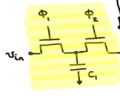
Very interesting concept. So from a practical point, from what I understand this is used for, and please correct me if Im wrong, this switched-capacitor filter is literally replacing a resistor with 2 mosfets.
1721351784103.png
From what I understand, and this is a brand new concept for me, if the resistor is too big, like 1M for ex, the signal will be very small current and unpractical and amplifying it will add more noise and problems with it. Also replacing a precision capacitor temperature dependent in a low pass RC filter. So you are fv modulating the tr's until you get the same signal as with that resistor but at bigger current flow, so more clear signal in conclusion. Very interesting, very niche application !
Please do explain what you used it for.
 

dl324

Joined Mar 30, 2015
18,329
I cant see [right now]. where I can practically use this type of cct.
Current mirrors have a lot of applications. The 10mA was an idea for another member's question. Normally I would have done it with BJTs, but since I'm learning how to use MOSFETs, I decided to go that route.

Since the threshold voltages of a number of discrete power MOSFETs have a 2V variation (2-4V for IRFZ44), I did MOSFET only versions and 2 using BJTs because the BE voltage is more will behaved.

With the MOSFET only versions, threshold voltage must be matched for the other MOSFET to have the same current. It worked for me because I had previously binned my MOSFETs by threshold voltage and the threshold for the devices I used were within 0.01V at worst. Best case, they were closer.
 

Danko

Joined Nov 22, 2017
2,169
- On a simplified note, when I see BJT, I know I must continuous drive them; when I see Mosfet, I know I must pulse drive them.
This is the little rule in the back of my head, and is automatic now.
======
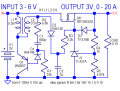
In circuit below MOSFET perfectly works in continuous mode.
With input voltage 3 V out voltage is 2.9776 V at current 20 A!
So, in continuous mode MOSFET works much better than BJT.
======
BJT exceptionally good works in pulse mode.
It controlled by low voltage in boost converter,
which generates 20V DC for driving MOSFET gate.
So, in pulse mode BJT works better than MOSFET.
1721363031864.png
https://forum.allaboutcircuits.com/threads/cant-figure-this-circuit-out.201291/post-1916067
 

BobTPH

Joined Jun 5, 2013
11,516
Yes there is a very important reason. Efficiency and power loss.
That is not true in general.

Show us an example of a circuit where a MOSFET is less efficient when driven continuously than when pulsed and a BJT is less efficient when pulsed than when driven continuously.

And when I say efficient I mean useful power divided by total power, a mathematical quantity, not something like “it requires more components.
 

Ya’akov

Joined Jan 27, 2019
10,235
You are trying to confuse things when they are very simple. Or is not that 'simple' for some? It may be.
My answer to your "question" is because many different brands that are making them like Motorola,On Semi, Philips etc, different factories with diferent budget and production tools, designers from different countries like Germania,Russia,China,USA,Romania,Poland,France, mostly euro-asia designs, year of production and renaming the same thing each year for marketing reasons, variants and versions to fit a particular industry application, like audio,automatization,logic, etc; technology updates with better materials but the same design, the same rules goes to ICs. Tr are easier to fabricate than a chip die etching and layering process; so convenience is another good motive. I know a little bit, but never had to deal with too much, is the internal ON resistance of a mosfet, some have bigger and cheaper, some smaller and more expensive, usually used in SMPS or DC-DC converters, for power loss eficiency.
Its not because that tr is better that the other tr. It is because you test it and it fit on your specific application and worked in your specs you needed them. You sure burned a couple tr in your life. I know I did. Until I learned better use of them, their limitations thus their application. Sometime you get lucky, sometime you get garbage or low spec or so called "fakes".
Thats why there are so many. In my opinion ofcourse and from my experience. They are more reasons that I can not think or enumerate here too, Im sure. I just pointed the ones that floated first in my mind.
This is not the discuttion I want here.
I want more interesting and inovative circuits I can use mosfets with. SO far only one interesting cct provided my mr dl324. I want more mosfet 'specialized' ccts and not so BJT compatible. Because in most general circuits, bjt or mosfet usage it will work the same. No clear difference where to use one or another, except power applications that I know of (from experience).
If you need a very blunt tool to choose a device, your ”rule” is at least not completely useless. That is to say, if you followed it you would probably not lose much as a result. On the other hand, you would also miss out on the potential improvements more nuanced understanding could offer.

@LowQCab was trying to point out that modern solid state components are highly optimized. Manufacturers are constanly refining designs to make them more suitable to particular scenarios. This doesn’t prevent them from being used in others—but it means they will perform less well than some other part designed to be used there.

If you want a heuristic for selection that is a bit more inline with the details, and offers more mental tools than your extreme simplification, you might consider something like this list. (thrown together and subject to withering criticism by others here as needed)

Keep in mind these are not rules! They are always subject to invalidation based on the particular device and its possible alternative, as well as the circuit being used. It also does nothing to address cost and other things that real engineering must account for.

1. Input Impedance—if you have a control voltage choose a MOSFET (or IGBT) over a BJT; with a control current choose a BJT.​
2. Linear Stability—if your application requires high gain, linear response, and low distortion choose a BJT over the MOSFET or IGBT. In linear applications the MOSFET can suffer from instability and poor performance.​
3. High Frequency Switching—if you need the device to switch at high speed, choose the MOSFET for its much faster response time and less complex drive requirements.​
4. Efficiency—if you need low power consumption when the device is being used as a switch choose the MOSFET.​
So, in a nutshell:

MOSFETs are generally more suitable
for digital switching and high-frequency pulsed applications thanks to fast switching speeds, high input impedance, and low power consumption. But possible non-linear behavior and thermal instability might make them less suited to precise linear applications.

BJTs, on the other hand, are generally more suited to analog and linear amplification use cases thanks to high gain, linearity, and lower harmonic distortion. On the other hand slower switching speeds, higher power consumption, and more complex drive requirements make them less desireable for high-frequency pulsed applications.

So your “rule“ is not so much wrong as it is woefully incomplete to encompass any significant part of the current state of knowledge about semiconductor switches and amplifiers—which is, much more than mere marketing, the reason for so many distinct parts in the catalogs of manufacturers.
 

Ya’akov

Joined Jan 27, 2019
10,235
[…] not something like “it requires more components.
Drive complexity is, though, a valid consideration when selecting a device.

This is not an argument against your fine point, but engineering should encompass all of the relevant concerns and BoM reduction surely is a relevant concern in real life design.
 

BobTPH

Joined Jun 5, 2013
11,516
Drive complexity is, though, a valid consideration when selecting a device.

This is not an argument against your fine point, but engineering should encompass all of the relevant concerns and BoM reduction surely is a relevant concern in real life design.
Of course. I was just trying to nail down what is meant by efficiency, in case we were talking about different things.
 
Top