Mosfet open discussion

Thread Starter

q12x

Joined Sep 25, 2015
2,227
I believe, that over voltage from 5V was an error. Now, at 12V I was repeating the same error. Whatever it was.
So I stop and think a bit and I realized that I have to modify the cct for the secondary 12V PSU. Because that should power ONLY the logic cct, and have no contact with the power through the mosfet side. So I desoldered the thick wires from the board and rewire, to adapt for 2 PSU's. Now this new PSU will have no issue with overpowering anything so even if I get no feedback from it, I will trust it will have no problems.
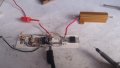
1722144361643.png20240728_082411.jpg
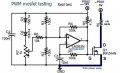
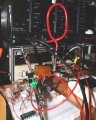
and this is the new cct:
20240728_mosfet testing v3.jpg
I didnt test the power side yet. I only setup the fixed PSU.
 

Thread Starter

q12x

Joined Sep 25, 2015
2,227
Heheheeeee !!!
I made the power test now.
The fixed 12V PSU is powering only the logic cct, down to the gate of the tr.
I set my var PSU to 5V and powered VDS through that 1R50W, exactly as in the skematic.
I was happy to hear the same squicky sound comming from my PSU.
The POT was at maximum, and PSU showed 5V @ 400mA and with 88% DUCY reading over DS, with Vmax ~10V fluctuating (8.5V to 13V).
As I rotated the POT, the sound was higher and higher, changing with fv and also the PSU Amps were starting to get higher and higher.
As an example:
100% POT travel, PSU = 5V @ 400mA
~90% POT travel, PSU = 5V @ 550mA
~75% POT travel, PSU = 5V @ 1A
I only back down a little to check what is happening and I believe these new readings are the correct ones.
Am I correct now? I think I am.
- Also very important detail is that --NOW--, in this configuration. my PSU Amp meter is showing the true amperage going through this power side of the circuit, so basically is doing this mosfet power reading, right? Minus the power over the 1R resistor.
 
Last edited:

Thread Starter

q12x

Joined Sep 25, 2015
2,227
The data fields you have don't make much sense.
They will make sense in time and with acceptance.
These are the values from this last experiment where I used 2 PSUs.
Screenshot_3.jpgI keep alive the circuit for about 1minute continuously and I checked for overheating after that. The tr was cold and resistor cold as well (maybe 5% warmer)
If before everything was getting very hot in a fraction of a second, now, for 1min everything remains cold. I think this is progress !
So... my conclusion, for driving a mosfet, I need 2 PSU's. -Very interesting!
I start to think a mosfet is specifically a 2 PSU device. Right?
 
Last edited:

dl324

Joined Mar 30, 2015
18,329
The POT was at maximum, and PSU showed 5V @ 400mA and with 88% DUCY reading over DS, with Vmax ~10V fluctuating (8.5V to 13V).
You should use accepted abbreviations/acronyms. We refer to duty cycle as DC (we can usually tell from context if you referring to duty cycle or direct current or something else). If you continue to make up your own terms, you'll only continue to confuse yourself, and others trying to read your posts.

When you're referring to the voltage across the drain-source and the source is grounded, mentioning source is redundant. You can just say drain voltage, or voltage on the drain - there's no need to mention the other net if it's ground. Unless specified otherwise, it's always assumed that voltage measurements are with respect to ground.
As I rotated the POT, the sound was higher and higher,
This is an ambiguous statement. You can see with your scope that frequency changes with duty cycle. I mentioned this as a limitation of the single comparator PWM. You're hearing it because the frequency is in the audible range.

Something that I hadn't considered was that the output voltage also changed with duty cycle because there's a voltage divider on the output.
As an example:
100% POT travel, PSU = 5V @ 400mA
~90% POT travel, PSU = 5V @ 550mA
~75% POT travel, PSU = 5V @ 1A
These statements are meaningless. The current reading from your power supply isn't useful quantitatively because PWM is involved. Qualitatively, I can tell that your 100% travel statement is the lowest duty cycle. Other than that, it's meaningless.
Also very important detail is that --NOW--, in this configuration. my PSU Amp meter is showing the true amperage going through this power side of the circuit, so basically is doing this mosfet power reading, right?
No. The current display on your power supply is still not giving you any very useful information. The MOSFET is being switched on and off rapidly and the current display is giving you some sort of average value.

If you want to know the actual current, you need to measure the voltage drop across the load resistor and calculate current.
They will make sense in time and with acceptance.
Many of the fields you have do not make any sense. Recording the wattage of the load resistor is also meaningless. It would be assumed that if you were using a load resistor that it would be sized appropriately. Being massively over specified isn't necessarily a good thing.
I keep alive the circuit for about 1minute continuously and I checked for overheating after that. The tr was cold and resistor cold as well (maybe 5% warmer)
The whole point of using a PWM for testing current capability is that the MOSFET isn't on long enough for heating to be a concern. The same applies to the load resistor. It's assumed that it's sized appropriately. 5% warmer has no meaning. 5% warmer than what? The sun?
my conclusion, for driving a mosfet, I need 2 PSU's. -Very interesting!
I start to think a mosfet is specifically a 2 PSU device. Right?
I don't know what you're basing your conclusions on, but they're wrong.

Using 2 power supplies is a convenience, not a requirement. You know this to be the case from the current sink circuit we were using in your LM317 thread used a single supply. Another example is the discrete voltage regulator I posted in this thread. Yet another are the current sources and sinks in my first post in this thread.

In your initial PWM tests where a load resistor wasn't used, the MOSFET had to dissipate most of the power. When you were testing with a single 5V supply, the only reason your power supply wasn't going into current limiting was the gate voltage wasn't high enough to turn the MOSFET on hard.
 
Last edited:

Thread Starter

q12x

Joined Sep 25, 2015
2,227
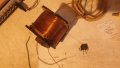
I found a transformer with 13VAC on secondary. After rectifying will give me 12VDC.
20240728_191826.jpg
And a 5VDC one as well, also from an isolation transformer.
 
Last edited:

dl324

Joined Mar 30, 2015
18,329
I found a transformer with 13VAC on secondary. After rectifying will give me 12VDC.
Is there something wrong with the other 12V supply you were using? The PWM circuit doesn't need much current.

You should measure the 5V supply output when testing the MOSFET. I was surprised, and disappointed, that the output of my Wanptek was dropping about 0.5V when the MOSFET was on. I was intentionally drawing no more than 5A because the supply is only rated for 6A. It's too late to complain to the sellers, but I feel cheated.
 

Danko

Joined Nov 22, 2017
2,169
I believe, that over voltage from 5V was an error. Now, at 12V I was repeating the same error. Whatever it was.
You should measure the 5V supply output when testing the MOSFET. I was surprised, and disappointed, that the output of my Wanptek was dropping about 0.5V when the MOSFET was on. I was intentionally drawing no more than 5A because the supply is only rated for 6A. It's too late to complain to the sellers, but I feel cheated.
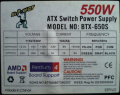
For experiments you can take big current @ 12 V and 5 V from old computer power supply:
1722190031497.png
 
Last edited:

dl324

Joined Mar 30, 2015
18,329
I was surprised, and disappointed, that the output of my Wanptek was dropping about 0.5V when the MOSFET was on. I was intentionally drawing no more than 5A because the supply is only rated for 6A. It's too late to complain to the sellers, but I feel cheated.
My bad. It finally occurred to me to check voltage drop in the leads. I switched to some #10 leads I had made for high current testing and the voltage drop decreased to 0.2V. Maybe I can make shorter leads if I put the circuit closer to the power supply.
 

dl324

Joined Mar 30, 2015
18,329
Very useful tool for experimental works:
A member gave me one of those when he decided to stop doing electronics. But the point of this thread was to expose @q12x to circuits that he could build with parts that he likely had and, hopefully, understand how they work.
 

Danko

Joined Nov 22, 2017
2,169
A member gave me one of those when he decided to stop doing electronics. But the point of this thread was to expose @q12x to circuits that he could build with parts that he likely had and, hopefully, understand how they work.
I understood and disappear...
Good luck with your mission!
 

Thread Starter

q12x

Joined Sep 25, 2015
2,227
Very useful tool for experimental works:
Spasiba daragoi Danko, and because of its cheapness, I buy it. It was more expensive than Danko link. For him, in mother Russia, it costs 1.4$ and absolutely FREE transport, I specifically look for this detail. But for me a + 1.19$ for the transport. In total is 2.56$. Maybe is Free for him because Russia + China = brothers and very close in territory space, practically neighbors. They most probably have a special train from Beijing to Moskva.
A member gave me one of those when he decided to stop doing electronics. But the point of this thread was to expose @q12x to circuits that he could build with parts that he likely had and, hopefully, understand how they work.
Very true and Im happy you remember this very important point about me !
This time I made an indulgence and buy the thing. How truly useful it will be, it will remain to be seen in the future. It was cheap so I fall for it. How useful was for you mister dl324?
 

dl324

Joined Mar 30, 2015
18,329
I put a box on my bench so I could use some shorter #12 leads I had already made (6-9"). That helped a little more (power supply drop about 0.15V) and removed most of what you've been characterizing as "boost converter" effects. I still contend that it's lead inductance.
shortPowerLeads.jpg
 

dl324

Joined Mar 30, 2015
18,329
How useful was for you mister dl324?
I powered it up to see if it worked. Fiddled with the buttons, set it aside, and haven't used it since...

I still prefer to build circuits whenever I can. I had never used a 555 timer to build a PWM, so I did. Normally I would have gone with a triangle wave oscillator and comparator so it's easier to control duty cycle. That method doesn't affect frequency.
 

Thread Starter

q12x

Joined Sep 25, 2015
2,227
this is about preparing some isolation transformers I had in my let's say 'junk box'. Its not a box, but more like a pile of stuff. Its a small one, I cant permit too big because space wise.
Im not very happy about this traf , but it should be good enough for the next stage of tests. I hope now is a bit more clearer for you the direction Im pursuing.
 

dl324

Joined Mar 30, 2015
18,329
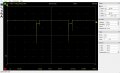
Photo of the drain voltage:
20240729_075155.jpg
I'm driving the gate with a CD4049, so there shouldn't be any turn on/off issues. My take is that the rise in the on voltage is due to junction heating.

After trying to use that Hantek 6022BE scope for about 2 years, it finally has a stable trigger.
 
Top