Mosfet open discussion

Thread Starter

q12x

Joined Sep 25, 2015
2,227
A small progress !
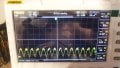
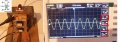
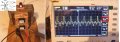
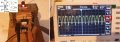
I inserted a Capacitor 1000uF@25V in // with the PSU2 power lines and when looking on the osciloscope, the waveform is way more stable and consistent and most importantly more cleaner - no spikes!! like before, also the data can be read, especially DUCY that before was 0 most of the time because spikes.
The goal here is to perfectly mirror the Gate impulse frequency into the Mosfet Drain side !!! mmmmmm..... how to do this?
The capacitor idea I mention it in the movie and my friend dl324 also mention it too. So I put it in practice because it was a very simple implementation.
There are still spikes but extremely rare, like 1 spike in 1 minute. It's fine by me !!! haha.
We really need to make a bridge of filtering - I call it filtering, but it may be called something else. Something that will separate and protect PSU2 power rails from the aggressive switching of the mosfet ! How to do that? Very interesting, yes? Heh.
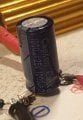
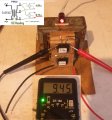
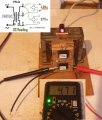
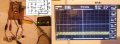
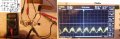
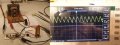
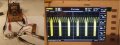
20240801_111530.jpg 20240801_111456.jpg 20240801_111506.jpg
 

Thread Starter

q12x

Joined Sep 25, 2015
2,227
Check this out ! What do you observe? (from my observations)
- I took out the circuit and I leave only the transformer for measuring, even some wires remain visible, they are disconnected from the circuit.

20240801_115351.jpg
20240801_115428.jpg
20240801_115541.jpg20240801_115608.jpg20240801_115855.jpg20240801_115912.jpg
20240801_115943.jpg
20240801_120022.jpg
 

sarahMCML

Joined May 11, 2019
697
A small progress !
I inserted a Capacitor 1000uF@25V in // with the PSU2 power lines and when looking on the osciloscope, the waveform is way more stable and consistent and most importantly more cleaner - no spikes!! like before, also the data can be read, especially DUCY that before was 0 most of the time because spikes.
The goal here is to perfectly mirror the Gate impulse frequency into the Mosfet Drain side !!! mmmmmm..... how to do this?
The capacitor idea I mention it in the movie and my friend dl324 also mention it too. So I put it in practice because it was a very simple implementation.
There are still spikes but extremely rare, like 1 spike in 1 minute. It's fine by me !!! haha.
We really need to make a bridge of filtering - I call it filtering, but it may be called something else. Something that will separate and protect PSU2 power rails from the aggressive switching of the mosfet ! How to do that? Very interesting, yes? Heh.
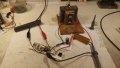
View attachment 328329 View attachment 328330 View attachment 328331
You need to have a big (4700uF) smoothing capacitor across the output of the bridge rectifier. That will supply the smooth DC voltage for your circuit, not that 1000uF in the circuit AFTER the 1 Ohm resistor. The 1000uF at that point defeats the whole purpose of the switching function!

And as you have seen with your later post, you cannot use two bridge rectifiers that way.
 

Thread Starter

q12x

Joined Sep 25, 2015
2,227
And as you have seen with your later post, you cannot use two bridge rectifiers that way.
Why? What have you seen in my later post?
Why do you think my BR are wrong? How you would do it then? Make a sketch.
that 1000uF in the circuit AFTER the 1 Ohm resistor.
I put it after intentionally, to make use of the resistor in potential new readings. I didnt use it for measurements (YET), but thats the intention. And 1R is practically nothing to the cct. Is like a piece of thicker wire.
You need to have a big (4700uF) smoothing capacitor across the output of the bridge rectifier.
Yes, I will test with one now. What else should I add on this output to further clean it and "isolate" it from the mosfet switching ?
Any idea is good enough, since I have none left.
 

Thread Starter

q12x

Joined Sep 25, 2015
2,227
You need to have a big (4700uF) smoothing capacitor across the output of the bridge rectifier.
Yes ! It did the trick ! Bravo ! This is what I call a fresh pair of eyes ! Very good !
It smoothed the DC into a very constant line and not wobbly like it was before ! (from a 5V/div reading)
Although very interesting is that before inserting the 4700uF in the cct, nothing got warm, not the 1R, not the mosfet.
NOW, however, BOTH got very hot in ~1min of testing. I could smell the heated metal ! And when I touch them, they were probably 100*C finger reading. Now! they are power testing !
- I powered PSU2 only (PSU1 is OFF) and is reading a 7.02V - very steady line - excelent !
Ive added a 10k over the cap to auto-discharge it when unpowered. I noticed the osc reading was still reading 7V after I unplugged PSU2. I tested with 1M, then 100k, then this 10k that is discharging in about 20sec. Not instantly but with delay. It is nice to see it on the osc !!! Very cool !
- I powered PSU2 and PSU1, so the mosfet is now switching.
On this point I got 4.17Vpp and 100Hz.
20240801_155723 copy 1.jpg
While on this point I got
20240801_155723 copy 2.jpg
This last one, with 1V/div is wobbly here, but at 5V/div was a straight line. Hmmmm....
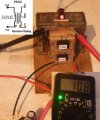
Ive updated the skematic with the cap and bleeding 10k.
You can observe that the osc reading is getting closer now to DMM reading !!! That is GOOD !
 
Last edited:

dl324

Joined Mar 30, 2015
18,329
There are still spikes but extremely rare, like 1 spike in 1 minute. It's fine by me !!! haha.
We really need to make a bridge of filtering - I call it filtering, but it may be called something else. Something that will separate and protect PSU2 power rails from the aggressive switching of the mosfet ! How to do that? Very interesting, yes?
You need to stop this.

You have lost track of what the PWM circuit is being used for and you're going down the wrong path trying to power the MOSFET with your transformer "supply". Neither that transformer or the rectifier you're using, can provide more than an amp or so. With a 1 ohm load resistor, you're trying to draw more than 4A. That's never going to happen with that small of a transformer and that small of a rectifier and that small of a filter cap.

Additionally, you put the filter cap in the wrong place. And it's far too small for the current you're trying to draw.

Please start referring to duty cycle as DC or duty cycle. DUCY reminds me of a ducky (as in rubber duck).

Reset your thinking because you've completely lost sight of what you're trying to do. You are trying to measure the MOSFET at "high" current using PWM so you don't need to heat sink the MOSFET. Case in point, I tested an AO3400 in the circuit and confirmed that it can switch more than 4A.

Go back to powering the PWM with that 12V supply and use your variable supply to power the MOSFET. Put that transformer back in your pile of stuff because it's not appropriate for this experiment.
 
Last edited:

sarahMCML

Joined May 11, 2019
697
Yes ! It did the trick ! Bravo ! This is what I call a fresh pair of eyes ! Very good !
It smoothed the DC into a very constant line and not wobbly like it was before ! (from a 5V/div reading)
Although very interesting is that before inserting the 4700uF in the cct, nothing got warm, not the 1R, not the mosfet.
NOW, however, BOTH got very hot in ~1min of testing. I could smell the heated metal ! And when I touch them, they were probably 100*C finger reading. Now! they are power testing !
- I powered PSU2 only (PSU1 is OFF) and is reading a 7.02V - very steady line - excelent !
Ive added a 10k over the cap to auto-discharge it when unpowered. I noticed the osc reading was still reading 7V after I unplugged PSU2. I tested with 1M, then 100k, then this 10k that is discharging in about 20sec. Not instantly but with delay. It is nice to see it on the osc !!! Very cool !
- I powered PSU2 and PSU1, so the mosfet is now switching.
On this point I got 4.17Vpp and 100Hz.
View attachment 328354
While on this point I got
View attachment 328355
This last one, with 1V/div is wobbly here, but at 5V/div was a straight line. Hmmmm....
Ive updated the skematic with the cap and bleeding 10k.
You can observe that the osc reading is getting closer now to DMM reading !!! That is GOOD !
You need to take the 1000uF and the 10K resistor off, put the 4700uF back across the bridge rectifier, power up PSU2 again and re-do the tests. Or preferably, do as Dennis suggests!
 

Thread Starter

q12x

Joined Sep 25, 2015
2,227
I changed that 1000uF already what are you talking about?
I did mention it already. Read #125 post.
Also look close in the small cct inside the img - you will see the 4700uF specified there.
 

sarahMCML

Joined May 11, 2019
697
I mistakenly took that to be the original 1000uF capacitor. But it is still in the wrong place! It needs to be on the other end of the 1 Ohm resistor, not the Drain side, otherwise it's acting as an R/C filter, stopping you getting the correct Drain pulses.
 

Thread Starter

q12x

Joined Sep 25, 2015
2,227
You have lost track of what the PWM circuit is being used for
Reset your thinking because you've completely lost sight of what you're trying to do
Haha...I dont think so. Remember that you give me this cct, and that you suggested to use 2 PSU's. I did exactly what you told me.
And you didn't suggest anything in the Drain to drive with that mosfet. This is your lesson, not mine. I am trying my best to make it work somehow and Im adding whatever I can imagine it will be good for the circuit for further test and towards a clearer view of the situation. So far is not that clear, but I think is progress.
- Do you have a clear cct path for me to try it and obtain a good and serious result from it? Like you are saying you got in your side?
Give me your cct that you are trying there and let me test it and obtain the same results as you do. Thats the point of this thread here. You said you are "game" for a discussion about mosfets. You were when you give me the PWM cct with the comparator. That was very good ! But now... not so game anymore. Please come back and be game again.
 

Thread Starter

q12x

Joined Sep 25, 2015
2,227
mistakenly took that to be the original 1000uF capacitor. But it is still in the wrong place! It needs to be on the other end of the 1 Ohm resistor, not the Drain side, otherwise it's acting as an R/C filter, stopping you getting the correct Drain pulses.
Believe it or not, I did thought of it but I also thought it is 1R afterall and basically is like a piece of thicker wire. I can change the cap location, no problem.
OOOhhh, you think those different results in my images are because of this R/C filtering? hmmmm..... that I didnt see it. Ha. Ok, I will change it now and measure again.
---
I change it now. And you are right it does change the waveform and is even better now !!! Hmmm....
As you can see from the images, the cap is on the PSU lines.
20240801_192430 copy 1.jpg

20240801_192430 copy 2.jpg
 
Last edited:

dl324

Joined Mar 30, 2015
18,329
Haha...I dont think so. Remember that you give me this cct, and that you suggested to use 2 PSU's. I did exactly what you told me.
Let me clear this up for you.

You are not doing exactly what I told you to do. You have exhibited a tendency to change things as if you know more about my circuits than I do.

I never told you to use that transformer to power the MOSFET.
And you didn't suggest anything in the Drain to drive with that mosfet. This is your lesson, not mine.
You're twisting things. I never told you to do what you're doing.

I told you to power the PWM circuit from something like 12V and to use a separate 5V supply to power the MOSFET. You've taken what I said and twisted and morphed that into something that's unrecognizable from the original intent.

I'll say it again. I am trying to show you how to make high current measurements on a MOSFET without needing to worry about heat sinking.

Somehow, you've come to believe that you can use a PWM circuit to measure power dissipation capability. You also changed the PWM supply to 5V. I've told you repeatedly that you can't do that. To have the MOSFETs conduct "high" current, you need to drive them hard. I believe I've mentioned a gate voltage of 10V several times because that's what the manufacturer used for their specifications.

You also ignore the point I made about the power supply leads dropping voltage. You said something to the effect that you don't know what I'm doing or that it wasn't important. I wouldn't bring it up if it wasn't important. Why would I want to confuse you with unimportant details when you were already confused?
 

Thread Starter

q12x

Joined Sep 25, 2015
2,227
I never told you to use that transformer to power the MOSFET.
True, but you must understand why I use it. It was for protecting my var PSU1 and I think you know and understand my reason already.
You're twisting things. I never told you to do what you're doing.
Relatively true. Because other complications appeared specific to my tools Im using here and you can not foresee everything. Neither can I. So my adaptation to the new needs is "twisting things" for you. Dont take this discussion here as a bad behaviour from my side. All I want is to make something with a mosfet work in a powerful way. One way or another.
Somehow, you've come to believe that you can use a PWM circuit to measure power dissipation capability. You also changed the PWM supply to 5V. I've told you repeatedly that you can't do that. To have the MOSFETs conduct "high" current, you need to drive them hard. I believe I've mentioned a gate voltage of 10V several times because that's what the manufacturer used for their specifications.
Yes, you'll have to repeat things for me because I have to change direction as you say and is not easy for me to do it "like that". I am starting to see the 10V and even 20V mosfet gate hard drive is giving results in my experiments. That's why is taking a bit of time until I believe a new idea. I test it, I try it. Im sure you understand me by now.
...
On another note, I am fascinated a little bit by this switching method. It is a new thing and the first time Im trying it. If you believe me, I never stay and specifically think on switching any transistor in my life. This is the first time. And it is fascinating, even if it's outside the road a little bit, like you like to put it. I think it is still on the road. Im playing to get used to this thing. Ideally I will play with something certain. But what I have is what I got. And Im dealing with it.
- Your idea of driving continuously the mosfet is a bold one and it is responding perfectly to the "mosfet power driving" problem that I'm after. We should have started this thread with that.
So you say I should put my pulsing fascination aside and turn around to this other cct now ..... hmmmm I believe Im starting to get some results here but I can not see a continuation with it. I already start to see some serious power disipation on my mosfet and 1R heating up very quickly. So I think this direction is already starting to show some "power" results, all it needs is a bit of patience and more pushing. But I will leave it aside and turn around towards what you say. I do try my best to make it as you say in the end. I appologise if my methods are not by the book or how you imagine they should be.
 

Thread Starter

q12x

Joined Sep 25, 2015
2,227
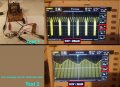
I was curious of those interrupted square waves in Test1.
But "zooming in" from the Horizontal knob I realized that Test1 was a glitch in the osc display ! Imagine that !
So this new waveform in Test2 is the highest in DC/DUCY than any other test made with this setup I have here.
This is a bit more progress update since I have it on the table.
20240801_192430 copy 3.jpg
Why the triangle waveform? Is that because of that 4700uF capacitor in the BR input? Hmmmm. Theoretically this should have been a straight line with square waves in it.
 
Last edited:

dl324

Joined Mar 30, 2015
18,329
True, but you must understand why I use it. It was for protecting my var PSU1 and I think you know and understand my reason already.
I don't think you were stressing your power supply. I thought it was rated for 6A and you're trying to draw less than 5A for "brief" periods.
On another note, I am fascinated a little bit by this switching method. It is a new thing and the first time Im trying it. If you believe me, I never stay and specifically think on switching any transistor in my life.
We're using PWM to test current capabilities of the MOSFETs because they're on (hard) for a fraction of the time and off for the rest. That keeps average power dissipation low enough that a heat sink isn't required to keep the junction temperature low.
Your idea of driving continuously the mosfet is a bold one and it is responding perfectly to the "mosfet power driving" problem that I'm after. We should have started this thread with that.
Why? We had already done that in your LM317 thread. We started discussing the PWM at the end and you started a new thread.
So you say I should put my pulsing fascination aside and turn around to this other cct now ..... hmmmm I believe Im starting to get some results here but I can not see a continuation with it. I already start to see some serious power disipation on my mosfet and 1R heating up very quickly. So I think this direction is already starting to show some "power" results, all it needs is a bit of patience and more pushing. But I will leave it aside and turn around towards what you say.
There was something wrong with your test setup or you had the duty cycle too high. I think you noticed things getting hot after you put a filter cap on the bridge rectifier.
 

Thread Starter

q12x

Joined Sep 25, 2015
2,227
I think you noticed things getting hot after you put a filter cap on the bridge rectifier.
yes, and with latest cct modifications is hot. Probably more power over 1R than over mosfet.
They rise the heat quite equally, in the same time, both of them. I may be inclined to think its a 50-50. But this is finger testing, and not proper testing. We will get to that soon enough if we push it.
Im thinking to change the 1R with a 10R or 100R. To limit further the current. My impression is that driving too much current, may add additional waveform errors also for fv and DC. Also my osc might get confused or influenced by it. But that's my theory.
I still didnt get to measure anything with this setup yet. Still very new thing to me.
 

Thread Starter

q12x

Joined Sep 25, 2015
2,227
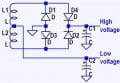
Alright. I got a correction from mister @Danko (and again, thank you!). I kind of "slap" those 2 BR there without thinking too much originally. I admit I make stupid mistakes and thats why is good to have friends with eagle eyes around. It was a simple task to change it, so I did.
Here is his sketch:
20240801_1722515749336.jpg
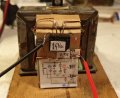
And here is how it looks now. I measured the voltages with the osc voltmeter this time. My DMM is very close though too !
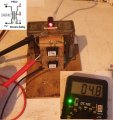
20240802_120744.jpg
I was thinking to add a switch between these 2 (+) lines. Instead of de-soldering and re-soldering every time. We'll see.
 

Thread Starter

q12x

Joined Sep 25, 2015
2,227
I did a little power test and in the same time a functionality test.
I rotated the POT in both it's extremes. I know you told me not to do it willy nilly. But it was bothering me that waveform.
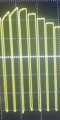
The waveform is looking like Test2 from #134 post when is at 88% ducy.
1722605336140.png
At 10% ducy, 1R = very hot <30sec ~50*C Waveform = when is more on (-) and spikes to (+)
At 88% ducy, 1R = very hot ~1min ~50*C Waveform = when is more on (+) and spikes to (-)
And I was thinking, you may have been referred to that 10% when the Waveform is more on (-) and spikes to (+). All this time I had it on this 88%. Heh. But I dont see any heat difference or is too small. Both these maxims makes 1R hot relatively in the same time.
I would have expect 1R not to get hot at this 10% ducy. But it does. Very strange.
And why the waveform is sinusoidal ? ~~~ It should have be a straight line.
I put 15VGS. The tr never got warm. Only 1R got hot.
 

dl324

Joined Mar 30, 2015
18,329
At 10% ducy, 1R = very hot <30sec ~50*C Waveform = when is more on (-) and spikes to (+)
At 88% ducy, 1R = very hot ~1min ~50*C Waveform = when is more on (+) and spikes to (-)
If you want a response, start using the correct term for duty cycle.
 
Top