Model Rocketry - Launch Controller

wayneh

Joined Sep 9, 2010
18,104
Just one comment to expand on what I said earlier about switches. You don't need serial relay arrangements, you only need a relay to switch the large final current. That's where any arcing at the contacts might occur. Switching done upstream of that will not be done under load and very simple (to use and wire) switches could accomplish that chore. Arguably you don't need relays at all if your switch can handle the chore, but anyway you don't need to worry about the life of switches other than the momentary buttons.
 

Sensacell

Joined Jun 19, 2012
3,784
From my experience with model rockets as a kid, the most frustrating thing was poor continuity from the launcher alligator clips to the igniter.
Using an LED as a simple continuity tester was problematic because the LED will illuminate even if the igniter circuit has 500 ohms of resistance, which for sure won't heat up enough to fire the rocket.

I solved the problem with a low current incandescent lamp in series with the igniter circuit.
The lamp was good because it needs about 100 mA to light up, which requires a decent connection.


You need a nice reliable way to sense when you have a solid connection, less than a few ohms.

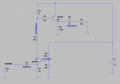
The attached circuit can be installed permanently to the launcher terminals, the maximum open-circuit voltage output is less than a volt, it puts about 100 mA into a short. This circuit lets you know that you have ~ 5 ohms maximum resistance in the circuit.cont.png
 

wayneh

Joined Sep 9, 2010
18,104
You could also use a fixed current supply to drive 10-100mA through the igniter and use a comparator to watch the voltage drop of the igniter circuit. Light an LED for any voltage below the threshold. You could even use a bi-color LED for open/closed. The LM339 (quad comparator) could handle 4 igniter circuits, so I think would be more efficient if you want that capability. I've used a comparator circuit like this on my battery tender, to indicate a good connection to the battery.
 

Ylli

Joined Nov 13, 2015
1,092
I might be breaking some forum law, but I'm going to suggest you take a look over at http://www.rocketryforum.com/forumdisplay.php?142-Ground-Support . Most ignitors do not need as much current as the did in the past, -- some may even fire with that 100 mA continuity check current. Some ignitors end up in a shorted state after they fire. Using a MOSFET to drive such an ignitor is going to mean a lot of failed MOSFETS.

The model rocket codes do require a safety key and a string loaded return to off launch switch/button.
 

Thread Starter

dgulledge

Joined May 31, 2017
8
As for your 5V continuity test, you need to get over the though that the voltage matters. The key to the continuity test is not the voltage, it's the current. Applying 5V to the igniter is far too risky, in my opinion. You want to apply just a few mA, far less than could ever fire the igniter. You can use your 12V supply for this, or you could use 120V AC for this as long as the current is limited. Limiting the current could be as simple as using a resistor in series with the igniter and power source. It might be safe to pass 10mA through both the igniter and your indicator LED. If so, that's how I'd do it. So with a 12V supply your LED would drop ~3V and the resistor needs to drop ~9V. Using Ohms law ∆V = I•R , 9V = 0.01A • R Ω and R = 900. So you could use a 1000Ω resistor. Of course you need to know that 10mA is in fact safe. I'm pretty sure but it would be wise to nail it down for safety.
No I totally get that, I'm not stuck on the 5v for the igniter test - I'm using 5v so I can use whimpy CAT-5 interface cables for the 15 yards out to the launch pad. If I have my controller running on 12V, or I route the 12V from the controller out to the pad I need much bigger "power" type cables to handle the igniter voltage and current and then I also have much higher cable losses and potential heat during the actual fire signal. I could of course use 12v in the controller with current limiting and still push it through the CAT-5, but why? There are so many cheap, small, rechargable and convenient 5V sources based on USB power converters (like $5 phone rechargers) and it makes using 3V LEDs with smaller cheaper current limiting resisters, and plenty of cheap 5V coil 12/24v relays. I fully intend on using current limiting resisters on the continuity test paths, but conveniently on the 5v path. Then when the fire button is pressed the high current 12V battery is routed through a shorter path, with 100% heavier gauge wiring, and without current limiting so the igniter fires. Diodes on the igniter test path protect the reverse flow back up the 5v circuits. I haven't yet calculated the exact values of the current limiting resisters for the igniter test path as I need to research based on the igniter data sheets, but it will be limited to very small, just as I have limited the current through the indicator LED's to protect them as well.
 

Thread Starter

dgulledge

Joined May 31, 2017
8
I might be breaking some forum law, but I'm going to suggest you take a look over at http://www.rocketryforum.com/forumdisplay.php?142-Ground-Support . Most ignitors do not need as much current as the did in the past, -- some may even fire with that 100 mA continuity check current. Some ignitors end up in a shorted state after they fire. Using a MOSFET to drive such an ignitor is going to mean a lot of failed MOSFETS.

The model rocket codes do require a safety key and a string loaded return to off launch switch/button.
Thanks, that is great info.
 

PhilTilson

Joined Nov 29, 2009
154
Here are revised circuit drawings for proposed 10 pad launcher, placing all 12V stuff out at the launch pad and then having a 5 V only based controller that triggers relays at the launcher. By doing so all cables going to/from the launcher can be handled with low cost easily replaceable Cat-5 cables.
12v power to be supplied using modern tool batteries (Dewalt / Ryobi / etc) and 5v controller to use simple AA battery (3 or 4) power with a voltage and current regulator circuit to ensure insufficient power to ignite starters during igniter continuity tests.
I won't respond to the original question - you have more than enough people giving you ideas! But I just wanted to say what a refreshing change it is on this forum to have somebody who states clearly exactly what his requirement is and provides very reasonable and complete diagrams to illustrate the query.

So often we get postings from someone who says "I want to operate a relay remotely using a bent matchstick and a dead budgerigar - does anyone have any ideas?" from which we are expected to conjure up a solution. Congratulations on using this forum in the way it really should be used!

Phil
 
Top