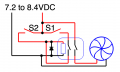
Bilge pump circuit for model sailboat

Thread Starter

Ken_NJ

Joined Feb 22, 2021
73
I am considering adding a bilge pump to an RC model sailboat I am working on. There is a possibility the boat will take on some water as it heels over in the wind.

This image shows the general layout of the keel.

IMG_2270.jpeg

Here is the interior layout showing the lead ballast

IMG_2271.jpeg

What I'd like to happen is this.
With no water in the keel, sensor #1 and #2 are both disabled, pump is off
As water gets in the boat, sensor #1 activates and sensor #2 is disabled, pump is off
As the water rises, sensor #1 and #2 activate, pump turns on
As the water level drops, sensor #1 is still active and sensor #2 is disabled, pump is still on
All water is removed, sensor #1 and #2 are now disabled, pump turns off

IMG_2274.jpeg

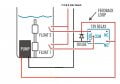
This diagram is from the Instructables page (link below). The pump (link below) is self priming. I've made my own float switches in model submarines I've built. If not float switches, I can possible use probes as a sensor? Maybe 2 pins from a header? The pump would not be submerged. Power would be from either 7.2 or 8.4 volt Nimh batteries. A silicone tube would extend from the pump into the bottom of the keel, then pump the water overboard.
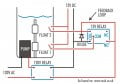
Diagram.jpeg

Useful article designing the circuit
https://www.instructables.com/Simple-Pump-Controller-and-Circuit/

Type of pump
https://www.amazon.com/dp/B08QTS5YR...2HAX2JXG&psc=1&ref_=list_c_wl_lv_ov_lig_dp_it

My questions are...
What modifications need to be done to that diagram? I can eliminate the 120v relay.
Is the relay and diode all that is needed? (1N4001 diode sufficient?)
If I use probes in place of float switches, what else do I need to add?
 

B-JoJo-S

Joined Jan 3, 2026
210
Some questions in need of an answer from you is:
Your RC Model Sailboat has on-board 120VAC?
Are you saying the relay coil operates on 120VAC? Or is that what the contacts are rated for?
Are you open to the idea of a different approach?
 

Loreani

Joined Mar 23, 2026
7
I did something similar on an RC boat a while back. Honestly, you don’t need anything too complicated for this.

I just used a small 5–6V micro pump wired through a simple float switch, straight to the receiver battery. When water builds up, it kicks on automatically and pumps it out.
 

B-JoJo-S

Joined Jan 3, 2026
210
Screenshot 2026-03-24 at 7.43.53 AM.png
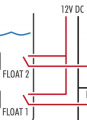
Your diagram shows the pump will only run when both "Float 1' & "Float 2" are closed. In this case the only switch (or sensor) is Foat 2 (or sensor 2) that will do anything regarding running the pump.
If you're open to a different approach, and I'm thinking about a model boat with 12V available. A small circuit with hysteresis. When the water reaches a certain level the circuit activates and remains active for a duration long enough to pump out the water, then shut off to conserve battery energy.
I just used a small 5–6V micro pump wired through a simple float switch
There would need to be some sort of circuitry. Otherwise the pump would come on when the high water sensor sensed the water but as soon as the water level fell below the sensor it would shut off. The pump would keep cycling every time there was a small wave.

Question for the TS: What kind of sensor do you have in mind? The circuit you show looks like it's designed for a sump pump, not a bilge pump.
 

MrChips

Joined Oct 2, 2009
34,626
The other simple solution is to install sufficient buoyancy in the boat so that even when completely flooded, the boat stays afloat.
 

B-JoJo-S

Joined Jan 3, 2026
210
The other simple solution is to install sufficient buoyancy in the boat so that even when completely flooded, the boat stays afloat.
Reasonable suggestion. However, a completely flooded boat will lose the electronics and the boat would become a bobber.
 

MrChips

Joined Oct 2, 2009
34,626
Reasonable suggestion. However, a completely flooded boat will lose the electronics and the boat would become a bobber.
I can only guess that any RC sailboat will be operated at a line of sight distance and you always have to have a real rescue boat on standby.
 

B-JoJo-S

Joined Jan 3, 2026
210
I can only guess that any RC sailboat will be operated at a line of sight distance and you always have to have a real rescue boat on standby.
I've seen that where RC Boats (speed boats) crash and the rescue boat goes out and collects what's left of the two boats. A boat that floods and quits responding when it could have had a bilge pump only to be in need of rescue can be avoided if you prevented the water from entering the boat. Me? I'd plug up the leaks. No water, no need for a pump. On another hand, if the boat got swamped, water would spill in and stall operations. If that's a frequent problem then a pump seems the best way to go. That way you don't have to row out and collect the model.

I'm not convinced we're talking about a model boat, even though the TS stated so. The diagram strikes me as a sump pump circuit. Something you see in basements prone to flooding.
EDIT: The electronics should be water proofed.
 

Thread Starter

Ken_NJ

Joined Feb 22, 2021
73
This is a 42 inch sailboat. They have a tendency to heel over in winds and possibly take on water, usually through deck fittings or the deck. I will be designing the deck structure in a way to minimize this from happening. If we can please stay away from that discussion and stick to the design of the bilge pump.

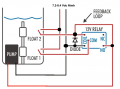
AC voltage will not be in the sailboat, only 7.2-8.4 volts Nimh batteries. Here is a somewhat modified diagram. I'd like to minimize the battery weight so I prefer not going to 12v.

In the Instructables article he mentions that when the water drops below Float2, the pump remains on until the water drops below Float1, that is what I am looking for. Like what was said, with only one float switch the pump will be constantly cycling, not what I want.

Wouldn't the different connections of the two floats to the relay change when the pump is shut off?

Diagram.jpeg
 
Last edited:

B-JoJo-S

Joined Jan 3, 2026
210
OK, NOW this makes some sense to me.

Screenshot 2026-03-24 at 9.02.39 AM.png
Those missing dots tell me these points are connected. Simply drawing a blank space where lines intersect can be confusing.
Now: A 12V relay running at 7.2VDC will probably kick in when the sensors tell it to. So we need to focus on how the sensors work. Are they switches? Are they capacitive sensors? What kind of sensors do you have in mind? Whether the sensors can conduct enough current to trigger the relay will be another question. So we need to focus on the sensors for this circuit to work.
 

B-JoJo-S

Joined Jan 3, 2026
210
Quite a few years back I messed with HHO (to no avail. Had to learn the hard way). The reactor tank needed to be topped off. So I built a side tank that had a float in it. The float had a magnet that triggered a reed switch. You can probably do something similar for your sensors.
How much space do you have? You DID say your boat was something like 40 inches. Where would the sensors be? Where would the pump be? Where would the pump pickup be? If this pump isn't self-priming then the pump itself must be below the water line (where you want the max water level to be at).
 

B-JoJo-S

Joined Jan 3, 2026
210
Spotted another issue: The pump will be drawing current through the sensors. They will have to be robust enough to handle the load. Unless you switch to a DPDT relay, then the pump can be powered directly by the second set of contacts. Maybe even a DPST relay would work.
 

Thread Starter

Ken_NJ

Joined Feb 22, 2021
73
I should have blanked out the label for the 12v relay, it doesn't have to be 12v. That can be changed to a relay with another spec if need be. That diagram was just a beginning thing for me to try to get across what I am trying to do.

The float switch I made up for the model submarines uses this type of reed switch. It only powers on and off a few LED's.
https://www.digikey.com/en/products...-4-2/9687352?s=N4IgTCBcDa4AwEY4FokE4CsIC6BfIA

I only have on hand SPDT right now. For the sailboat I would have to order a pair of SPST.

BUT! I've seen people use two wires close together, or two gold pins from a header soldered to wires to use as the sensor. I'm not opposed to changing the sensor type. But I surmise a circuit will be needed which is fine with me.
 

Thread Starter

Ken_NJ

Joined Feb 22, 2021
73
How much space do you have? You DID say your boat was something like 40 inches. Where would the sensors be? Where would the pump be? Where would the pump pickup be? If this pump isn't self-priming then the pump itself must be below the water line (where you want the max water level to be at).
Yes 42 inches. Sensors placement can be seen in the first post. The pump would be in a dry space, but if you look at the Amazon link, the pump is self priming and it is waterproof. A hose from the pump will go down to the very bottom below sensor number 1.
 

B-JoJo-S

Joined Jan 3, 2026
210
While you all were talking I drew up this diagram (with a DPST relay). Looking at it I should have labeled pos and neg. Red is positive.

Screenshot 2026-03-24 at 9.46.04 AM.png
 

B-JoJo-S

Joined Jan 3, 2026
210
Correct me if I'm wrong but:
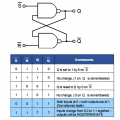
What you need is called a set-reset flip-flop. Sensor #2 sets the flip-flop. Sensor #1 resets the flip-flop.

View attachment 365092
Holding both set and reset high will be occurring when the water reaches sensor 2. Only when it drops below set will the reset be held high. I always have had trouble following the logic of this device.
 
Top