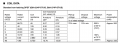
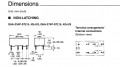
@Alec_t post 32 shows a single coil relay. The specs below; under "Type" the first box calls out G6A-234:-ST(15,40)-US, which is what is linked to in post 38. Also in post 38 the TS said this:
The "Coil Data identifies the G6A-234P-ST-US as a "Non-Latching" type.
The pin-out for the same part number indicates a Non-Latching type.
Couldn't find anything on the (15,40) in the part number so I don't know for sure what it is. However, that data sheet is quite confusing and requires close attention to the exact part number.
So the TS doesn't have a dual coil and it is not a latching type relay.
In post #40 I made a mistake and have edited out the diagram showing the set/reset type single coil. That wasn't a G6A it was a G6AU, which is a single coil latching set/reset type. Sorry for the confusion.
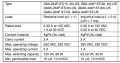
In conclusion: the relay you have is not a latching relay nor is it a dual coil. You can use that relay. But something else concerns me: You're running a pump motor, which is an inductive load. See the chart below:
The max operating current on an inductive load is 1 amp. I don't recall if we discussed the power consumption of your pump motor. But with all motors the heavier the load the more current they draw. This relay might not be up to the task.
Let's forget the about the dual coil relay for now.
I have this circuit working now with a 12v supply/12v relay. The low and high switches are a toggle and momentary switches. It will take a while for me to design the floats with reed switches that I'll be using. Functionally this works, but I'll need to have all the proper parts for a final test.
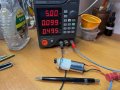
This is the pump I bought. No load it draws 0.1 amp.
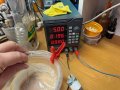
Under load it draws just under 0.2 amps. BTW it is very quite, submergible and self priming. It's going to work very well.
Now I need to buy a 5v relay. Amazon will be the quickest. This relay is rated for 2 amps. I know it needs to be a sufficient amount above the actual draw. Will this one do?
FYI, I know enough about electronics to be partially dangerous so please forgive my lack of knowledge.
I connected the pump to the circuit and everything works great. I have to place an order with Digikey for the reed switches so that will take a while to get those parts.
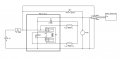
In the meantime. I have the circuit drawn up in a schematic program. There are a few additions I added to the schematic, which I will try next week (weekends are a no hobby time).
I added a manual bypass switch so if the boat is removed from the water and there is some water in the bilge, not enough to activate, I can manually push a monetary switch to remove the water.
Also added a connection from the radio receiver, which is connected to a servo switch, which is connected to the pump. The servo switch draws power from an external source, not the receiver. It is rated for 20 amps. I can manually kick off the pump while it is in the lake via the radio.
It seems redundant to add both of them, so why not.
I need to add an on-off switch to this.
If you see anything wrong here, please comment.
As an afterthought, how/where would I add LED's to indicate the reed switches are active or the the on-off switch is on?
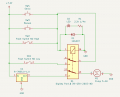
Your latest diagram doesn't look like it would work. Though it is hard to follow. <edit> I see what you've done here with the 2nd 1N4001, you're using it in place of the 2nd set of contacts on the relay as a way to keep it energized through the low level switch.</edit>
You only need a single 1N4007 across the relay coil.
The low level switch should be run NO through one set of contacts.
The high level switch should trigger the relay coil directly. Once energized this allows the low level switch to maintain power to the relay until it opens.
The pump should run through the second set of contacts wired NO, with it's power being run through a 5V 1A buck converter first. 370 Pumps only draw between 0.3-0.6A at 5V so 1A is safe.
Your manual bypass switch, and servo switch can run directly between your battery and the relay coil +.
The resistor value for the LED can be changed to 1k(6-7ma), 1.5k(4-5ma), or 2.2k(3ma) depending on how bright you want it to be. Set up this way it turns on no matter what activation source is used. For the LED it's self you can use (DigiKey example: 160-1143-ND (Kingbright WP710A10ID – red, 20 mA, T-1 3/4)) or any generic 5 mm LED.
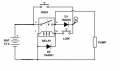
The circuit I drew up was redrawn from the one in post #45 which is someone else's design I found online. That was done in a program I've always had. I guess I need to find one that does more like what you did.
I'll try your circuit next week. Looks pretty straight forward.
The circuit I drew up was redrawn from the one in post #45 which is someone else's design I found online. That was done in a program I've always had. I guess I need to find one that does more like what you did.
I'll try your circuit next week. Looks pretty straight forward.
There is another way of doing this as well without the use of float switches since it looks like space is really tight.
You can use a pair of wires as an "Electrode" to trigger a TIP120 transistor to activate the relay.
In normal mode the Base of the TIP120 is pulled high to 5V thru R3 which keeps the relay off.
As the water level rises the 2 wires of the low level electrodes shorts to ground, this does nothing at first since the relay needs to be on for them to be connected to the circuit, once the water level reaches the high level electrodes those wires are shorted to ground and will pull the Base of the TIP120 low turning on the Relay.
Once the relay is active the pump will turn on, and the connection from the low level electrodes which are now connected to the circuit will keep it on until the water level drops and clears their short to ground.
Both of your switches emulate the high level electrodes being tripped turning on the relay, as a side as long as the water is above the low level electrodes the relay will stay active even if you release the switches.
C1, C2, D3 were added for protection to the various sections of the circuit.
I did mess up on the placement of C1, it should be after the RBT10W24S05 on the 5V side. That said the datasheet suggests also having on where C1 is currently as well to protect against input voltage spikes, in which case you can add C3 on the 5V side of the DC-DC buck.
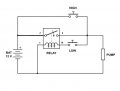
Simplest version yet.
Low switch closes - nothing happens.
High switch closes - pump and relay activate.
Water level drops - high switch opens - pump still running via the relay.
Low switch opens - relay drops out - pump shuts down.
Only concern: Flyback from the relay coil and from the DC motor.
Yes this will work, as mentioned by B-JoJo-S it lacks Flyback protection.
Using a DPDT relay over the SPST like in this example does exactly the same thing except gives the pump it's own power circuit that is in no way connected to the switches.
Simplest version yet.
Low switch closes - nothing happens.
High switch closes - pump and relay activate.
Water level drops - high switch opens - pump still running via the relay.
Low switch opens - relay drops out - pump shuts down.
Only concern: Flyback from the relay coil and from the DC motor.
Back EMF (BEMF) shouldn't cause any harm. Depending on the switches used. Reed switches are quite delicate. The flyback could potentially weld the contacts or burn them up. It's cheap protection no matter what kind of switch you use. Not saying you're wrong, nor am I disagreeing with you. Just personally I'd include them.
I like the idea Dirus posted in #52. Have not placed a Digikey order yet. I do not mind a more complicated circuit. I can etch my own PCB for it. Can I use 2 pin header pins as the sensors? Digikey has the TIP120.
Before I order, I'll check what I have on hand and list here what I need to order to make sure I have everything.
I'll also try out MrChips simple circuit in #51, but I see there sould be some problems with it from the discussion.
Too late to the game here, you’ll probably stick with something that now works, but if I started from scratch I’d question the need for a relay when you could power the pump with a transistor. And if you use a small processor it’d probably be fine to have just a high level switch and run the pump for a fixed time after the switch turns the pump on. Compact and easy to waterproof. ATtiny85 has more than enough I/O. Resistance measured between to adjacent metal probes going low when they are immersed in water might even be the simplest level switch. Processor could go to sleep for a while between tests to minimize power loss
I thought of using an Arduino or Bluno Ble with a timer. Maybe there is something simpler than that.
Think I'll stick to the direction we are headed with either float switches and probe sensor. To me, I'd like to do the probe sensor if it works, float switches can have a mechanical failure and they are more cumbersome, to make and fit.

 Facebook
 Google
 GitHub
 Linkedin