Well I'm hoping it won't be a problem. However, the motors are from a commercial tennis ball machine which use the system I mentioned above of voltage feedback. I think it becomes an issue when the motors are throwing a ball every 3 seconds or so, they are unable to recover before the next throw. I actually found the original patent which describes how it works, below is an excerpt which you might understand better than me:
"As each ball is thrown there is a precipitous and almost instantaneous decrease in motor speed accompanied by a decrease in their back EMF. This signal is converted into pulses and supplied to the base of the amplifier transistor T2 where it is inverted in amplified form at the junction of R13, R14. This back EMF signal proportional to motor speed is delivered to the negative input of comparator I1b to provide output signal pulses in step with the frequency of the oscillator circuit and of variable width. This variable signal is utilized to turn on the field effect transistor T1 to supply full power to motors 35 for variable pulse periods and at the rate of the oscillator output signal. In this manner the resumption of full speed of motors 35 is restored in a most efficient and expedited manner. If the operator wishes to vary the speed of motors 35 he adjusts the potentiometer 71 to vary the DC offset voltage added to the feedback signal enroute to comparator I1b."
So apparently they are not running full tilt all the time, but at a reduced rate/power it seems.
If you intend marketing these, you could be in patent violation if you copy the design.
Basically it would seem you need a feedback system that maintains the motor rpm throughout the whole operation.
Max.
Thanks Max, no intention of marketing it, just a DIY project for myself. Perhaps I'll stick with the Arduino feedback loop. I intend to read the rpm of each motor using an encoder wheel mounted to each motor shaft, but that's some way down the track from now. Next aim is to measure the current to determine the required circuit breaker
So thinking ahead to measuring the current, will I need to measure the current draw when the wheels are spinning freely and also the current when a ball is fed between them? The speed of each wheel/motor will be independently controlled by a potentiometer. In which case, should these tests be performed at maximum motor speed?
Ok, but would the maximum current during a normal (no stall) operation, be when the motors are firing the ball at full speed? As opposed to if the motors are firing the ball at a lower speed.
If the means of control does not change the nature of the output, then it would be the lower speed, if the control output is changed for the low speed, then the higher (full speed) one would result in higher current.
Max.
Basically, I intend to adjust the speed of both motors independently to control how fast a ball is thrown. So for the purposes of testing for the maximum current draw, should it be measured when both motors are set to maximum speed - drawing the most current?
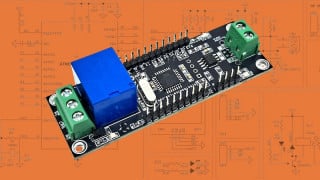
While I'm still waiting for parts to arrive, I'm looking at how to connect the 43A BTS7960 motor driver to the Arduino Uno. As I only want to control the motor in one direction using PWM, should the R_EN and L_EN pins just be set to HIGH and then either RPWM or LPWM connected to a PWM pin of the Arduino - the direction of the motor dependent on which one was receiving the PWM signal?
Attached is a picture of the driver for better reference. Thanks
Hi Max. I've been using the module documentation (previously posted) until it arrives. it's something I'm slightly confused by so thought I should ask. This page describes two usages: http://www.hessmer.org/blog/2013/12/28/ibt-2-h-bridge-with-arduino/
I think I need to do the first option, but I'm not 100%.
So I've nearly completed building my test rig. I currently have one motor being controlled via PWM using a potentiometer as an input to the Arduino and an H bridge connected to the motor. I now need to measure the highest current when the motor is running, but I'm not sure of a few things:
1. Would the method be to use a shunt resistor with my DMM, as it only goes up to 10A?
2. Could the PWM be a problem for measuring the current?
3. If so, would it be safe to just connect the motor directly to the 12v SLA battery to take the measurements?
The peak is always at switch on particularly where there is NO controller, with PWM the rpm can be increased gradually overcoming the large inrush associated with direct connection.
I did an empirical test on a 2HP DC motor, off load where the voltage was gradually increased, the current did not go over 2amps, and stayed constant from zero to max rpm.
Max.
Then I guess in my situation the peak current will be when a ball is fired between the counter rotating wheels - since the gap between the wheels is smaller than the size of the tennis ball. Do you know how I could set my DMM up to measure this?

 Facebook
 Google
 GitHub
 Linkedin