LTSpice - How to add new Diode

Thread Starter

PsySc0rpi0n

Joined Mar 4, 2014
1,786
May I ask what technical course you are attending at college or university.?

E
Electrotecnic Engeneering!

My calculations for R_s are as follows:

I just did the same calculations as you did for 6.5V but i have used an exact Vin of \(6\sqrt{2} - 2*0.7\)
 

Attachments

Last edited:

Thread Starter

PsySc0rpi0n

Joined Mar 4, 2014
1,786
No.!
Do not use the Vpeak on the capacitor for the formula!!

Remember the ripple voltage will cause Vc to fall to about 6.4V.
I don't understand that...

The voltage from V1 is 6 rms which means \(6\sqrt{2}\) minus the voltage drop from 2 diodes which is 2*0.7... This is the voltage exiting the diode bridge, right?
 

ericgibbs

Joined Jan 29, 2010
21,469
No its only the peak voltage, the voltage on the cap will fall due to current flowing in RL.

It will fall to 6.4V before the next half cycle recharges it.
 

ericgibbs

Joined Jan 29, 2010
21,469
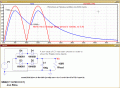
Look at my post #142 it shows the plot of Vc.

The Vpk is ~ 6.94V and Vmin is 6.4V , thats a ripple of ~0.54V, thats approx 8%.

Which is close to what your tutor said of 10%
 

Thread Starter

PsySc0rpi0n

Joined Mar 4, 2014
1,786
But at that point you're assuming you already know th R_s value... :|

And why do you use the minimum value for that voltage and not any other value?
 

ericgibbs

Joined Jan 29, 2010
21,469
No I did not assume Rs

I am sorry, it maybe better if some else helped you, we are going around in circles for such an easy problem.

E
 

Thread Starter

PsySc0rpi0n

Joined Mar 4, 2014
1,786
No I did not assume Rs

I am sorry, it maybe better if some else helped you, we are going around in circles for such an easy problem.

E
In that simulation you have a value for R_s...

I know this is not easy when i have no knowledge about diodes and zeners and capacitors behaviour...

I have no one else to ask help...

Are you going to stop helping me? That's why i asked you if you could help me on Google Talk or so...
 

ericgibbs

Joined Jan 29, 2010
21,469
Hi,
I enjoy helping anyone who is keen to learn electronics or computing.:)

But we seem to have a problem in that you are not able to understand what I am explaining, we are now into 15 pages of posts.!

You will find that many problems in electronics, especially zener regulators do not have precise answers due to the variance in the parameters of zeners.

If you want to continue discussing this I will go back to a simplifier way of explaining the basics will you be happy to go with that method.?

E
 

Thread Starter

PsySc0rpi0n

Joined Mar 4, 2014
1,786
Sure mate...

I appreciate that!

I'm lacking of some knowledge about the behavior that diodes, capacitors and resistors have when combined. I find hard to understand what voltages goes thru where, and what currents goes thru where and so on!
 

ericgibbs

Joined Jan 29, 2010
21,469
Sure mate...

I appreciate that!

I'm lacking of some knowledge about the behavior that diodes, capacitors and resistors have when combined. I find hard to understand what voltages goes thru where, and what currents goes thru where and so on!
ok,
Lets get back into it tomorrow, its getting late in the UK.

In the mean time, look up the formula for the Time Constant for a Capacitor discharge.

Eric
 

Thread Starter

PsySc0rpi0n

Joined Mar 4, 2014
1,786
Ok!

That constant time at a low pass filter is R.C, i guess!

At UK I think it's the same time as here, Portugal!

Let me just ask the following:

R_s value is 48.1 ohms, right? I'm asking just to finish the report that I have to send to my teacher...

I have to send him that simulation and calculations. I'm already out of schedule for delivering the report!
 

ericgibbs

Joined Jan 29, 2010
21,469
hi,
Lets get back to basics and use a simplified explanation.

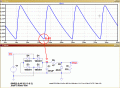
Look at the attached image Tut1.
It shows a single cycle of 50Hz at 10.7Vpk charging a 100uF cap C1 to +10Vmax, using a half wave rectifier.

Note we will use Vmax as the peak voltage on C1, which occurs at the peak/crest of the half wave rectifier input, the term Vmin is the lowest voltage after 10mSec on C1.

The load resistor is 100R and C1 is 100uF

So during the 10mSec period after Vmax the voltage on C1 will decay, after 10mSec it will be Vmin.
So for the example Vmax = 10V and Vmin = 6.3V., so the voltage on C1 has decayed by 3.7V, this is referred to as the 'Ripple Voltage'.

If you exam the decay plot over the 10mSec period, it appears almost linear, so engineers sometimes use the C= [I * t ]/V formula to approximate the ripple.

Its important to note that this formula will only be accurate IF the discharge current remains constant, which is does not, the current and voltage decay exponentially.

Study the plot and the notes, ask if you have a query.

E.
 

Attachments

ericgibbs

Joined Jan 29, 2010
21,469
hi,
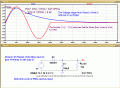
Look at image Tut2, it shows one cycle of 50Hz, rectified by a full wave bridge.

Note how the voltage on C1 decays for approx 12mSec, before the rising edge of the next half cycle recharges C1 upto Vmax.

The rectified voltage from the bridge has to exceed Vmin before it can start recharging C1 back upto Vmax.

So the ripple is actually greater than predicted by the C = [I /t]/V formula when using 10mSec.

A low value of C1, 100uF and Rload, 100R has been chosen in order to highlight the ripple.

Study the plot and the notes, ask if you have a query.

E.
 

Attachments

Thread Starter

PsySc0rpi0n

Joined Mar 4, 2014
1,786
Ok, let me ask you somethings...

1 - What you mean with:

Note how the voltage on C1 decays for approx 12mSec, before the rising edge of the next half cycle recharges C1 upto Vmax.

2 - Where can i check this in the plot?

The rectified voltage from the bridge has to exceed Vmin before it can start recharging C1 back upto Vmax.
3 - Why do you use 10ms to calculate C when the slope is considered to be linear? Is when Vin goes from positive to negative?
 

ericgibbs

Joined Jan 29, 2010
21,469
Q1.
It means the voltage falls from Vmax to Vmin.

Q2.
Look at the image I posted.

Q3.
50Hz has a Period of 20mSec so half cycle is 10mSec.

You are asking some very basic questions, which you should already know the answers.

E
 

Thread Starter

PsySc0rpi0n

Joined Mar 4, 2014
1,786
R1 - Ok, I understood now what you meant... The voltage drop lasts 12msec. (just didn't understood the sentence, but understood now)

I think I can't understand this unless i can see a real time simulation. I mean, i need to see what happens to current and voltage directions during the full period. I can't understand what happens at Vo when capacitor is charging.

Is there any online simulator that shows me the current and voltage directions during a period? I need to understand what happens in several points of the circuit!
 
Top