Is this Zeta Converter Will work?

MrAl

Joined Jun 17, 2014
13,720
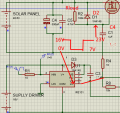
A1 is powered by V3, which is the solar panel. I'm presuming that the control circuit shares a power supply with A1.
1) The control circuit needs to measure the battery voltage. This isn't quite as easy as it would be if Rload shared a common negative with the control circuitry and V3, but it's not exactly difficult, because all that needs to be done is measure the voltage at C2 positive terminal with respect to the negative of V3, then subtract V3.
2) V3 will disappear gradually at dusk and reappear at dawn. The control circuitry must start up and close down properly, and not leave M1 switched on (which would happen as it needs more and more boost as V3 falls). If M1 remained switched on it could never properly re-start.
If the control circuitry is performing any sort of data logging, then it needs a supply from the battery, otherwise there will be no logging at night.
Hi,

Oh yes measuring the output means either a voltage translator or some other isolated means to measure it. This is done a lot though in everyday wall warts so maybe not too difficult. We could look at methods for this.

Is that the only real problem he faces because of the inverted output?

As to the M1 switching problem, since it uses an intermediate boost circuit and every boost circuit needs duty cycle limitation, that would of course have to be incorporated into this circuit as well. I would think offhand that the circuit would have to stop converting once the minimum duty cycle was encountered. This would be something to consider using either N channel or P channel devices.

The implementation would have to be thought out carefully too because once the load is disconnected, it may look like it can supply power once again when really it would just cycle back off again. This is one of the problems we faced back in the 1980's where it was hard to decide whether to allow it to try again after some time period, or have it manually reset. I had incorporated a reset circuit that would reset after maybe 10 minutes, but it was able to be disabled by the user in case they wanted to reset it manually.
One of the issues that came up with Sandia Labs was they didn't want to see 100 or more line tied solar converters turning off and then back on asynchronously even if the interval was fairly long (like 10 minutes). That would disturb the mains lines too much they thought. I don't know if they changed that later some time, but the option was always built in already.
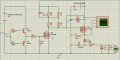
 

Thread Starter

RIskiZeta

Joined Dec 6, 2025
31
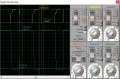
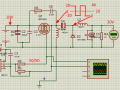
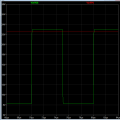
this is the latest i tried about tour advice, the converter seems work very well with inverting driver. it can operate with good error persen between duty cyle and voltage output. So the theory about zeta converter work very well in this circuit. because when the duty cyle <50%, zeta converter act like buck converter.
113.png

this is the signal in gate (yellow) and drain as a output (blue)

112.png
note : in this case i tried using zeta converter as mppt using incremental conductance (InC) algorithm. thats why its need MCU to process voltage and current data from solar panel in both input and output to reach MPP using InC algorithm.
 

Thread Starter

RIskiZeta

Joined Dec 6, 2025
31
thanks, i appreciated
Hello again,

Well you can use an N MOSFET if your application can tolerate a new ground connection. That is, if your load does not have to have a ground in common with the input ground you can flip everything and that allows you to use an N channel device the same way you would use a P channel device with an output ground in common with the input ground.
With this N channel solution everything gets a lot simpler, but you lose the common input/output ground. You end up regulating the ground (-) rather than the output (+) itself. This is done with converters sometimes.

What is the reason you need to use an N MOSFET for this project? Is it because you are already committed to that topology?
when flip everything maybe it work, but i need measering voltage and currrent in both input and output converter using sensor and MCU. i think that was become problem for me.
What is the reason you need to use an N MOSFET for this project? Is it because you are already committed to that topology?
i dont have to use N mosfet actually, the point is the converter must work as MPPT using algorithm to reach mpp. that why i need better topology to measurement for my sensor. in case flip the component of zeta converter not the choice.
 

Thread Starter

RIskiZeta

Joined Dec 6, 2025
31
As long as we are talking about news ways to do this, let's explore some.
P-Fet PWM From IT here is a data sheet of the PWM that drives a P-fet. I have not used this part, the one I have used are not in production now. There is a class of PWM that drive P-FETs.
Using that part: -converter design Here is an interesting read.
View attachment 360449
I have done this.
that report give me idea to use coupled inductor in zeta converter. but i have to use MCU as PWM generator because the duty cyle have to be controlled by voltage and current feedback. so i cant build exact converter like that report. because i need MCU to run incremental conductance algorithm for mppt method.
 

Thread Starter

RIskiZeta

Joined Dec 6, 2025
31
I agree (see post #6). It produces two different problems
1) measuring the output (battery) voltage, as the control circuit negative becomes the negative of the solar panel. Easy to solve, because one can measure the solar panel voltage, and the total battery+solar voltage, and then subtract one from the other to give the battery voltage
2) The power supply for the circuitry disappears when the sun goes in, unless a supply can be derived from the battery. The disappearance of the power supply itself isn't a problem as it doesn't need to be there when there is no power to convert, but it needs to behave sensibly when it is at the margins.
my converter work with power supply for MCU and driver using Ac to Dc adapter. the converter will be suplly by solar panel to reach MPP of solar panel. Im using chalk resistor in output converter as a load. also there is data testing about converter it self using different value of chalk resistor to look out the performance of converter, especially the efficiency.
 

Thread Starter

RIskiZeta

Joined Dec 6, 2025
31
After looking this project over, it appears to be a solar to battery MPP controller where the PWM is done in software. This is something we do at the local university every year. I have helped on several of these projects and did some for commercial jobs.

Here is a another try at 22.5V in 20Vout using hardware. No MPP control but just a simple flyback PWM.
I am using the UC3842 current mode PWM. at 100khz. 1A output.
I removed the capacitor in the Zeta because it often fails. Real world experience.
Here I set the battery on top if the 22.5Vin.
Q2 looks at the voltage on the output and translates it down for the PWM to look at. This circuit can be changed to work with a computer running at 3.3V with a simple resistor change. I can also make it more accurate later. This is just a first try.
View attachment 360468
I attached the LTspice file if you want to play with it. The error amp is not right yet. There are some things I would change.
RonS.
thank you very much
This circuit can be changed to work with a computer running at 3.3V with a simple resistor change
but i dont understand about this one
 

Thread Starter

RIskiZeta

Joined Dec 6, 2025
31
Hi,

See post #36 and try to show me what you expect to be a problem. I'd like to understand you completely.

Since this circuit is partly a boost circuit, the duty cycle must be limited or else the voltage actually comes down.
the converter wil work in 57% - 71% to reach MPP. so the converter will be work mostly as boost converter if the solar panel because the datasheet about solar panel tell will produce voltage around 12-22.2 volt. the converter have to produce 30 volt in output. so yeah duty cyle is limited
 

Thread Starter

RIskiZeta

Joined Dec 6, 2025
31
A1 is powered by V3, which is the solar panel. I'm presuming that the control circuit shares a power supply with A1.
1) The control circuit needs to measure the battery voltage. This isn't quite as easy as it would be if Rload shared a common negative with the control circuitry and V3, but it's not exactly difficult, because all that needs to be done is measure the voltage at C2 positive terminal with respect to the negative of V3, then subtract V3.
2) V3 will disappear gradually at dusk and reappear at dawn. The control circuitry must start up and close down properly, and not leave M1 switched on (which would happen as it needs more and more boost as V3 falls). If M1 remained switched on it could never properly re-start.
If the control circuitry is performing any sort of data logging, then it needs a supply from the battery, otherwise there will be no logging at night.
everything about your said its correct except measure baterry voltage (i dont use battery). maybe i was wrong not telling for beggining. my project will be measuring the input of converter which is from solar panel and output of converter when its use resistior load. its need data logging to process mppt algorithm. thats why its need different suplly for driver, sensor,MCU. i will use AC to DC adapter that will work in 12 VOLT.
 

Thread Starter

RIskiZeta

Joined Dec 6, 2025
31
Is that the only real problem he faces because of the inverted output?
very simple problem but critique for my project. because it does not prove according to theory of zeta converter. where duty cyle <50%= buck converter, >50%= boost converter. my professor didnt want that
 

ronsimpson

Joined Oct 7, 2019
4,708
OK, after all that lets start over at the beginning. I see why you want to have the solar and the battery connected to a common ground.
Quick review. 20Vin, 20Vout, 50% duty cycle, Solar(+) not connected to Battery(+)
At the Right side of C3 we have a voltage that is at 20V for 50% and at -20V for 50%. (approx) The average is 0V because the inductor must have 0Vdc across it.
C4 blocks the dc from the solar so it cannot get to the battery. Only the ac can pass through C4. The 22.5V is removed.
On the right side of C4 the most negative the signal can be is slightly negative. The signal sits above ground. About 0V for 50% and +40V for 50% with a average of 20V. (yes, I know one diode drop off from ground)
1765771249530.png
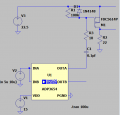
Now move back to this ac coupled Gate drive. I don't know why this did not work. I have done this many times.
I renamed the DC blocking cap to C4 to make the circuit look the same as the one above.
D2 is the diode that sets the highest voltage the ac can get to.
Rload is the load like in the top circuit.
1765772130401.png
If you are willing to use C4 to block the 22.5V in the top circuit, then why not use C4 in the Gate drive, to do the same job?
If you are willing to use a diode to set the minimum voltage in the top, why not use a diode to set the most positive voltage?

The reason for a real Gate drive is that it is built to drive amps into the Gate on the edges. It will be faster than any two-transistor circuit we have looked at.
Input the signal in on LIN while connecting HIN to ground. There might be the problem.
 

MrAl

Joined Jun 17, 2014
13,720
when flip everything maybe it work, but i need measering voltage and currrent in both input and output converter using sensor and MCU. i think that was become problem for me.

i dont have to use N mosfet actually, the point is the converter must work as MPPT using algorithm to reach mpp. that why i need better topology to measurement for my sensor. in case flip the component of zeta converter not the choice.
Hi,

Oh ok, but if you don't actually have to use an N MOSFET then why not use a P device instead?

There are a lot of ways to measure the output even using a simple N MOSFET circuit with inverted output, but since you can use a P MOSFET why not just do that and save a lot of work. Electronic measurements anywhere in the system would be easy then.
 

Thread Starter

RIskiZeta

Joined Dec 6, 2025
31
Now move back to this ac coupled Gate drive. I don't know why this did not work. I have done this many times.
I renamed the DC blocking cap to C4 to make the circuit look the same as the one above.
D2 is the diode that sets the highest voltage the ac can get to.
Rload is the load like in the top circuit.
when use LIN as input, output PWM cannot build up voltage around the gate. LIN always have reference to ground. and LIN doesnt know voltage around SOURCE. because IR2101 designed to drive N channel MOSFET, the gate is only driven 0–5 V with against to ground. LIN is a low-side referenced input, not suitable to directly drive a P-channel high-side MOSFET whose source is at +20 V. However, in the gate drive case the problem is not the DC blocking capacitor (C4), but the reference of the driver input
 

Thread Starter

RIskiZeta

Joined Dec 6, 2025
31
Hi,

Oh ok, but if you don't actually have to use an N MOSFET then why not use a P device instead?

There are a lot of ways to measure the output even using a simple N MOSFET circuit with inverted output, but since you can use a P MOSFET why not just do that and save a lot of work. Electronic measurements anywhere in the system would be easy then.
in my previous post i use P channel FET using push pull driver and N channel MOSFET (POST #42). the problem not just the inverted output of converter. the question will be why the zeta converter have inverted output when in theory it doenst. Im afraid thats will make me fail in this project/research. because it's not match up with characteristic of zeta converter.
 

MrAl

Joined Jun 17, 2014
13,720
in my previous post i use P channel FET using push pull driver and N channel MOSFET (POST #42). the problem not just the inverted output of converter. the question will be why the zeta converter have inverted output when in theory it doenst. Im afraid thats will make me fail in this project/research. because it's not match up with characteristic of zeta converter.
Hi,

I am not entirely sure what you are saying here.
You are using a P channel device and a driver, whatever driver you choose, so you effectively have a regular Zeta converter.
Also, a positive pulse on the input produces a positive response from the P channel part of the circuit, which seems normal. That means the duty cycle of the input matches the duty cycle of the P channel device.
What could the problem be then?

A little question, why not use a dedicated MOSFET driver chip? You would not have to bother with the two bipolar transistors for example. Regular MOSFET driver chips are easy to use. One chip, one driver.
 

ronsimpson

Joined Oct 7, 2019
4,708
inverted output when in theory it doenst.
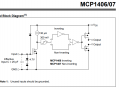
I don't understand why an inversion is a problem but here is a gate driver that can be inverting or non-inverting (06 or 07) if that helps you think. There are a number of 5,6, or 8 pin low side gate drivers that are low cost and easy to use. This one the two outputs have commonly tied together. The reason the are not is that often I use a different gate resistor to pull up verses pull down.
1765912888912.png
 

MrAl

Joined Jun 17, 2014
13,720
I don't understand why an inversion is a problem but here is a gate driver that can be inverting or non-inverting (06 or 07) if that helps you think. There are a number of 5,6, or 8 pin low side gate drivers that are low cost and easy to use. This one the two outputs have commonly tied together. The reason the are not is that often I use a different gate resistor to pull up verses pull down.
View attachment 360659
Hi,

I wasn't sure if he was talking about the power output inversion or the signal to output inversion so I was asking about that.
Usually, if it is he signal to output and the control come from a uC chip, I would think it would be easy to change the programming that little bit.
 
Top