Is this Zeta Converter Will work?

Thread Starter

RIskiZeta

Joined Dec 6, 2025
31
i wanna make zeta converter coupled inductor as MPPT for solar panel 100WP. I read in many article that in zeta converter the switch usually use PMOS. But in this case i want use NMOS using gate driver IR2101 High Side driver only (not synchronus converter). In simulation the circuit is perfectly fine and the voltage output is great. but after i make the prototype, i realise that the VS and Source (MOSFET N-Channel IRFZ44n) connected to the ground by inductor (L1). So i still wanna validated my circuit before testing the protoype.
VIN=12-22.5
VOUT=30V
Iout= 3-5A
Fs=31.4kHz
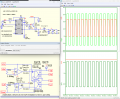
#Simulation in proteus
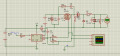
simulasi.png
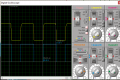
#image of gate signal and source MOSFET
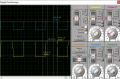
gate and source signal.png
sorry for my bad english, thanks guys
 
Last edited:

ronsimpson

Joined Oct 7, 2019
4,645
i realise that the VS and Source (MOSFET N-Channel IRFZ44n) connected to the ground by inductor (L1). So i still wanna validated my circuit before testing the protoype.
SPICE and real life are not the same.
I think a IR2101 will not work right if VS goes below ground. In this case VS is pulled up to almost 22V then needs to fly down well below ground. SPICE will not check to see if this will kill the IC.
 

Thread Starter

RIskiZeta

Joined Dec 6, 2025
31
SPICE and real life are not the same.
I think a IR2101 will not work right if VS goes below ground. In this case VS is pulled up to almost 22V then needs to fly down well below ground. SPICE will not check to see if this will kill the IC.
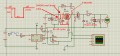
Answer1.png
I check it again and the VS is below the ground. But the problem is the voltage is to much below the ground. Because in IR2101 maximum VS below the ground for my driver is -4.7 Volt. Should i change the driver or not?
 

Ian0

Joined Aug 7, 2020
13,097
There’s a reason you don’t often see zeta converters. It is because they need either a P-channel FET, or a gate drive which can go well below the negative rail, and that almost necessitates a transformer drive.
You can make a SEPIC circuit out of the same components, which avoids the gate-drive problems.
I would have thought that, for an MPPT circuit, having continuous current on the input was more use than having continuous current on the output, and that would favour the SEPIC.
 

Thread Starter

RIskiZeta

Joined Dec 6, 2025
31
There’s a reason you don’t often see zeta converters. It is because they need either a P-channel FET, or a gate drive which can go well below the negative rail, and that almost necessitates a transformer drive.
You can make a SEPIC circuit out of the same components, which avoids the gate-drive problems.
I would have thought that, for an MPPT circuit, having continuous current on the input was more use than having continuous current on the output, and that would favour the SEPIC.
thanks for reply.
unfortunately i propose this as final project at uni that cant be changed. So i have to succeed built zeta converter as MPPT. Do you think this will be work using isolated gate driver and isolated supply for the driver or just change the switch using P Channel FET?
 

Ian0

Joined Aug 7, 2020
13,097
thanks for reply.
unfortunately i propose this as final project at uni that cant be changed. So i have to succeed built zeta converter as MPPT. Do you think this will be work using isolated gate driver and isolated supply for the driver or just change the switch using P Channel FET?
Should have been a big more vague in the proposal!
TI has a load of isolated gate drivers.See if they might work. your challenge will then be getting a floating supply for the isolated part, and making sure it starts up and continues to work at 100% duty cycle.
If you can’t make that work, go for the P-channel FET as a last resort.

Another idea, which is a bit left-field. There is no good reason why your solar panel and your battery should share a negative supply. Start with the P-channel circuit and turn it all upside down, so that you have a N-channel FET, and your panel and battery share a common positive supply.

Just out of interest, why did you go for the zeta converter, not the SEPIC in the first place? If you had wanted continuous current on both input AND output, a Čuk should have been the preferred choice.
 

Thread Starter

RIskiZeta

Joined Dec 6, 2025
31
Should have been a big more vague in the proposal!
TI has a load of isolated gate drivers.See if they might work. your challenge will then be getting a floating supply for the isolated part, and making sure it starts up and continues to work at 100% duty cycle.
If you can’t make that work, go for the P-channel FET as a last resort.

Another idea, which is a bit left-field. There is no good reason why your solar panel and your battery should share a negative supply. Start with the P-channel circuit and turn it all upside down, so that you have a N-channel FET, and your panel and battery share a common positive supply.

Just out of interest, why did you go for the zeta converter, not the SEPIC in the first place? If you had wanted continuous current on both input AND output, a Čuk should have been the preferred choice.
I was a little rushed when choose the topic of my final project. From my previous experience i thought High side Switch in zeta topology just like the other converter that doenst need isolated driver when using N-MOS (because i have experience built buck converter that the same high side topology switch as zeta).
Is it the solar panel negative have to share negative with the other circuit like MCU and sensor. Because i generate PWM from arduino nano and using voltage sensor (voltage divider) , current sensor (ACS712 5A) for measurement.
im not using sepic is because my senior already did that. Thats why i have to pick different converter. And why i didnt choose cuk even it has continues current in input and output because it has inverting voltage output. That become problem for my sensor. Anyways thanks for the advice, that really help me alot to develop my prototype.
 

Thread Starter

RIskiZeta

Joined Dec 6, 2025
31
thanks for reply @Bordodynov .
i mean when using spice it worked very well. But in reality when VS connected to the ground by inductor (L1), that was become serious problem. It make the IC is very hot like burning. And the VS below to much to the ground that maximum negative limit is -10.7 Volt. thats why i still wanna check the circuit.
Anyway thanks for the effort.
 

ronsimpson

Joined Oct 7, 2019
4,645
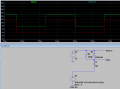
P-MOSFET. Note pulling down on the Gate turns it on. (inversion)
Add RC to the gate. Time constant needs to be 10 cycles of the PWM or more.
The G-S diode keeps the gate from going above the 22V supply. The signal will now hang below the 22V supply.
1765380981434.png
This will work from 0% to 90% duty cycle. It will not work at 100%!
Note you will need to invert the signal at R1. (HIN)
 

Thread Starter

RIskiZeta

Joined Dec 6, 2025
31
P-MOSFET. Note pulling down on the Gate turns it on. (inversion)
Add RC to the gate. Time constant needs to be 10 cycles of the PWM or more.
The G-S diode keeps the gate from going above the 22V supply. The signal will now hang below the 22V supply.
View attachment 360300
This will work from 0% to 90% duty cycle. It will not work at 100%!
Note you will need to invert the signal at R1. (HIN)
thanks for reply, for power diode i will use MBRD5200. Is it to much for RC in gate that needs time constant 10 cyles of PWM?
because it the switching will be become slower.
if become inverting PWM signal in input and output i think i will add another gate logic. for the duty cyle im not gonna think i will used at 100%. Because my converter just need 57%-71% to operate.
 

Ian0

Joined Aug 7, 2020
13,097
thanks for reply, for power diode i will use MBRD5200. Is it to much for RC in gate that needs time constant 10 cyles of PWM?
because it the switching will be become slower.
if become inverting PWM signal in input and output i think i will add another gate logic. for the duty cyle im not gonna think i will used at 100%. Because my converter just need 57%-71% to operate.
For a zeta converter 100% duty cycle makes no sense because the ratio of input to output is D/(1-D), and that would theoretically give infinite output voltage.
Personally, I would prefer something like UC23113 instead of capacitve coupling.
As your solar input is 22V and battery 16V maximum, it is always going to be a step-down function, so what are the advantages of the Zeta over a simple buck? Unless you want to capture the very last rays from the setting sun!
 

ronsimpson

Joined Oct 7, 2019
4,645
UC23113 instead of capacitve coupling.
The UCC23113 needs a floating power supply.
Is it to much for RC in gate that needs time constant 10 cyles of PWM?
because it the switching will be become slower.
Try it. Use a 1uf or almost any value. I have used it many times. The capacitor blocks the DC and allows the AC to pass from the Gate Driver to the Gate.
 

Thread Starter

RIskiZeta

Joined Dec 6, 2025
31
For a zeta converter 100% duty cycle makes no sense because the ratio of input to output is D/(1-D), and that would theoretically give infinite output voltage.
Personally, I would prefer something like UC23113 instead of capacitve coupling.
As your solar input is 22V and battery 16V maximum, it is always going to be a step-down function, so what are the advantages of the Zeta over a simple buck? Unless you want to capture the very last rays from the setting sun!
UC23113 or 6n137. Because 6n137 have much faster i think than UC23113. the converter need work from 12 volt minimum of the solar panel because it will be testing 9 am until 4 pm. thats why its need increasing and decresing voltage output.
 
Top