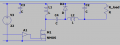
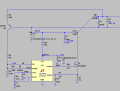
Is this Zeta Converter Will work?

Ian0

Joined Aug 7, 2020
13,158
UC23113 or 6n137. Because 6n137 have much faster i think than UC23113. the converter need work from 12 volt minimum of the solar panel because it will be testing 9 am until 4 pm. thats why its need increasing and decresing voltage output.
They are pretty much comparable in terms of speed, but the UCC23113 can output 5A and the 6N137 can only manage 50mA. You'll need more than 50mA to switch a big MOSFET.
 

Thread Starter

RIskiZeta

Joined Dec 6, 2025
31
They are pretty much comparable in terms of speed, but the UCC23113 can output 5A and the 6N137 can only manage 50mA. You'll need more than 50mA to switch a big MOSFET.
my plan is gonna use 6n137 and push pull for gate driver. But the rise time must become worse. Because UCC23113 not available in my country. that was the main problem why i didnt choose UCC23113. my alternative right now maybe just HCPL3120 or TLP350
 

Thread Starter

RIskiZeta

Joined Dec 6, 2025
31
@ronsimpson
i tried your method and the circuit work. But there's some issue.
I know the PWM signal will be inverting. So when is 30 % in input, at the gate is 70%. But its okay i think. The main issue the voltage drop in output converter is like -10 volt than it should be.
# note i tried using 2 MOSFET, even with 1 MOSFET the issue still there
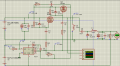
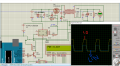
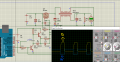
circuit ZETA_PMOS.png

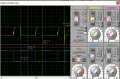
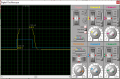
# yellow (gate mosfet) and blue (drain). I connected VS to drain of mosfet and the voltage in drain minus 21 volt. it still safe to operate like this?
signal PWM.png
note : the supply driver i will use adapter AC to DC if my circuit doenst need floating supply. if need floating supply i will use B1515s modul
 
Last edited:

ronsimpson

Joined Oct 7, 2019
4,705
so it kinda like bootsrap. but the main reason is Floating insulation component supply
I must respond to bootstrapping. It is designed to work where there is a diode to keep all pins from going below ground.
In the case of this schematic the Source of the MOSFET (right side) must go well below ground. I could go to -11 or -22V. (If the Gate driver internal diodes were removed)
D1 normally charges C1 to +16V-0.7V. (that depends a little on what circuit is in use) BUT in this case the Charging current frows from +16V, through D1, into C1 which is at some voltage like -11V. There for C1 may get charged to 25V. This will break the IC for many reasons and also kill the Gate.
.1765465800200.png
 

ronsimpson

Joined Oct 7, 2019
4,705
# note i tried using 2 MOSFET, even with 1 MOSFET the issue still there
It looks like you need a MOSFET with more current. I think that is why you are paralleling the transistors.
To parallel two MOSFETs, connect S-S and D-D but do not connect G-G. Use two different resistors like R5. Place R5a and R5b very close to the Gare.
There is no need for the HO output on the Gate Driver. LO is a better output. D3 is probably not needed.
1765467222030.png
 

Thread Starter

RIskiZeta

Joined Dec 6, 2025
31
There is no need for the HO output on the Gate Driver. LO is a better output. D3 is probably not needed.
i tried using Low Input for switching my MOSFET. it work very well even though i add NPN in input to change the inverting of the driver. i also erased RC snubber and this is the result :
Note : i tried operated in 71 % cyle
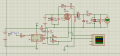
PMOSZETA.png

i still wanna be experiment using transistor driver for PMOS. and this is the result :
D=71%
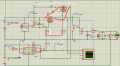
PMOSZETA_PushPull.png

what do you think its the best for my application?
 

ronsimpson

Joined Oct 7, 2019
4,705
Somewhere on this form there is a post about driving a P-=FET like you are trying to. I will see if I can find it.
Right now you pull the Gate down to 1V and lift it up to 10V. But that will make the FET very hot. The transistor does not care what the voltage is (as measured from ground). It only cares what the S to G voltage is.

Also, when the S on 22.5V and the Gate at about 1V you have 21.5V on the S-G which is more than most MOSFETs can take.
 

Thread Starter

RIskiZeta

Joined Dec 6, 2025
31
Right now you pull the Gate down to 1V and lift it up to 10V. But that will make the FET very hot. The transistor does not care what the voltage is (as measured from ground). It only cares what the S to G voltage is.

Also, when the S on 22.5V and the Gate at about 1V you have 21.5V on the S-G which is more than most MOSFETs can take.
1234.png

i tried to measured gate, voltage will be up like 6 volt and going down to -6.4 volt. so its pull down like 10 volt after pull up to 6 volt. When the source is 22.5 volt, the gate is about 6 volt. so on the S-G is like 16.5 volt. is it right?
Somewhere on this form there is a post about driving a P-=FET like you are trying to. I will see if I can find it.
thanks btw, you help me alot
 

MrAl

Joined Jun 17, 2014
13,716
i wanna make zeta converter coupled inductor as MPPT for solar panel 100WP. I read in many article that in zeta converter the switch usually use PMOS. But in this case i want use NMOS using gate driver IR2101 High Side driver only (not synchronus converter). In simulation the circuit is perfectly fine and the voltage output is great. but after i make the prototype, i realise that the VS and Source (MOSFET N-Channel IRFZ44n) connected to the ground by inductor (L1). So i still wanna validated my circuit before testing the protoype.
VIN=12-22.5
VOUT=30V
Iout= 3-5A
Fs=31.4kHz
#Simulation in proteus
View attachment 360224
#image of gate signal and source MOSFET
View attachment 360226
sorry for my bad english, thanks guys
Hello there,

For this kind of circuit I think you need to use either a P MOSFET or an isolated N MOSFET driver. That, as I think you know, is because the inductive kickback will most likely exceed the limitations of the N MOSFET source connection on the IC chip.

Doing it either way like that will be the cleanest. P MOSFETs have gotten better over the years so you may be able to tolerate using one easily.

Another solution that might work involves the N MOSFET is where we create a secondary isolated switch to keep the negative excursion away from the N MOSFET without limiting that negative excursion too much. I will not be easy however, and at the least would require two more N MOSFETs, and whatever drive is needed. This can get pretty complicated because then there will be a total of three MOSFETs instead of just one.

You could look into this if you like. As I said though, it will complicate the circuit quite a bit. If you want a Zeta topology then you need to accept certain limitations unless somebody comes up with a better driver.
There is the UCC21520 which is an isolated driver, but you'd have to look into that also to see if it will work right for this.
 

Thread Starter

RIskiZeta

Joined Dec 6, 2025
31
Hello there,

For this kind of circuit I think you need to use either a P MOSFET or an isolated N MOSFET driver. That, as I think you know, is because the inductive kickback will most likely exceed the limitations of the N MOSFET source connection on the IC chip.

Doing it either way like that will be the cleanest. P MOSFETs have gotten better over the years so you may be able to tolerate using one easily.

Another solution that might work involves the N MOSFET is where we create a secondary isolated switch to keep the negative excursion away from the N MOSFET without limiting that negative excursion too much. I will not be easy however, and at the least would require two more N MOSFETs, and whatever drive is needed. This can get pretty complicated because then there will be a total of three MOSFETs instead of just one.
thanks for reply, that was my early problem doing zeta converter using N channel FET. i think will be a lot complicated if i still wanna be used N mosfet to driving my converter because like u said it needs isolated driver and isolated suplly. that will be increasing number of MOSFET.
You could look into this if you like. As I said though, it will complicate the circuit quite a bit. If you want a Zeta topology then you need to accept certain limitations unless somebody comes up with a better driver.
right now i tried using transistor driver like ronsimpson said. it was using push pull as buffer and 1 channel N-MOSFET to driving P- MOSFET.
 

MrAl

Joined Jun 17, 2014
13,716
thanks for reply, that was my early problem doing zeta converter using N channel FET. i think will be a lot complicated if i still wanna be used N mosfet to driving my converter because like u said it needs isolated driver and isolated suplly. that will be increasing number of MOSFET.

right now i tried using transistor driver like ronsimpson said. it was using push pull as buffer and 1 channel N-MOSFET to driving P- MOSFET.
Hello again,

Well you can use an N MOSFET if your application can tolerate a new ground connection. That is, if your load does not have to have a ground in common with the input ground you can flip everything and that allows you to use an N channel device the same way you would use a P channel device with an output ground in common with the input ground.
With this N channel solution everything gets a lot simpler, but you lose the common input/output ground. You end up regulating the ground (-) rather than the output (+) itself. This is done with converters sometimes.

What is the reason you need to use an N MOSFET for this project? Is it because you are already committed to that topology?
 

Ian0

Joined Aug 7, 2020
13,158
Hello again,

Well you can use an N MOSFET if your application can tolerate a new ground connection. That is, if your load does not have to have a ground in common with the input ground you can flip everything and that allows you to use an N channel device the same way you would use a P channel device with an output ground in common with the input ground.
With this N channel solution everything gets a lot simpler, but you lose the common input/output ground. You end up regulating the ground (-) rather than the output (+) itself. This is done with converters sometimes.

What is the reason you need to use an N MOSFET for this project? Is it because you are already committed to that topology?
I agree (see post #6). It produces two different problems
1) measuring the output (battery) voltage, as the control circuit negative becomes the negative of the solar panel. Easy to solve, because one can measure the solar panel voltage, and the total battery+solar voltage, and then subtract one from the other to give the battery voltage
2) The power supply for the circuitry disappears when the sun goes in, unless a supply can be derived from the battery. The disappearance of the power supply itself isn't a problem as it doesn't need to be there when there is no power to convert, but it needs to behave sensibly when it is at the margins.
 

ronsimpson

Joined Oct 7, 2019
4,705
As long as we are talking about news ways to do this, let's explore some.
P-Fet PWM From IT here is a data sheet of the PWM that drives a P-fet. I have not used this part, the one I have used are not in production now. There is a class of PWM that drive P-FETs.
Using that part: -converter design Here is an interesting read.
1765643138073.png
I have done this.
 

ronsimpson

Joined Oct 7, 2019
4,705
If I had to make this supply with the minimum parts, I might try this. It is 'upside down'.
N-mosfet which is low cost and easy to drive.
I use a current mode PWM.
1765643734806.png
If I had to make this supply with the minimum parts, I might try this.
Actually, there are lower cost ways to do this, but you want Zeta.

lol I see I did not get C3 connected to the (-) of V3.
 

MrAl

Joined Jun 17, 2014
13,716
I agree (see post #6). It produces two different problems
1) measuring the output (battery) voltage, as the control circuit negative becomes the negative of the solar panel. Easy to solve, because one can measure the solar panel voltage, and the total battery+solar voltage, and then subtract one from the other to give the battery voltage
2) The power supply for the circuitry disappears when the sun goes in, unless a supply can be derived from the battery. The disappearance of the power supply itself isn't a problem as it doesn't need to be there when there is no power to convert, but it needs to behave sensibly when it is at the margins.
Hi,

See post #36 and try to show me what you expect to be a problem. I'd like to understand you completely.

Since this circuit is partly a boost circuit, the duty cycle must be limited or else the voltage actually comes down.
 

ronsimpson

Joined Oct 7, 2019
4,705
After looking this project over, it appears to be a solar to battery MPP controller where the PWM is done in software. This is something we do at the local university every year. I have helped on several of these projects and did some for commercial jobs.

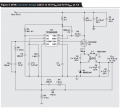
Here is a another try at 22.5V in 20Vout using hardware. No MPP control but just a simple flyback PWM.
I am using the UC3842 current mode PWM. at 100khz. 1A output.
I removed the capacitor in the Zeta because it often fails. Real world experience.
Here I set the battery on top if the 22.5Vin.
Q2 looks at the voltage on the output and translates it down for the PWM to look at. This circuit can be changed to work with a computer running at 3.3V with a simple resistor change. I can also make it more accurate later. This is just a first try.
1765668037166.png
I attached the LTspice file if you want to play with it. The error amp is not right yet. There are some things I would change.
RonS.
 

Attachments

Ian0

Joined Aug 7, 2020
13,158
Hi,

See post #36 and try to show me what you expect to be a problem. I'd like to understand you completely.

Since this circuit is partly a boost circuit, the duty cycle must be limited or else the voltage actually comes down.
A1 is powered by V3, which is the solar panel. I'm presuming that the control circuit shares a power supply with A1.
1) The control circuit needs to measure the battery voltage. This isn't quite as easy as it would be if Rload shared a common negative with the control circuitry and V3, but it's not exactly difficult, because all that needs to be done is measure the voltage at C2 positive terminal with respect to the negative of V3, then subtract V3.
2) V3 will disappear gradually at dusk and reappear at dawn. The control circuitry must start up and close down properly, and not leave M1 switched on (which would happen as it needs more and more boost as V3 falls). If M1 remained switched on it could never properly re-start.
If the control circuitry is performing any sort of data logging, then it needs a supply from the battery, otherwise there will be no logging at night.
 

MrAl

Joined Jun 17, 2014
13,716
After looking this project over, it appears to be a solar to battery MPP controller where the PWM is done in software. This is something we do at the local university every year. I have helped on several of these projects and did some for commercial jobs.

Here is a another try at 22.5V in 20Vout using hardware. No MPP control but just a simple flyback PWM.
I am using the UC3842 current mode PWM. at 100khz. 1A output.
I removed the capacitor in the Zeta because it often fails. Real world experience.
Here I set the battery on top if the 22.5Vin.
Q2 looks at the voltage on the output and translates it down for the PWM to look at. This circuit can be changed to work with a computer running at 3.3V with a simple resistor change. I can also make it more accurate later. This is just a first try.
View attachment 360468
I attached the LTspice file if you want to play with it. The error amp is not right yet. There are some things I would change.
RonS.
Hi,

I think he is obligated to use a Zeta converter, or at least that's what I gathered from his previous posts. That's unless something changed that I missed.
 
Top