Inverting 2800VA, 60Hz, 120V, seeking proper transformer

Thread Starter

MrSoftware

Joined Oct 29, 2013
2,273
I have a supply (Generator) that gives me 2800VA @ 110V. I need a transformer to invert the phase 180 degrees so that I can have a pair of 110V lines out of phase, giving me 220V, so that I can power both phases of my house. Can anyone recommend a product line or brand, or the proper google search term? I'm finding lots of transformer articles, but so far nothing for sale that is suitable, so I must be searching for the wrong thing. ;)
 

ebp

Joined Feb 8, 2018
2,332
There are a couple of ways to do it.

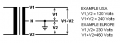
Isolation transformer: use a 1:1 (i.e. Vin:Vout) isolation transformer. Connect the primary to gen output and the secondary "in series" with the output, paying attention to phase. Typically you would use a transformer rated for half the power from the gen, assuming you have "balanced" loads. A 1400 VA transformer is going to be big and expensive

110:220 centre-tapped transformer - much bigger because all the power goes through it and no real merit

I found a Hammond that might work, but the idiots spec the primary and secondary as "120x240" - which may mean that each winding is split so it can be used in parallel or series. [EDIT - yes this appears to be the case; I hate electrical trade jargon]
PH1500PP is the model number
 

Thread Starter

MrSoftware

Joined Oct 29, 2013
2,273
Thank you very much, I didn't think of an isolation transformer for flipping the phase but that makes perfect sense. Here's the wiring diagram for PH1500PP (this doc, top of page 7) It looks like shunt a couple terminals on each side to get the coils in parallel, then connect the source and load to terminals 2 and 5 on each side respectively. I'm not sure how to read their schematic as far as which of the load pins to connect to the neutral source pin for a common neutal, but I'm sure it will pop a breaker quick if I get it wrong the first time. ;)
 

MaxHeadRoom

Joined Jul 18, 2013
30,706
I found a Hammond that might work, but the idiots spec the primary and secondary as "120x240" - which may mean that each winding is split so it can be used in parallel or series.
That odd? I have used Hammond for several decades now and all my info states 120/240 50/60hz etc for e.g. for series/parallel.
And I also have the old hard copy catalogues with the same.
Max.
 

ebp

Joined Feb 8, 2018
2,332
No, what is odd is the 120 X 240. I suspect it derives from the fact that the winding drawing has an X of sorts.
I'm accustomed to the slash notation 120/240, which is what they use for many/most of their transformers.

I should note that Hammond, like many others, uses a E stack and an I stack that are welded rather than alternating E's and I's for some of their transformers. This is a cost saving method, but sometimes they are noisy.
 

be80be

Joined Jul 5, 2008
2,395
Just one thing
transformer will only transform voltage, it will not convert phases, and does not create a neutral

Hooking one up backward going to over come that then why do we use Phase Converters

US power sys is 120/240 2 Phase in homes and 3 Phase in most businesses.

I've made 2 Phase power with a 2 generators never tried 2 transformers off the same generator.
 

ebp

Joined Feb 8, 2018
2,332
They tend not to specify efficiency as such in most cases. Sometimes there is enough data that you can reasonably approximate it, but not often. In general, Hammond transformers are good quality and they don't try to save money by scrimping on iron or copper. I would guess something in the range of 95 to 98 percent for that transformer - probably closer to the upper end.

There are multiple contributors to losses in transformers. In iron core transformers winding resistance is usually the main contributor to loss. "Eddy current" loss in the iron core is usually the second greatest contributor (transformers use thin steel laminations, each electrically insulated over its surface, to reduce eddy current loss).

There is a "standby" loss common to all transformers. When the primary is energized but there is no load on the secondary, there is still some current that flows in the primary because the primary is an inductor. This is usually referred to a "magnetizing current." The phase relationship of voltage and current is such that there is no "true" power loss. However, the current does act against the resistance of the winding, so there is some true power loss there. Because Hammond designs conservatively, this loss is generally quite small, though there is a trade-off between adding length of wire (more "turns") and accepting higher magnetizing current. The transformer in question is designed for use at 50 or 60 Hz. When used at 60 Hz you get some extra benefit because that is the less-demanding case with regard core and copper for magnetizing current. Eddy current losses also contribute to the no-load losses.
 

Thread Starter

MrSoftware

Joined Oct 29, 2013
2,273
Just one thing
transformer will only transform voltage, it will not convert phases, and does not create a neutral

Hooking one up backward going to over come that then why do we use Phase Converters

US power sys is 120/240 2 Phase in homes and 3 Phase in most businesses.

I've made 2 Phase power with a 2 generators never tried 2 transformers off the same generator.
An isolation transformer will invert the phase depending on how you connect the output side. And you should be able to connect the source neutral with the matching terminal on the output side to give you a common neutral.
 

be80be

Joined Jul 5, 2008
2,395
Like I said I've done this with 2 matching generators and can also bond them that give double the amps out
But I was just checking the transformer idea out. Lots of people here only have single phase power there not in the US

But I think you are I can see the transformers as working idea one will be reversed.
I never tried this out. I was really wondering is with the generator when you bond for power as long as it's at zero crossing they bond
by bringing the phase inline as it should they load up one generator a little till the power phases right.


I could see that being hard to do with just two transformers. If the phasing is off you have a big short.

I've seen that happen and pop the head off a 14 h generator

Here a picture Your going to make it with 2 isolation transformer split phase should work good if they match.


Split_phase2.png

Your only going to have 11.66 amps of power tho.
 
Last edited:

Reloadron

Joined Jan 15, 2015
7,893
I have a supply (Generator) that gives me 2800VA @ 110V.
So you are saying 110 Volts at 2.8 kVA. That kVA is actually the apparent power and not the true power. The VA is merely E * I or if you prefer V * I without consideration for the power factor. The true power expressed in watts is W = E x I x Cos phi. Since the guys making the generator have no clue what type load it will work into they use VA or kVA. While we can assume for a single phase genset a power factor of 1.0 that is not always true.

Even less any transformer loss and assuming a perfect transformer the best you can hope for is split phase 220 Volt @ 1400 VA. A typical US residence has 240 Volt Split phase 100 Amp service with most new construction getting 200 Amp service and older homes like mine originally was having 60 Amp service. You are starting with 110 Volts and just under 25 amps. Going to split phase 220 volts you will have about 12 amps per side in an ideal world. If you plan to back feed into your house during a power outage you may want to consider the loads, you also want to disconnect mains when you run on the genset. You want to configure things so utility company power never meets your generator power face to face as things get very ugly very fast. Anyway, power being power and things like that you need to know your limitations and work within them.

Your only going to have 11.66 amps of power tho.
That would be on a really good day too! :)

Ron
 

Thread Starter

MrSoftware

Joined Oct 29, 2013
2,273
I'm using a single generator. Also I've powered the house many many times with my old 4kva generator, which has 220v output, and do disconnect from the utility. After a storm you just want to run some lights, the fridge and a window air conditioner. 4kva was plenty, 2.8kva will probably be enough, if not I'll just revert to the old generator. The new one is just really quiet, I got it primarily for travelling in my trailer. :) It is possible for the phases to be unbalanced though, so I might want to go for a larger transformer in case most of the power ends up on that phase. Current wise there will be 23ish amps at 120v available, minus losses . It just needs to be 2 phases because houses here are wired with multi wire branches and it's possible to overload the shared neutral if it's all on the same phase.
 
Last edited:

be80be

Joined Jul 5, 2008
2,395
window air conditioner that's what i was running 4 of them on a jobsite trailer had two honda generators that where made to bond
they couldn't start all 4 at one time 40 amps was all they could handle.
 

be80be

Joined Jul 5, 2008
2,395
Just to be clear, N.A. residential is 1ph power not 2 phase.
Just as using 2 phases of a 3ph transformer is also single phase.
Max.
Well your right but what do you do they call call it 2 phase here or split phase

Not trying to argue or nothing it's 2 hots and center tap connected to a grounded and use for neutral
Screenshot from 2018-03-08 00-20-32.png
 

Janis59

Joined Aug 21, 2017
1,893
Firstly - what means the generator? Most of generators works very far from 50 or 60 Hz or even produces DC. You may use a standard trafo only if You have checked the frequency is OK.
Secondly, 3 kW trafo is thingy rather costy, thus I am sure it is more economically to wind it by DIY methods. The core may serve old welding AC transformer, those are lot in the car-boot-sales or garage-sales for coins. Then the primary You already have and must decide - or to create the half-winding center-tap or wind a half of turns count secondary, what will serve as primary, and primary as secondary. At least any 130-180 Amp welder has those ca 3kW qualification.
 

ebeowulf17

Joined Aug 12, 2014
3,307
It just needs to be 2 phases because houses here are wired with multi wire branches and it's possible to overload the shared neutral if it's all on the same phase.
Where are you located? I would've thought that would be a code violation in the U.S. I'm not disagreeing with your statement, just curious about it. I could be remembering that wrong, and even if I'm right, I know there are tons of houses grandfathered in on all sorts of code issues if they're older.
 

ebeowulf17

Joined Aug 12, 2014
3,307
Just one thing
transformer will only transform voltage, it will not convert phases, and does not create a neutral

Hooking one up backward going to over come that then why do we use Phase Converters
I think the distinction here is what sort of phase relationships you're looking for. In this case simply reversing polarity will suffice. While it's easy to think of this as a 180 degree phase shift, technically that's not what's happening.

Phase converters allow more complex phase relationships. Three phases, 120 degrees apart, is the common application (and would not be achievable with a simple isolation transformer like what's being discussed here) although, at least in theory, any arbitrary phase relationship could be created with a phase converter.
 

Thread Starter

MrSoftware

Joined Oct 29, 2013
2,273
I'm in S. Florida USA. Multi wire branch circuits is actually the standard here. I don't like it myself, the price of the wires in a house has got to be a fraction of a percent of the house price, there must be a reason other than cost savings that they do it. Here's the 2017 FL code where they discuss it: See section "E3701.5 Multiwire branch circuits".

This is the generator I'm working with (Yamaha ef3000iseb).

Good point about the phase terminology. I wasn't sure how to indicate 180 degrees out of phase, but it looks like split phase is the term to use.
 
Last edited:

be80be

Joined Jul 5, 2008
2,395
Kind of like Janis Blahins pointed out to the only problem I see is the generator the power coming in is done the same way as you want but it's dropped down but I don't think 2 transformers going to work they make ones for this but there more then a good generator.

And your going to find out that 2800 VA is not enough for air conditioner but that depends on the uint some are 8 to 9 amp 5000 bpu

much bigger it's not enough.
 
Top