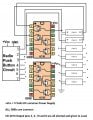
Nice! It does function on my breadboard correctly.The 1 meg resistors in conjunction with the input capacitance provide enough delay so the latch being accessed doesn't reset before the reset signal goes away.
Given the expanding input count as more push-buttons are added, could the or gates be replaced with wired-or using diodes??The big deal is the "OR" gates.
Yes, but each OR gate would consist of n-1 diodes where n is the number of push-buttons.Given the expanding input count as more push-buttons are added, could the or gates be replaced with wired-or using diodes??
This circuit, posted in #79, is certainly the best I have seen, It allows all 7 selections and uses ONLY THREE CMOS IC devices. AND the functional logic is simple to follow because it is well drawn with a good logical flow! It could as easily utilize SPAT button switches as well, with only a slight reduction in error protection.Hi,
Here's an alternative circuit. It works in simulation but needs breadboard testing (I don't have all the chips).
This also uses a CD4532 but uses an CD40175 to store the selected address. A CD4051 is used as a selector to select the desired PWM generator. The SPDT input buttons are daisy chained so only one button output can be present at any time.
I used low PWM frequencies for simulation purposes only. All switches are momentary SPDT.
View attachment 327076
View attachment 327077
Thanks for the circuit. So far I made and tested the one given by Crutschow using two ICs 4532 and 4514 both are easily available in my place. This circuit uses 3 ICs and CD 40175B is not readily available at my place.Hi,
Here's an alternative circuit. It works in simulation but needs breadboard testing (I don't have all the chips).
But the one using 4532 and 4514 shown in post #67 uses only 2 ICs. That is the reason I proceeded with that on perfboard. Though you said one of them is out of production that is available in my place easily may be in the future it could not be.This circuit, posted in #79, is certainly the best I have seen, It allows all 7 selections and uses ONLY THREE CMOS IC devices. AND the functional logic is simple to follow because it is well drawn with a good logical flow! It could as easily utilize SPAT button switches as well, with only a slight reduction in error protection.
Yes, but you still need to add an analog switch to select the PWM outputs. The circuit I posted already has that.But the one using 4532 and 4514 shown in post #67 uses only 2 ICs. That is the reason I proceeded with that on perfboard. Though you said one of them is out of production that is available in my place easily may be in the future it could not be.
Yes right, all is accomplished with three ICs. I am using two 4016 ICs to switch between the PWMs so it makes a total of 4 ICs in the circuit I am making.Yes, but you still need to add an analog switch to select the PWM outputs. The circuit I posted already has that.
You can substitute D flip flops for the CD40175, but you'll need three FF's.
You apparently have a incorrect connection that is seriously loading the circuit.When I connected the outputs from the radio PB circuit to the 4016 ICs and then to the PWM circuits and to load, this happened.
What exactly is the load on the output of the 4016 ?Here is the circuit I made.
One more update I disconnected the load and 4016 IC s and tried the radio push button circuit. It does not work and stays in PWM 1 all the time even if other buttons are pressed. I suppose the ICs sustained damage.
![]()
You need to show us details of the PWM circuit and its connections to the PB selector circuit, so we don't have to guess.Powering your PWM units with the outputs of your radio circuit is not a good idea.
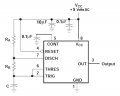
This is the NE555 timer square wave generator PWM circuit.You need to show us details of the PWM circuit and its connections to the PB selector circuit, so we don't have to guess.
I suppose I have shown the connections from the output of the radio PB Circuit in post #92 to the 4016 ICs and how it is connected to the load.post #67 shows a “MOSFET Module”.This is the NE555 timer square wave generator PWM circuit.
View attachment 327785I suppose I have shown the connections from the output of the radio PB Circuit in post #92 to the 4016 ICs and how it is connected to the load.
I suppose Electric Spidey is right. The load current drawn by the PWM circuit is through the radio push button circuit ICs so it possibly is not a good idea. I should use 4016 ICs to supply power to the loads.
This is the circuit in post #67 without the 4016 ICs.post #67 shows a “MOSFET Module”.
What is that? Give us details on how it is connected to the 555?
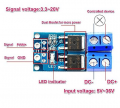
This is the MOSFET switching module.
The PWM signal is given to this module which switches the 12 Volts supply ON and OFF to the load at different frequencies of the PWM. I suppose the load of the PWM circuits is only this MOSFET module and it draws small current only to switch ON and OFF like a relay or contactor.