Yes right every design has its own advantages and disadvantages. All aspects like efficiency, power consumption, life of components due to usage needs to be considered. It is best to choose the design based on application needs. The method you suggested using SPDT switches is simple, good and does not use much power but I am designing a low power application and wastage of power wouldn't be much significant when compared with ease of use where simply pushing the buttons does the desired task of interlocking and being one ON at a time.
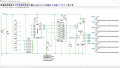
You do realize that the circuit in post #26 will require more ICs for controlling 7 outputs (total of 6 ICs), than some of the other posted circuits which only require 2(?).
I made the radio push button circuit and it works correctly.
But the below circuit doesent.
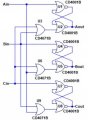
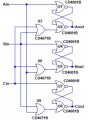
Could you please confirm me the purpose of this circuit using OR and NOR gates.
I thought it was to make only one PWM output present at a time. So I shorted Aout, Bout and Cout until Gout. But when I apply 7 volts Vcc and give input of 7 Volts at Ain then the shorted output terminals gives a 0.3 Volts. The outputs are not shorted in the above drawing. Am I doing anything wrong here because I can only use one output wire to the mosfet pwm pin to ground.
Edit : I am using 7 inputs A, B, C, D, E, F and G, the OR gate of A takes input from Bin and Gin. The OR gate of B takes input from Ain and Cin. This is what I followed for all until G.
Consider for a moment that a "radio button" circuit delivers the identical result of a "winner detect" circuit used for a lot of things. The big difference being that it demands a manual reset before another input can be latched.
So if the TS can accept needing to reset prior to another selection there is another realm of solutions not requiring any creation.
Consider for a moment that a "radio button" circuit delivers the identical result of a "winner detect" circuit used for a lot of things. The big difference being that it demands a manual reset before another input can be latched.
So if the TS can accept needing to reset prior to another selection there is another realm of solutions not requiring any creation.
I have no idea what you are doing, where the PWM is going, or what you are shorting (which you likely shouldn't be).
Please post a schematic of the complete circuit with what you are doing, otherwise I can't help you.
It works.
It is a radio push-button circuit.
I have no idea what you are doing, where the PWM is going, or what you are shorting (which you likely shouldn't be).
Please post a schematic of the complete circuit with what you are doing, otherwise I can't help you.
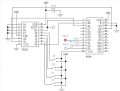
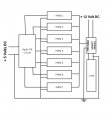
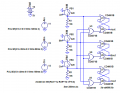
This is the radio push button circuit you gave that I made on the perf board. This works correctly. I have 7 pwm square wave generator circuits each generating 7 different frequency PWM waves. The output of these 555 timer PWM circuits are shorted and given to the MOSFET switching module that supplies power to the load. Here is the circuit. Now I can switch the PWM 1 to 7 using the radio push button circuit you provided above and it works fine. But I don't want the outputs shorted and want to provide some sort of isolation between them. Since if One is giving pulsed output voltage that will be present at the OUT of all 555 timers even though power to them will be OFF.
You are right, your circuits are perfect and they are very useful. I think I did a misunderstanding and used the OR, NOR circuit at the PWM outputs.
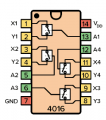
Thanks Crutschow. The PWM signals are 5 Volts so I power the other IC s with 5 Volts. The ouput of Radio PB circuit, I give parallel connections to both the power supplies of the PWM and to the 4016 control pins to give outputs accordingly.
Ok but what is this OR and NOR gate circuit for. It does not have any push buttons so I thought it was for isolation purpose. I should have asked this in the beginning itself but I just assumed it to be. I made a mistake there.
It tends to get a bit more complex when there are more than three inputs. Three inputs take 3 ICs, 4 inputs take it to seven ICs and after that it gets complicated. The big deal is the "OR" gates.
Top
It tends to get a bit more complex when there are more than three inputs. Three inputs take 3 ICs, 4 inputs take it to seven ICs and after that it gets complicated. The big deal is the "OR" gates.
Hi,
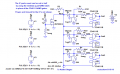
Here's an alternative circuit. It works in simulation but needs breadboard testing (I don't have all the chips).
This also uses a CD4532 but uses an CD40175 to store the selected address. A CD4051 is used as a selector to select the desired PWM generator. The SPDT input buttons are daisy chained so only one button output can be present at any time.
I used low PWM frequencies for simulation purposes only. All switches are momentary SPDT.
The 1 meg resistors in conjunction with the input capacitance provide enough delay (likely at least 10µs) so the latch being accessed doesn't reset before the reset signal goes away.

 Facebook
 Google
 GitHub
 Linkedin