Is there a correlation between the voltage produced by a generator and the voltage produced by a boost converter?

Thread Starter

tsmspace

Joined Mar 16, 2026
133
Ok so as I understand it: In a simple conceptual generator, a coil moves through a magnetic field producing a current in the coil. this results in a voltage on the line. The voltage on the line will in some part be based on the strength of the magnetic field. (it will also be based on the rate the coil moves through the field, the qualities of the coil, and probably other things but those must be the big ones). Or maybe the coil is static and the magnet moves past the coil, but the difference here will be in the machine but not in the voltage assuming everything else is equal, the speed and qualities.

Is there a correlation between this function and the voltage that is produced by a boost converter? a boost converter ends up with an inductor that has a magnetic field on it, and when the transistor connecting the inductor to ground is off, the inductor resists change in current and forces electrons toward vout and onto the filter capacitor charging it. Can you calculate the resulting charge on the capacitor based on the magnetic field strength in the same way that you would do so for the generator?
 

MisterBill2

Joined Jan 23, 2018
28,042
BOB has described the total extent of the similarity! In a GENERATOR, MECHANICAL energy from an external source produces the changing magnetic field thru the coil.
In MOST boost converters, an electronic circuit causes ELECTRICAL energyfrom an external source to produce a magnetic field that passes thru a coil, causing a current to flow, and a voltage to be produced.
you will discover that physically there is not much similarity between a generator and a boost converter. The most obvious difference is that a generator is powered by a machanical input while a converter is powered by an electrical input.
I regardthat as a very great difference.
 

schmitt trigger

Joined Jul 12, 2010
2,177
Bob is absolutely correct. The change in magnetic field strength. The derivative of the magnetic field over time, dΦ/dt
The most important takeaway of this equation is that no matter how strong the magnetic field is, if it is not changing, no current will be induced.
 

Thread Starter

tsmspace

Joined Mar 16, 2026
133
BOB has described the total extent of the similarity! In a GENERATOR, MECHANICAL energy from an external source produces the changing magnetic field thru the coil.
In MOST boost converters, an electronic circuit causes ELECTRICAL energyfrom an external source to produce a magnetic field that passes thru a coil, causing a current to flow, and a voltage to be produced.
you will discover that physically there is not much similarity between a generator and a boost converter. The most obvious difference is that a generator is powered by a machanical input while a converter is powered by an electrical input.
I regardthat as a very great difference.
What i mean, is does the magnitude of the magnetic field in both cases correlate to the resulting voltage produced in the same way. So, could you use the "same equation".?
 

Danko

Joined Nov 22, 2017
2,222
What i mean, is does the magnitude of the magnetic field in both cases correlate to the resulting voltage produced in the same way. So, could you use the "same equation".?
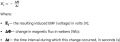
In both cases resulting voltage defines by speed of magnetic flux changing:

1780592788633.png
 

MisterBill2

Joined Jan 23, 2018
28,042
OK, there is an issue here, which is that any voltage produced also has some amount of POWER, depending on the CURRENT. So the second variable is the MAGNITUDE of the magnetic field, in addition to it's rate of change. I hope that this clarifies things.
 

WBahn

Joined Mar 31, 2012
33,076
OK, there is an issue here, which is that any voltage produced also has some amount of POWER, depending on the CURRENT. So the second variable is the MAGNITUDE of the magnetic field, in addition to it's rate of change. I hope that this clarifies things.
Not so much that magnitude. It's not the rate of change of the magnitude of the magnetic field, but rather the rate of change of the magnetic flux, which is dependent on both the magnitude of the field, and the area through which it is acting. So you can get more power with a smaller (i.e., smaller magnitude) field by simply increasing the area.
 

Thread Starter

tsmspace

Joined Mar 16, 2026
133
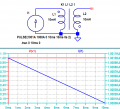
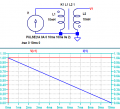
I'm getting it. The decay of the magnetic field would be the same as the conductor moving out of the magnetic field. So if an inductor with a given strength and a conductor at the center of a magnetic field of the same strength both lose/leave their respective fields at the same rate, then the same voltage would be produced in both. So while the magnetic field is constant (in the generator because the conductor is not moving, and in the inductor because the current is not changing) the voltage of each is 0. But, while either of them experiences a change in the strength of the magnetic field (ideally rapid, as the more rapid the more voltage is produced), a voltage is produced, which would be equal for both assuming the same rate of change in the magnetic field. (It does not appear though, that these behaviors will be similar, with the inductor seeming in explanations to experience a very rapid fall-off in voltage, while the generator produces a sine wave)
 

WBahn

Joined Mar 31, 2012
33,076
If you want to explain how a switched-inductor inverter produces a voltage based on the changing magnetic field as the inductor current goes from full to zero, then you also take on the burden of explaining why a comparable voltage isn't being produced as the current then goes from zero to full.
 

Thread Starter

tsmspace

Joined Mar 16, 2026
133
If you want to explain how a switched-inductor inverter produces a voltage based on the changing magnetic field as the inductor current goes from full to zero, then you also take on the burden of explaining why a comparable voltage isn't being produced as the current then goes from zero to full.
I am presently to understand that a negative voltage is produced, but that the voltage will be measured on the source side of the inductor, therefore this voltage will not pull down the voltage on the output side of the inductor. So there IS a comparable voltage being produced, but it does not prevent the successful operation of the power supply.
 

Jonas1

Joined May 11, 2026
4
I am presently to understand that a negative voltage is produced, but that the voltage will be measured on the source side of the inductor, therefore this voltage will not pull down the voltage on the output side of the inductor. So there IS a comparable voltage being produced, but it does not prevent the successful operation of the power supply.
I think you're getting close to the key distinction. Both the generator and the boost converter rely on changing magnetic flux, but the energy source is different. In a generator, mechanical motion provides the energy, while in a boost converter the energy comes from the electrical source and is temporarily stored in the magnetic field before being transferred to the output. That's why the underlying physics is related even though the systems serve different purposes.
 
Top