The signal needs to go between Vcc and ground (a CMOS input can never be left open/floating).
If you want to use a SPST push-button switch that switches to Vcc, then connect each input to ground with a 10kΩ resistor.
Ok I got momentary push button switches with only NO contacts. For this application I need a push button switch with both NC and NO contacts, NC connecting inputs to ground and when the push button is pressed the NO connects the input to Vcc momentarily and then when it is released the input is connected to ground again through NC contacts.
Or if I am using only NO contacts, I connect each input to ground through a 10kOhm resistor.
I got the rotary switches and they get too messy, every time I should turn them all the way to the end and all the way back and with every frequent usage they get worn out pretty quickly. So you are right, thanks for the circuits in post #14.
In this circuit using OR and XOR gates for interlocking the 555 timer outputs for making one signal output at a time and signal output is isolated from the other 555s. Since pulsed signals are used at ranges of 0.1 to 42 Hz, what is the value of capacitors need to be used at Vcc to ground. Do pull down resistors have to be used. They are not present in this drawing so wanted to confirm.
what is the value of capacitors need to be used at Vcc to ground. Do pull down resistors have to be used. They are not present in this drawing so wanted to confirm.
A 100nF ceramic is a typical IC decoupling capacitor to ground.
Yes, the circuit needs 10kΩ resistors to ground at each input if a SPST PB to Vcc is used.
A 100nF ceramic is a typical IC decoupling capacitor to ground.
Yes, the circuit needs 10kΩ resistors to ground at each input if a SPST PB to Vcc is used.
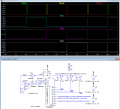
Below is the LTspice sim of the basic PB Radio latch circuit shown in post #19:
It does have the advantage of not requiring pull-up/down resistors if a SPST NO push-button is used.
I changed the oscillator inhibit circuit to stop the oscillator between button presses, as it doesn't need to oscillate during that time, thus reducing quiescent circuit operating current to just the leakage current of the IC.
I also significantly increased the frequency of the oscillator to minimize the length of the observed normal one clock-period output glitch (about 8µs here).
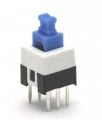
Thats a momentary push button switch with 6 pin connections has normally open (no) and normally closed (nc) contacts. NC I will connect inputs to ground and NO I will connect input to Vcc so when it is pressed it will release the contact from ground and touch Vcc and when released it connects to ground again.
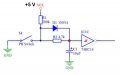
This is the circuit I will be using for switch debouncing at every PB switch for a Vcc of 5 Volts I hope the resistor and capacitor values are correct. Let me know if I need to change. Thanks.
You don't need switch debouncing for the circuit you are using, as once the switch makes contact, further bounce connections make no difference at the output.
You don't need switch debouncing for the circuit you are using, as once the switch makes contact, further bounce connections make no difference at the output.
You do realize that the circuit in post #26 will require more ICs for controlling 7 outputs (total of 6 ICs), than some of the other posted circuits which only require 2(?).
You do realize that the circuit in post #26 will require more ICs for controlling 7 outputs (total of 6 ICs), than some of the other posted circuits which only require 2(?).
Great! That's a good solution. A rotary switch for selection. I didn't think of that and I was thinking of so many other ways to provide interlock. This is the simplest solution.
If you use rotary switch, the selection is sequential. You cannot randomly select any input because of the construction of the switch. You need to wire a push button in series to inject the input when the desired channel had been selected.

 Facebook
 Google
 GitHub
 Linkedin