Interlocking between manual switches

Thread Starter

sab201

Joined Nov 18, 2023
297
That's NOR.
Yes I have mistaken it for XOR. The IC number is present in the circuit you provided CD4001B IC four numbers and CD4071B IC two.

Thanks for correcting.

Edit: You already corrected it in post #36, I missed to see that post.
 
Last edited:

activerfid

Joined May 30, 2020
31
Good Day,

I have searched about this on google and found no solution. I am looking for advice in this circuit. I have 7 PWM generator circuits and I wish to switch them ON and OFF manually as and when I wish. Switches S1 to S7 are manual. But incase more than one switch is pushed on accidentally then I want no supply going to the circuits 1 to 7 so that there is only one PWM output at a time and when there is more than one it is avoided.
View attachment 325603
Is it possible to provide this interlock in the circuit.

Thanks.
When you include your micro, try a TI TS3A4751 analogue switch, either to select 1 of n outputs or supplies. No idea if this will fit with the micro and supply you will use, but I have used them with PWM outputs and there has been no impact on speed, pulse shaping, drive current etc.
 

MisterBill2

Joined Jan 23, 2018
27,522
This is in response to the TS statement about wearing out rotary switches: There may still be available interlocking push-button assemblies that provide exactly the same "Radio Button" function in that when any button is pressed it first releases the previosly selected button, and then it latches mechanically.
 

MisterBill2

Joined Jan 23, 2018
27,522
There is also a cheaper and vastly simpler to assure that only one device at a time is powered, It requires a single pole two position switch that selects one position connected to it's common terminal when operated and the other circuit connected when it is released. (an SPDT switch). The operated contact connects to the device selected, the released contact connects to the common of the next switch. And so on, for as many devices as you want. Thus operating any switch removes the possible power connection for all of the others. If you also want to select the output signal only from the selected device, then you would use DPDT switches in the same scheme. NO EXTRA electronics required. This scheme can be scaled to as many positions as you choose.
 

MisterBill2

Joined Jan 23, 2018
27,522
Operating any switch removes power from all of those switches beyond it. So there is a "priority sequence." but that is OK in this application as te requirement is to avoid having more than one on at a time. It does that part very well. And the electrical interlocking is more reliable than mechanical interlocking and take up much less space. And one additional benefit is that it is not brand specific. So it really does provide the same function except for mechanically resetting the switches.
 

AnalogKid

Joined Aug 1, 2013
12,130
These are still availabe from a variety of suppliers: https://www.aliexpress.com/item/4001178064332.html
That type of self-bailing switch set was all the rage back in the 70's. Relatively high actuating force, but good reliability.

But -

With the standard bail mechanism, it is possible to press two or more buttons at the same time and have all of them latch "on". Because of the high actuating force, you have to really want it; very difficult to occur accidentally.

ak
 

MisterBill2

Joined Jan 23, 2018
27,522
That type of self-bailing switch set was all the rage back in the 70's. Relatively high actuating force, but good reliability.

But -

With the standard bail mechanism, it is possible to press two or more buttons at the same time and have all of them latch "on". Because of the high actuating force, you have to really want it; very difficult to occur accidentally.

ak
Certainly correct on all counts, AK!
I have some i stock, but old stock and I was not sure that they were even still available. But the very simple SPDT lockout scheme is more reliable and probably impossible to have two active at once. The mechanically interlocked can, in fact, have all of the switches latched at once if the operator really puts some effort into it. Difficult but tedious, so not fool-proof with a determined fool.
 

Thread Starter

sab201

Joined Nov 18, 2023
297
There is also a cheaper and vastly simpler to assure that only one device at a time is powered, It requires a single pole two position switch that selects one position connected to it's common terminal when operated and the other circuit connected when it is released. (an SPDT switch). The operated contact connects to the device selected, the released contact connects to the common of the next switch. And so on, for as many devices as you want. Thus operating any switch removes the possible power connection for all of the others. If you also want to select the output signal only from the selected device, then you would use DPDT switches in the same scheme. NO EXTRA electronics required. This scheme can be scaled to as many positions as you choose.
Thats good idea. So the SPDT switch has to be put to neutral and then to the other side every time when it is put off.
 

Thread Starter

sab201

Joined Nov 18, 2023
297
Crutschow,

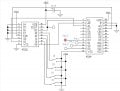
I am making this radio PB circuit using IC 4532 and 4514.
sketch-1719511203444.jpgI use the 7 inputs of CD 4532 I0 to I6 and I7 is grounded. In CD 4514 there are Outputs O0 to O15. I will be using only 7 of them which is O0 to O6. The rest are left open in the circuit shown above. Should there be anything done to set the number of outputs (like connecting O7 to some other pin) or the other outputs can be left open.

Thanks
 

MisterBill2

Joined Jan 23, 2018
27,522
Using two integrated circuits, including the 4514, which may be out of production, is fine, but you will still need interface circuits to drive the loads.
 

AnalogKid

Joined Aug 1, 2013
12,130
A priority encoder creates this possibility:

Switch 1 is pressed.
>> Out1 is active.

While switch 1 is pressed, switch 3 is pressed
>> Out1 goes inactive and Out3 becomes active - even though switch 1 was pressed first and still is pressed. This might not be a problem, but only the TS can say.

ak
 
Last edited:

Thread Starter

sab201

Joined Nov 18, 2023
297
Using two integrated circuits, including the 4514, which may be out of production, is fine, but you will still need interface circuits to drive the loads.
I am not sure about this. Only after I finish constructing the circuit I will come to know. But this circuit seem to be more easy to use than using SPDT switches. Here we are pressing only push buttons that release back and no chances of errors.

What sort of interface circuits do I need for the loads? This circuit only supplies power of few milliwatts at voltage of 5 Volts one at a time to 7 loads depending on the PB pressed. Thanks for all your responses.
 
Last edited:

Thread Starter

sab201

Joined Nov 18, 2023
297
A priority encoder creates this possibility:

Switch 1 is pressed.
>> Out1 is active.
ak
That is what the circuit Mr. Crutschow provided does, right. CD 4532 is a priority encoder and CD 4514 is a latch decoder. I am not an expert in electronics but I suppose this circuit in post #51 should work for switching and interlocking 5 Volts dc supplies.
 
Last edited:

Thread Starter

sab201

Joined Nov 18, 2023
297
While switch 1 is pressed, switch 3 is pressed
>> Out1 goes inactive and Out3 becomes active - even though switch 1 was pressed first and still is pressed. This might not be a problem, but only the TS can say.

ak
These are momentary push button switches. Once pressed and released they do not stay in that position, but they return to their original state using springs. So no chance of switch 1 staying pressed unless there is a malfunction with the switch.
 

MisterBill2

Joined Jan 23, 2018
27,522
I am not sure about this. Only after I finish constructing the circuit I will come to know. But this circuit seem to be more easy to use than using SPDT switches. Here we are pressing only push buttons that release back and no chances of errors.

What sort of interface circuits do I need for the loads? This circuit only supplies power of few milliwatts at voltage of 5 Volts one at a time to 7 loads depending on the PB pressed. Thanks for all your responses.
This points to the other benefit of using switches: The power handling ability. Even the small "ALCO" brand switches are good for over an amp and rated for at least 100 volts. All of that with NO EXTRA CIRCUITRY is a benefit. Having to flip one switch off and then another one on is indeed a bit extra, but it is fool -resistant and a lot less complicated, in addition to using no standby power and having a well defined start-up state.
 

AnalogKid

Joined Aug 1, 2013
12,130
These are momentary push button switches. Once pressed and released they do not stay in that position, but they return to their original state using springs. So no chance of switch 1 staying pressed unless there is a malfunction with the switch.
If there is "no chance", then what is this (post #1):

But incase more than one switch is pushed on accidentally then I want no supply going to the circuits 1 to 7 so that there is only one PWM output at a time and when there is more than one it is avoided.
? ? ?

ak
 

Thread Starter

sab201

Joined Nov 18, 2023
297
If there is "no chance", then what is this (post #1):


? ? ?

ak
I initially planned to use ON OFF switches when I started this thread and wanted to know if there can be an interlock provided using circuit components. Later Crutschow came up with the idea of radio PB circuit using momentary push buttons in post #8 and post #14. I thought of using rotary selector switches then finally I decided to make the radio PB switch circuit so my original plan of using ON OFF SPST was changed to using push buttons.

Initially I had thought of only using SPST switch so I wanted to avoid more than 1 switch being ON accidentally and providing some interlock for it if possible. After I got these ideas in this thread I changed my plans.

I hope I am clear. Thanks for your understanding.
 
Top