Impedance matching in capacitor discharging

Thread Starter

Tutor88

Joined Feb 8, 2023
306
It is not
An efficient way to transfer the energy from the capacitor to the battery is to use an inductor with a diode for resonant charging.
It's rather like a one-shot buck/boost converter.

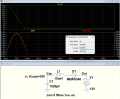
The LTspice simulation below shows the result for a nominal 100mH inductor and a Schottky diode for maximum efficiency.
The inductor stores the capacitors energy while it is being transferred to the battery and the diode blocks any return from the battery back to the capacitor.
The capacitor voltage (green trace) goes from 30V to about -5V (due to the resonant relation between the inductor and capacitor).
The peak current (yellow trace) during the charging is a little over 1.7A.
The energy transferred (red trace) is 423mJ (small Waveform window) from the initial 450mJ stored in the capacitor (of course that doesn't include any circuit/inductor/battery resistances which would reduce that some).


View attachment 289231
Interesting. So with an adjustable inductor, (I’m sure they must exist in textbooks if not in suppliers) one can tweak it for the greatest energy transfer.
 

BobTPH

Joined Jun 5, 2013
11,566
You don’t need an adjustable inductor, look up buck converter to understand how they work.

To get all of the energy out of the capacitor, you need a buck / boost converter so it can continue to operate when the capacitor voltage is lower than the battery.
 

crutschow

Joined Mar 14, 2008
38,552
So with an adjustable inductor, (I’m sure they must exist in textbooks if not in suppliers) one can tweak it for the greatest energy transfer
The value of the inductor is not a big factor in the efficiency of the energy transfer expect when considering the parasitic resistances in the circuit.
A smaller inductor increases the current peak during the transfer, which increases the I²R loss due to those resistances.
The simulation below shows the results for a 10mH inductor instead of the previous 100mH.
Notice that the peak current is higher, with a shorter charge time.
And, as expected, the energy transferred is slightly less due to the stray resistances in the circuit.

Since a small inductor, in practice, may also have a smaller series resistance, than the efficiency difference by going to a smaller inductor may not be significant.
Looking at real inductor values and calculating/simulating the losses would help in selecting the best value.
A suitable inductor could be the primary of a main's transformer, rated for probably 100VA or greater.

1678297244722.png
 
Last edited:

crutschow

Joined Mar 14, 2008
38,552
To get all of the energy out of the capacitor, you need a buck / boost converter so it can continue to operate when the capacitor voltage is lower than the battery.
Look at my circuit in post #17, which does exactly that without the complexity of a buck/boost circuit.
 

Thread Starter

Tutor88

Joined Feb 8, 2023
306
Look at my circuit in post #17, which does exactly that without the complexity of a buck/boost circuit.
Yes it does seem simpler and more ‘elegant’. Tomorrow I will draw it up and try and understand more fully how it works. There is always more than one way to do these sorts of task and I appreciate everyone’s input.
 

crutschow

Joined Mar 14, 2008
38,552
Well it’s mostly for student learning but it would be good to know what would be involved if it were to be built using electronic switches such as MOSFETs.
For that a high-side P-MOSFET could be used with the source terminal connected to the capacitor and drain to the battery.
A low gate voltage would turn it on and a high gate voltage (equal to the capacitor voltage or higher) will turn it off.+
Due to the MOSFET substrate diode, you still need the Schottky diode in series to block the reverse current flow.
 

crutschow

Joined Mar 14, 2008
38,552
Tomorrow I will draw it up and try and understand more fully how it works
Basically the capacitive energy is transferred to the inductance during the resonant half-cycle, which then all ends up in the battery at the end of the half-cycle.
Remember that the total energy in an ideal LC resonant circuit is transferred back and forth between the capacitance and the inductance as it oscillates.
The half-cycle period/frequency is determined by the resonant frequency of the LC series (tank) circuit.
 

Thread Starter

Tutor88

Joined Feb 8, 2023
306
At the risk of my 'drowning' in a sea of competing factors and nuances in electronic theory, in educational mode let me build some form of life raft to keep the sea mist from enveloping me (you can tell it's a grey foggy day where I am) :)
Firstly, with no inductor in the circuit, as per my original one, if the source and load resistances happen to match then that would be ideal for the largest amount of energy transfer (50% efficient). If they don't happen to match (most likely) then trying to lower the ESR of the capacitor is of little consequence since the higher resulting discharge current will incur higher I^2R losses so it becomes even more inefficient. Similarly, it was shown that the efficiency of the transfer is actually independent of the resistances but can be calculated from the ratio of the battery to the capacitor voltages; so increasing the capacitor voltage will also lower the efficiency.

Now with an inductor in the circuit, this form of 'L-type matching' involves transferring the capacitor's energy (with minimal losses) first to the inductor during one-half of its resonant frequency and then onto the battery by the end of that half cycle. While the total energy stored in the capacitor is 450mJ, (30V/1000uF combo), without the inductor being present the capacitor can only drop its voltage to that of the battery at 12V thereby limiting the voltage drop to 18V, and the maximum energy available to 162mJ. The presence of the inductor allows the capacitor to drop its voltage to zero (-5V from the simulation) thereby releasing all of its energy and with a little being lost to heat in the circuit. Is this then perhaps the largest factor in the improved energy transfer when using an inductor?

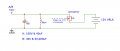
To illustrate some of these principles let's change the source voltage and capacitor to 100V and 40uF (A) and 40V and 50,000uF (B) as shown in the circuit below with a nominal 100mH inductor and the suggested P channel FET as a switch. The resonant frequency of A is 79.6Hz and B is 2.25Hz and the total energy stored in A is 200mJ and for B is 40J (assuming complete discharge). A few queries on this are:

Matching Circuit.jpg

What would the simulator graphs look like?

Are they wildly different in their efficiencies?

How would one tune the adjustable inductor for optimum energy transfer using a scope?
 

BobTPH

Joined Jun 5, 2013
11,566
Firstly, with no inductor in the circuit, as per my original one, if the source and load resistances happen to match then that would be ideal for the largest amount of energy transfer (50% efficient).
Apparently you ignored all the information we supplied in this in this thread.

The efficiency of energy transfer in your scenario depends only on the voltage of the capacitor and the voltage of battery.
 

Thread Starter

Tutor88

Joined Feb 8, 2023
306
Apparently you ignored all the information we supplied in this in this thread.

The efficiency of energy transfer in your scenario depends only on the voltage of the capacitor and the voltage of battery.
Which is what I state in the same paragraph . . . Also read post 8. There are others contributing here too .
 

Ian0

Joined Aug 7, 2020
13,158
Thinking of a switched-mode power supply in terms of impedance matching isn’t going to get you very far.
A switched-mode supply is much more about turning electrostatic energy into electromagnetic energy and back into electrostatic energy at a different voltage.

And, by the way, the purpose of having a low ESR on a capacitor is so that the voltage changes as little as possible when the load changes. Thus avoiding a change of voltage which could disturb other devices connected to the same power supply.
 

Thread Starter

Tutor88

Joined Feb 8, 2023
306
Thinking of a switched-mode power supply in terms of impedance matching isn’t going to get you very far.
A switched-mode supply is much more about turning electrostatic energy into electromagnetic energy and back into electrostatic energy at a different voltage.

And, by the way, the purpose of having a low ESR on a capacitor is so that the voltage changes as little as possible when the load changes. Thus avoiding a change of voltage which could disturb other devices connected to the same power supply.
Ok. Is using the inductor effective for the reason I state, that the voltage drop is greater than without it?
 

Ian0

Joined Aug 7, 2020
13,158
Your inductor is in the wrong place. A buck regulator inductor is Connected alternately between source and load, and between ground and load.
Between source and load makes the current increase, between ground and load makes the current decrease. The controller determines what proportion of the time it spends in each position and thus regulates the current.
Most switched mode supplies avoid resonance, so that the controller decides which way current flows, and doesn’t allow the tuned circuit to decide.
 
Top