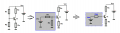
I need your help on CE amplifier

Thread Starter

PaulEngineer

Joined Dec 21, 2016
217
Hi again,

Your second expression is correct, a very well known expression for bipolar transistors. You'll use that many times.
I like taking this slow because it gives us both time to think.

Ok so then the next step so to solve for Ib. That may be a little harder but see what you can figure out.
Just keep in mind that the base to emitter is now a voltage source which we usually set at 0.7 volts for these kinds of problems in this setting, and the base current and collector current add and that makes the emitter current the sum.
Also, only the base current flows through the diode.
See what you think and if it seems too hard dont worry it will get very easy very soon :)
Well the formula is Ib=(Vbb-Vbe)/(Re+Rb(β+1))
 

Jony130

Joined Feb 17, 2009
5,598
Vbb, at least that's how i read it, is the voltage measured from base to ground.
Are you sure? Notice that if we have a voltage divider at the base we can apply Thevenin's theorem

YtdBY.png

And we have:

Vbb = Vcc * R2/(R1 + R2) , Rbb = R1||R2

Thus from KVL:

Vbb = Ib*Rbb + Vbe + Ie*Re

Additional we know that Ie = Ib + Ic = Ib + Ib*β = (β +1)*Ib
Therefore
Vbb = Ib * Rbb + Vbe + Ib*(β +1)*Re
And the base current is:
Ib = (Vbb - Vbe)/(Rbb + (β +1)*Re)
 

MrAl

Joined Jun 17, 2014
13,708
Are you sure? Notice that if we have a voltage divider at the base we can apply Thevenin's theorem

View attachment 274922

And we have:

Vbb = Vcc * R2/(R1 + R2) , Rbb = R1||R2

Thus from KVL:

Vbb = Ib*Rbb + Vbe + Ie*Re

Additional we know that Ie = Ib + Ic = Ib + Ib*β = (β +1)*Ib
Therefore
Vbb = Ib * Rbb + Vbe + Ib*(β +1)*Re
And the base current is:
Ib = (Vbb - Vbe)/(Rbb + (β +1)*Re)

Hello Jony,

We dont need to go there yet it just complicates matters at this point.
The main point i am pushing is that if you know that Vbb is the voltage base to ground, then you can calculate the collector current. Once we get that far, we can look at different biasing methods and how each one works.
Also, if Vbb is base voltage we dont have to know the network yet right?
I appreciate your input just the same though and we will need that next.
 

Jony130

Joined Feb 17, 2009
5,598
We dont need to go there yet it just complicates matters at this point.
The main point i am pushing is that if you know that Vbb is the voltage base to ground
I understand but notice that TS wrote Ib=(Vbb-Vbe)/(Re+Rb(β+1)) we have Vbb and Rb which suggests that Vbb is not the voltage measured from base to ground.
 

LvW

Joined Jun 13, 2013
2,030
I understand but notice that TS wrote Ib=(Vbb-Vbe)/(Re+Rb(β+1)) we have Vbb and Rb which suggests that Vbb is not the voltage measured from base to ground.
More than that, the resistors Re and Rb are swapped.

To all:
May I make a brief and general comment?
The questioner (PaulEngineer) has asked a question about the design of a classical CE transistor circuit (common emitter).
This has now resulted in a long discussion with over 90 (ninety !!) posts.
I am now afraid that the questioner (and other newcomers) might think that this is a very complicated task.
But the opposite is true:
If you know
(a) what you expect from the circuit (specifications) and
(b) that you can/must choose some values (rules of thumb),
the calculation of the individual components is a relatively simple and logical matter.

Therefore, my suggestion: Let`s design such a simple gain stage (resistors R1, R2, Re, Rc) as a demonstration example and calculate real resistor values - starting with a selection of a typical collector current of some mA. (My design approach - five basic steps - is given in post#63)
 
Last edited:

Thread Starter

PaulEngineer

Joined Dec 21, 2016
217
More than that, the resistors Re and Rb are swapped.

To all:
May I make a brief and general comment?
The questioner (PaulEngineer) has asked a question about the design of a classical CE transistor circuit (common emitter).
This has now resulted in a long discussion with over 90 (ninety !!) posts.
I am now afraid that the questioner (and other newcomers) might think that this is a very complicated task.
But the opposite is true:
If you know
(a) what you expect from the circuit (specifications) and
(b) that you can/must choose some values (rules of thumb),
the calculation of the individual components is a relatively simple and logical matter.

Therefore, my suggestion: Let`s design such a simple gain stage (resistors R1, R2, Re, Rc) as a demonstration example and calculate real resistor values - starting with a selection of a typical collector current of some mA. (My design approach - five basic steps - is given in post#63)
I suggest me and MrAI to talk in private. Of course I admire your help of all of you. But if I will not understand how to design something that for other people is considered as a piece of cake, i won't understand anything. To my point of view, all these formulas i provided has a missing information. In example if i won't know how to find the correct values for R1 and R2, then i can't calculate anything, as these values create the Vbb, the Rb and Ib which are the necessary pieces of a jigsaw. And based on these values, almost the big part of other formulas are made.
Ic=β*Ib.
Vbb=Vcc(R2/(R1+R2).
Ib
=(Vbb-Vbe)/(Rc+Re(β+1).
β=Ic/Ib.
Ie=Ib+Ic. Ieq=(1+β)
Rb=(R1*R2)/(R1+R2)

At least these are the ones i found. The marked values are these unknown values i mention. Without them, nothing can be done. At least to my point of view which may be true but may be even wrong.
 

LvW

Joined Jun 13, 2013
2,030
In example if i won't know how to find the correct values for R1 and R2, then i can't calculate anything,
Paul - your answer is a good confirmation of my doubts.
Let me explain:
As I have written - one must know (a) what the circuit must do (specification: gain A) and (b) if this is enough for finding the necessary parts values derived from known formulas.
And the answer to the last item (b) is: NO - this is NOT enough.
Because you must know that, theoretically, there is a set of infinite design options.

In particular: There are no "correct values for R1 and R2" as you wrote.
Instead, you must make the choice between many alternatives for designing a simple voltage divider (low-resistive? ... or high-resistive?....which values?).
"Design" does not mean to simply follow some known formulas - it is something more. This is what I have tried to make clear in my post '63 (five basic steps).
And you will see that the process of fixing some proper values for R1 and R2 is one of the last design steps and not - as you seem to think - the starting point.
 

MrAl

Joined Jun 17, 2014
13,708
I understand but notice that TS wrote Ib=(Vbb-Vbe)/(Re+Rb(β+1)) we have Vbb and Rb which suggests that Vbb is not the voltage measured from base to ground.
Hi Jony,

Yes you are right Vbb is not the base to ground voltage it is the voltage from the other end of Rb not the node where Rb connects to the base. My mistake. In his equation though it was almost right just reversed Rb and Re.
In other words, the base current considering a series base resistor Rb should be:
Ib=(Vbb-Vbe)/(Rb+Re*(B+1))
 

WBahn

Joined Mar 31, 2012
32,873
Ib=(Vbb-Vbe)/(Re+Rb(β+1))

Vbb, at least that's how i read it, is the voltage measured from base to ground.
Always ask if your equations make sense. There are a couple of pretty glaring issues with this one.

First, What (and where) is Rb and how does it get involved with things if Vbb is the voltage at the base?

Second, you are multiplying Rb by (β+1), but it is Re that has a lot more current flowing through it that Rb, so wouldn't it make much more sense for Re to be multiplied by (β+1) instead of Rb?

Don't be afraid to step back and analyze the circuit instead of just chucking formulas against the wall hoping that the right one somehow sticks.

If Vbb is the voltage at the base, then the voltage at the emitter is

Ve = (Vbb-Vbe)

The emitter current is then

Ie = Ve/Re = (Vbb-Vbe)/Re

And the base current would be would be

Ib = Ie/(β+1) = (Vbb-Vbe)/((β+1)Re)

No Rb.

Always ask if the equation makes sense.

IF you have a Thevenin equivalent voltage source, Vbb, with an equivalent resistance of Rb, NOW the value of Rb matters.

If we start with Ib, then we know that

Ve = Ie*Re = (β+1)*Ib*Re

The voltage on the base, Vb is then

Vb = Ve + Vbe

And the base current from the supply is

Ib = (Vbb - Vb)/Rbb

Ib = (Vbb - Ve - Vbe)/Rbb

Ib = (Vbb - (β+1)*Ib*Re - Vbe)/Rbb

Ib = (Vbb - Vbe)/Rbb - (β+1)*Ib*(Re/Rbb)

Ib*[1 + (β+1)*(Re/Rbb)] = (Vbb - Vbe)/Rbb

Ib*[Rbb + (β+1)*Re] = (Vbb - Vbe)

Ib = (Vbb - Vbe) / (Rbb + (β+1)*Re)

Again, always ask if the formula makes sense.
 

WBahn

Joined Mar 31, 2012
32,873
I suggest me and MrAI to talk in private. Of course I admire your help of all of you. But if I will not understand how to design something that for other people is considered as a piece of cake, i won't understand anything. To my point of view, all these formulas i provided has a missing information. In example if i won't know how to find the correct values for R1 and R2, then i can't calculate anything, as these values create the Vbb, the Rb and Ib which are the necessary pieces of a jigsaw. And based on these values, almost the big part of other formulas are made.
Ic=β*Ib.
Vbb=Vcc(R2/(R1+R2).
Ib
=(Vbb-Vbe)/(Rc+Re(β+1).
β=Ic/Ib.
Ie=Ib+Ic. Ieq=(1+β)
Rb=(R1*R2)/(R1+R2)

At least these are the ones i found. The marked values are these unknown values i mention. Without them, nothing can be done. At least to my point of view which may be true but may be even wrong.
But some of them are wrong.

Ic=β*Ib.
Vbb=Vcc(R2/(R1+R2).
Ib
=(Vbb-Vbe)/(Rc+Re(β+1). WRONG -- Rc needs to be replaced with Rb. Why would Rc have such a strong effect on Ib?
β=Ic/Ib. NOTE: This is just the first equation rearranged.
Ie=Ib+Ic. Ieq=(1+β) What is Ieq? If it is a current, how can it be equal to just (1+β), which is just a number?
Rb=(R1*R2)/(R1+R2)

As LvW has stated, you really can't design an amplifier unless you know what the goal of that amplifier are. An amplifier designed to amplify a DC signal, such as from a scale, is very different from an audio amplifier, is very different from an RF amplifier.

Your circuit in Post #5 gives some strong clues. Apparently this is for amplifying audio signals.

How much gain do you want at the audio frequencies? That is a major factor in the design of the amplifier. Without knowing that, you really can't go any further.

Once you have that, you can proceed provided you make a couple of assumptions. One is that the signal source has a very low output impedance and second is that the load on the output has a very high input impedance. If these are not good assumptions, then you need to take those into account in your design.
 

Thread Starter

PaulEngineer

Joined Dec 21, 2016
217
But some of them are wrong.

Ic=β*Ib.
Vbb=Vcc(R2/(R1+R2).
Ib
=(Vbb-Vbe)/(Rc+Re(β+1). WRONG -- Rc needs to be replaced with Rb. Why would Rc have such a strong effect on Ib?
β=Ic/Ib. NOTE: This is just the first equation rearranged.
Ie=Ib+Ic. Ieq=(1+β) What is Ieq? If it is a current, how can it be equal to just (1+β), which is just a number?
Rb=(R1*R2)/(R1+R2)

As LvW has stated, you really can't design an amplifier unless you know what the goal of that amplifier are. An amplifier designed to amplify a DC signal, such as from a scale, is very different from an audio amplifier, is very different from an RF amplifier.

Your circuit in Post #5 gives some strong clues. Apparently this is for amplifying audio signals.

How much gain do you want at the audio frequencies? That is a major factor in the design of the amplifier. Without knowing that, you really can't go any further.

Once you have that, you can proceed provided you make a couple of assumptions. One is that the signal source has a very low output impedance and second is that the load on the output has a very high input impedance. If these are not good assumptions, then you need to take those into account in your design.
Ib=(Vbb-Vbe)/(Rb+Re(β+1). Im sorry. There was a typo
 

WBahn

Joined Mar 31, 2012
32,873
Ib=(Vbb-Vbe)/(Rb+Re(β+1). Im sorry. There was a typo
No problem. We all make typos. But that actually underscores the need to always be asking if things are making sense at each step of the way (or nearly so). We DO all make typos, and if we don't catch them at the point they are introduced, which is when they are usually most easily spotted as something being out of kilter, then we can very easily proceed to work with a wrong equation and end up with a complete mess that doesn't get caught until either after a lot of work has been wasted or, worse, something gets built and doesn't work.
 

MrAl

Joined Jun 17, 2014
13,708
First ask if the equation that he is about to use makes sense.
It's not really that i just looked at it too fast. We all acknowledged that Rb and Re were swapped.
I think he made progress but with everybody jumping in with different viewpoints there is no way in h... he is going to learn anything because that in itself causes confusion.

@PaulEngineer
If you would like to continue in private i started a private conversation. We could always come back here later. It's up to you though what you want to do so feel free to follow whichever you rather.
 
Top