B-JoJo-S

Joined Jan 3, 2026
607
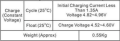
That's less than the recommended charge voltage for that battery.
Use a Schottky diode. One with a lower Vf.

The TS needs 4.52 to 4.6V for a float charge. At least for the data sheet I posted in post #6.

Another alternative is to modify the 5V supply. I did that with a 12V supply. I changed the reference voltage by modifying the resistors that controlled that part of the circuit. Modified it to put out 13.6V. I use that to keep a 12V tractor battery charged and ready to play my car stereo whenever I want. Should power go out I have a fairly large battery capacity, though I can't tell you off hand what that is. Perhaps it's 20Ah. Just a guess without climbing up on the shelving to read it.
 

MisterBill2

Joined Jan 23, 2018
28,588
It is also possible to "modify" a 5 volt supply with just a series resistor. That can reduce the charging current to whatever level is required.
There are all sorts of used 5 volt chargers around, at least where I am. Other locations may differ.
Those living Off-grid in a rain forest may not have as great a selection of available chargers to choose from.
 

B-JoJo-S

Joined Jan 3, 2026
607
Use a Schottky diode. One with a lower Vf.
1N5817 has a 0.45Vf drop. So if you have a 5V WW putting out 5.2V in series with a 1N5817 the total voltage would be 4.75V. That's higher than the recommended float charge of 4.52 to 4.6V. It's only 0.15V higher than the recommended peak float voltage. If you use a 1N5818 with a 0.55Vf then your final voltage would be 4.65. If your WW puts out 5.1V then it's final voltage with 1N5818 would be 4.55V, which is right in the characteristics of the proper float charge for that battery I showed in posts #4 & #6.
Screenshot 2026-11-01 at 7.19.53 AM.png
Source: https://www.amazon.com/dp/B079KDQQPD
 
Last edited:

B-JoJo-S

Joined Jan 3, 2026
607
I would think the TS is interested in having it be the charge voltage, not float.
From post #6
Screenshot 2026-11-01 at 9.20.34 AM.png
This is purely related to the battery I posed in post #4. We don't know (at least I don't recall the TS saying what battery he had other than it's 4V) - we don't know what battery the TS has. Relating to the battery in post #4, it shows the initial charge current at 4.8 to nearly 5 volts at a current of 1350mA. If the battery is not controlled when it reaches 4.96 (again MY posted battery) will eventually dry up and fail from overcharging. Using the float voltage to act as a charger will not dry out the battery. The maintenance free 12V AGM battery in the car is charged to a float of 14V. When the battery is depleted (not fully depleted, just after starting the engine) if the condition of the battery is old and worn it can see voltages as high as 15 volts coming from the alternator. A car alternator can do this. A wall wart can't. It can only produce the 5V (5.1 or 5.2 volts maybe). In order to get a higher voltage either a buck/boost converter could be used OR the 5V sense inside the WW can possibly be modified to produce 5.5V. Then a dedicated charge circuit with logic can control the 4V battery recharge after depletion. But just to maintain the battery at float voltage means it's ready when needed.

I don't recall for certain what the TS is doing with his project. Post #4 battery is for an electric fence charger with a range of 2 miles. I have to look back and see if the TS specifically stated his purpose. For now, I'm comfortable with the idea that holding the battery floating at 4.6V will be sufficient. I will look back and make further comment in a bit.
 

B-JoJo-S

Joined Jan 3, 2026
607
My goal was to keep it exceptionally cheap, cheaper than the ZK 4KX also avoiding huge trade offs.
With R5 = 240 Ω and R2 = 680 Ω , the LM317 output can be set between about 4.5 V and 5.0 V. A 4 V (2-cell) lead-acid battery wants about 4.55-4.6 V for float charging, so the range works.
Bold print my edit
TS is looking for 4.55 to 4.6 volts.
After the 1N5819 drops roughly 0.2 V, the battery sees about 0.2 V less than the LM317 output.
The BC547 turns on at about 0.6 V across Rs, so the limitt is 0.6 V ÷ 3.3 Ω ≈ 180 mA, not 1 A. That’s right for a 1 Ah battery, because charging a small SLA at 1 A would overheat it. I'm Expecting roughly 6-8 hours for a full charge.
The 5819 has a Max Instantaneous Forward voltage @ 1A is 0.6Vf. You stated 0.2Vf. I don't see a need for the LM317 at all. Of course you can engineer it any way you like. But you DID say:
My goal was to keep it exceptionally cheap.
Can't see it being cheaper than a 1N5818 Schottky diode. The more depleted the battery is the higher the initial current will be. The 5818 is rated for 1A at 90˚C. If you're going to have this in a cool climate the amp rating could be higher, though not stated (see post #23)
 

B-JoJo-S

Joined Jan 3, 2026
607
So - what is the exact battery you're using? Before we can answer with any confidence we'd need to know the battery. Read its specs. Unless I missed it - I didn't see a link to a battery.

[edit] How often do you expect to drain the battery with any significance?
 
Last edited:
Top