How To - Build a 6V AC Regulator

MisterBill2

Joined Jan 23, 2018
27,684
The whole point of the shunt regulator is to divert power from the load (the bulb) and into the MOSFETS so that bulbs don't keep blowing.
The HUGE benefit of a switching regulator is that it simply will block the excess voltage and not burn the unused power. A shunt regulator is what those folks in the 1960 era had available. The switching regulator will avoid all of that and avoid the whole problem of the higher voltage being able to cause problems.
Why keep on insisting on using an incredibly obsolete inefficient system???
 

Alec_t

Joined Sep 17, 2013
15,124
Why keep on insisting on using an incredibly obsolete inefficient system?
I'm not insisting on anyone using it. The circuit was suggested as a simple, small, cheap solution for a primitive magneto-powered bike. I agree a switch-mode regulator would be more efficient, but it would be at the expense of greater complexity.
 

MisterBill2

Joined Jan 23, 2018
27,684
I'm not insisting on anyone using it. The circuit was suggested as a simple, small, cheap solution for a primitive magneto-powered bike. I agree a switch-mode regulator would be more efficient, but it would be at the expense of greater complexity.
If an available product can provide the suitable solution then the added complexity within that product should not be a problem. And the improved operation and increased efficiency should be a worthwhile benefit.
 

Alec_t

Joined Sep 17, 2013
15,124
Agreed. But there seems to be a lack of such an available product (at least as far as the biking community is aware).
Can you provide a link to one, or a schematic for one?
 
Leds themselves are dc, a proprietry ac led is probabyl a led with abridge rectifier inside or a diode, or a pair of leds in inverse parallel.
A pair of luxeon leds in inverse parallel might do the trick, but you'd have to hack the original wiring.
 

MisterBill2

Joined Jan 23, 2018
27,684
Leds themselves are dc, a proprietry ac led is probabyl a led with abridge rectifier inside or a diode, or a pair of leds in inverse parallel.
A pair of luxeon leds in inverse parallel might do the trick, but you'd have to hack the original wiring.
LEDs unfortunately seem to mostly have a fairly low reverse voltage handling ability, and also, being diodes, they have a very non-linear voltage to resistance relationship. This means that in every instance there is a need for additional current control and reverse voltage prevention. The reverse voltage protection can be as simple as a series diode, while the current limiting can be provided by a series resistor, the resistance depending on the supply voltage, if the supply voltage is fairly stable.
 

rudio

Joined Jul 10, 2016
4
The whole point of the shunt regulator is to divert power from the load (the bulb) and into the MOSFETS so that bulbs don't keep blowing.
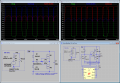
You're definitely right, and this was also my idea: modify the circuit in a way that the MOSFETs open more abruptly, i. e. in that moment when the AC voltage limit is reached. Best effect is achieved by using p-Channel MOSFETs and a TL431 shunt reference:

Snap 2020-03-29 at 12.46.48.png


I used a LT1431 and conneted some of it's pins to emulate the simple TL431.

And finally: the title of this thread was
"How To - Build a 6V AC Regulator"
Several of the last posts left that topic ...

cheers
 

Attachments

MisterBill2

Joined Jan 23, 2018
27,684
You're definitely right, and this was also my idea: modify the circuit in a way that the MOSFETs open more abruptly, i. e. in that moment when the AC voltage limit is reached. Best effect is achieved by using p-Channel MOSFETs and a TL431 shunt reference:

View attachment 202972


I used a LT1431 and conneted some of it's pins to emulate the simple TL431.

And finally: the title of this thread was
"How To - Build a 6V AC Regulator"
Several of the last posts left that topic ...

cheers
Once the purpose of having the regulated six volts was given, which was to light an incandescent light, it became clear that the application gained no benefit from having an AC power instead of DC power. At that point it was clear that converting to DC made a lot of sense.
Consider that with your proposed shunt regulation arrangement every bit of power generated by the magneto is dissipated, either as light or as heat in a shunt resistor. In a switching regulated DC system the only power dissipated is in the light and whatever losses are in the regulator system, which would be much less.
Of course this is a situation where it has probably not been done that way before, and so it would indeed be new and different.
The very first benefit will be that the lights will not all burn out almost immediately if there is a bad connection to the regulator. Probably the cost of a set of six volt replacement lights will be more than the cost of the switching regulator system.
 
Top