How To - Build a 6V AC Regulator

Thread Starter

Lumenosity

Joined Mar 1, 2017
614
Hello folks,
I need a 6V, AC, 5Amp voltage regulator. Maximum current "should be" 3Amps at any time, so 5Amps as a safety margin.
This shouldn't be difficult right?

I can't seem to find one so I was thinking there probably an easy way to make one.

Can anyone guide me along? Best direction to go?

Actually, the input voltage can vary but the ACTUAL voltage after regulation needs to be 7.2v +/-

I said 6v because it is a 6v system

Thanks
 
Last edited:

RichardO

Joined May 4, 2013
2,270
Do I understand correctly that you want an AC output voltage regulated down from an AC input voltage?

What is your input voltage?
 

Thread Starter

Lumenosity

Joined Mar 1, 2017
614
Aren't most motorcycle components DC, just like most car components? What specifically, within the motorcycle, do you need AC for?
Most vehicles use some form of alternator. Cars, motorcycles.
The AC voltage is rectified into DC to charge the battery and run lights.

On many motorcycles and scooters however, AC is actually used to power the headlight directly from the magneto to save weight and space.

As far as I know, there are no vehicles that use DC generators to generate power. other than maybe electric or solar powered vehicles?
 

Thread Starter

Lumenosity

Joined Mar 1, 2017
614
Here is the factory schematic for the 6V regulator. Does this help?
Can this be used to come up with a working design?
I doesn't look all that difficult? What would be the problem?

But isn't that an AC to DC rectifier in there? I was under the impression that AC came in and AC came out of it.
 
Last edited:

Alec_t

Joined Sep 17, 2013
15,101
the ACTUAL voltage after regulation needs to be 7.2v +/-
Is that the RMS voltage or the peak voltage?
What AC load uses '7.2V'?

:confused: I appreciate regulator 3 is a shunt regulator, but I don't see how the circuit shown actually provides regulated AC to 'AC load' 2, when the diode on the right-hand side of the regulator shorts out the magneto coil every other half cycle.
 
Last edited:

Alec_t

Joined Sep 17, 2013
15,101
Here's a simple circuit I designed a year or two back for a biker. He reported it worked for him.
It's a shunt regulator which clamps the AC voltage when its amplitude tries to go above a set level. R1 and R2 set the level. I suggest using a trimpot initially to adjust the level to what you want, then measuring the pot resistance and replacing the pot with a fixed resistor. Depending on the Vgs(thr) threshold voltage of the particular FETS, you may need to tweak R1. Ideally the FETs should be from the same batch. They should be a 'logic-level' type.
Current flows through the body diodes of the FETs and the FETS will get hot, so require a good heatsink. Choose beefy FETs and use insulated mounts for them so that the heatsink(s) can be thermally coupled to the bike chassis to take heat away.
MotorBikeReg.PNG
 

BobTPH

Joined Jun 5, 2013
11,463
Convert to DC, connect a Wien Bridge oscillator to a class D audio amp. Adjust the output voltage with a pot. Amp must be capable of 7.2V into a 1.5 Ohm load. 36W.

Bob
 

Thread Starter

Lumenosity

Joined Mar 1, 2017
614
Alec,
Thanks for this.
I like this solution because it's less expensive (I think) and I understand it (I think).
This was probably designed for a 12v system? If so, do other changes need to be made to use it in a 6V system?

In your diagram the MOSFETS - M1 & M2....
Is the AUIRF prefix the same as just IRF? (or do I need to find an "AU"IRF3205?)

Here's a simple circuit I designed a year or two back for a biker. He reported it worked for him.
It's a shunt regulator which clamps the AC voltage when its amplitude tries to go above a set level. R1 and R2 set the level. I suggest using a trimpot initially to adjust the level to what you want, then measuring the pot resistance and replacing the pot with a fixed resistor. Depending on the Vgs(thr) threshold voltage of the particular FETS, you may need to tweak R1. Ideally the FETs should be from the same batch. They should be a 'logic-level' type.
Current flows through the body diodes of the FETs and the FETS will get hot, so require a good heatsink. Choose beefy FETs and use insulated mounts for them so that the heatsink(s) can be thermally coupled to the bike chassis to take heat away.
View attachment 155764
 
Last edited:
Alec,
Thanks for this.
I like this solution because it's less expensive (I think) and I understand it (I think).
This was probably designed for a 12v system? If so, do other changes need to be made to use it in a 6V system?

In your diagram the MOSFETS - M1 & M2....
Is the AUIRF prefix the same as just IRF? (or do I need to find an "AU"IRF3205?)
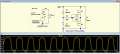
If you zoom int9 Alex's scope image, you'll see the p-p voltage of about 15 volts (and a lot of distortion towards a square wave) so RMS should be close to 6V. If you start blowing headlights, you might need to detune the circuit a bit towards lower voltage.
 

Thread Starter

Lumenosity

Joined Mar 1, 2017
614
Suppose I build Alec_t's circuit and it works and then I want to encase the circuit in an epoxy type resin to waterproof the circuit for use on a motorcycle where moisture could be an issue....

I've seen CDI modules and other electronics encased in some sort of resin (epoxy?) for that purpose.

Any suggestions?
 
Top