How to build a simple dual voltage regulator module?

Thread Starter

anoopak

Joined Nov 24, 2023
77
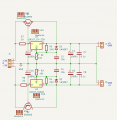
I want to build a to variable 5v to 24V dual dc supply using LM317 and LM337 voltage regulators. I haven't found any good reference article on this. Based on my internet search, I had made a schematic and want to try this circuit in a perfboard.
(a) Whether this circuit will work? Is there any fundamental mistakes is there in this circuit?
(b) Any suggestions to improve safety of the circuit for conditions like input short, output short , regulator internal short etc.
(c) What is the wattage requirement for diodes (D2,D3)
My load is maximum 500mA and there is no degree of freedom for input voltage values.(i.e. It is fixed at +/- 35 dc). This is a large dropout , so i incorporated a bypass NPN transistor to dissipate heat without affecting LM317/LM337.
Dual voltage regulator moduleD.png
 
Last edited:

Jon Chandler

Joined Jun 12, 2008
1,572
You have a problem with power dissipation.

Dissipation in the regulator:

Pd = (Vin – Vout) × i

Pd = (35 – 5) x 0.5 = 15 watts.

You'd need a huge heatsink to dissipate that power. Your options are lower input voltage or lower current.
 

panic mode

Joined Oct 10, 2011
4,947
the problem with linear regulators is heat dissipation when voltage drop is large. say input voltage is 35V and output voltage is 5V. the difference of 30V is massive and reason for heat dissipation. 0.5A * 30V = 15W.
and load only takes 5V*0.5A=2.5W
so to power 2.5W your circuit is drawing 17.5W and 15W are wasted as heat. this is the main reason for existence of switching regulators. energy is stored in inductor and released at low voltage. so even with high voltage difference between input and output, losses are small.

back to your circuit:
Q1 will be fine with nice heatsink. but output voltage will depend on Vbe of the transistor. not a big deal if load is not sensitive
but the negative supply is different story. U2 needs some 2..2.5V to regulate. but that will not happen since transistor Vbe is across regulator, bring this to 0.7V or so. for this to work like U1/Q1, Q2 need to be PNP.
 
Last edited:

crutschow

Joined Mar 14, 2008
38,423
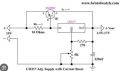
The output regulation of your circuit is compromised due to the way you have connected the power transistors outside the voltage control loop.

To keep the transistor output in the loop and improve the regulation, you can use a circuit such as the one below:
For the LM337 negative output, use an NPN such as the 2N3055.

The Rb value determines how much current goes through the LM317 (<100mA for the 10Ω value shown).

1727809084540.png
 

panic mode

Joined Oct 10, 2011
4,947
true... and those regulators have built in protection.
but at 10W dissipation that is is going to be one hot heatsink unless one uses forced air.
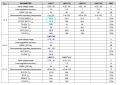
for example this heatsink would raise 90degC above ambient with that load. of room temperature is 24degC, that means 115DegC or about 240F.
https://www.sameskydevices.com/product/resource/hse-bx-04h-01.pdf

if not familiar with heatsink calculations, check this and this:
1727815979832.png
 
Last edited:

Thread Starter

anoopak

Joined Nov 24, 2023
77
The output regulation of your circuit is compromised due to the way you have connected the power transistors outside the voltage control loop.

To keep the transistor output in the loop and improve the regulation, you can use a circuit such as the one below:
For the LM337 negative output, use an NPN such as the 2N3055.

The Rb value determines how much current goes through the LM317 (<100mA for the 10Ω value shown).

View attachment 332829
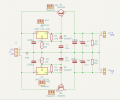
I have modified the circuit. How to take care of Large capacity Caps (C4, 6, 9,10)? Whether a bleeder resistor is required?Dual voltage regulator moduleD.png
 

MisterBill2

Joined Jan 23, 2018
27,359
The circuit in post #12 will provide the good regulation but poor efficiency. One option would be a switching regulator followed by a linear regulator.
Next concern would be if there is a tracking requirement. That matters in DC coupled amplifiers, instrument amps especially. One more thing to be aware of.
 

Thread Starter

anoopak

Joined Nov 24, 2023
77
The circuit in post #12 will provide the good regulation but poor efficiency. One option would be a switching regulator followed by a linear regulator.
Next concern would be if there is a tracking requirement. That matters in DC coupled amplifiers, instrument amps especially. One more thing to be aware of.
Whether LDO can nullify kHz noise in of SMPS out?
 

MisterBill2

Joined Jan 23, 2018
27,359
I did not suggest a two stage, with a linear regulator as the second stage and no filtering. ALWAYS, adequate filtering is required. AND, that seldom consists of one simple shunt capacitor. Certainly noise frequencies above the linear regulator's frequency response must be removed first. Those frequencies are best blocked by an inductive element that provides enough reactance to block the noise while also having a low enough resistance to not cause an unacceptable DC voltage drop. So there is a bit of design effort required.
And I would not count on ANY instrument Amplifier being unaffected by an unbalanced power source.
 
Top