Help needed with Floating Positive Regulator LM723

Thread Starter

Dankov

Joined May 27, 2025
10
Hello,

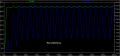
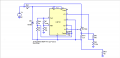
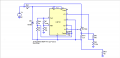
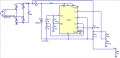
I am trying to make supply which can output 48V and 1A current. I found out that LM723 can output 48V if used in floating state. The things is that I calculated everything but when I use the same value Rz resistor which is in the datasheet of 2kOhms my output drops to 45V. But when I lower it to something like 200Ohms it starts working perfectly but the Zener Diode has too much current running through it. I don't understand what can cause this. The other things is that when I use 2kOhms and I try to get higher output voltage with the R1, R2 resistive feedback I can't move the voltage as it should. I am posting the files I use for the simulations if someone has any ideas I will be happy to hear them.
1765760096107.png
 

Attachments

panic mode

Joined Oct 10, 2011
4,864
wait what..?

this is a linear regulator, and you are using 155V AC input and a full wave rectifier to power it up.
resulting DC voltage is simply way too high) compared to desired regulated output voltage.
why not start with something more reasonable, and regulate it down to 48V?

but since the regulator did work as expected with larger Rz value, the problem seem to be that BJT has insufficient gain.
looking at the specs it is only 55-160 depending on grade.
 

Ian0

Joined Aug 7, 2020
13,097
If you want 48V from a 155V AC input, start with a capacitive dropper to get the voltage down to something sensible, so you don't dissipate so much power in the pass transistor.
 

Thread Starter

Dankov

Joined May 27, 2025
10
wait what..?

this is a linear regulator, and you are using 155V AC input and a full wave rectifier to power it up.
resulting DC voltage is simply way too high) compared to desired regulated output voltage.
why not start with something more reasonable, and regulate it down to 48V?

but since the regulator did work as expected with larger Rz value, the problem seem to be that BJT has insufficient gain.
looking at the specs it is only 55-160 depending on grade.
No the regulator works as expected when Rz has around 200Ohms resistance.On higher resistances it does not work. The high DC
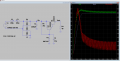
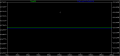
input voltage is because I used a formula I found in one of my university books which gives you the minimum required voltage for the regulator to work: \[ V_{IN}=(V_O+V_{CE_{sat}})/(1-k_p) + V_O \]. Where k_p is pulse coefficient which I use as 10% and I add one Vo because the regulators ground is the output voltage. I am not sure if I am doing this right but in the datasheet of uA723 it should be able to output as high as 200V but I can't seem to make it work. I will post pictures of the output voltage with Rz=200Ohms and Rz=2kOhms (the reason I try 2kOhms is because that is the value used in the datasheet as well as the 36V zener).
1765803114587.png
1765803145825.png
 

Attachments

panic mode

Joined Oct 10, 2011
4,864
the filter capacitor value is too low. try 1000uF or better 2200uF. that should make a massive improvement on the ripple.

for linear regulators you want input voltage to be few Volts higher than output. because if you ignore everything else, Q1 and Rload are essentially in series (those are the parts that see high current). and in series circuit, current is the same but the voltage may be different. basically, regulator adjusts Q1 till output is at desired voltage. you need to have enough of headroom for Q1 so that it can be absorb the difference, but you also want that difference to be reasonably small to reduce heat dissipation For Q1,
Pq1=Vq1*I where V is voltage across Q1, and I is load current.

here is an example open loop variant using capacitive dropper. if you cannot find 50uF .. 68uF non-polarized cap, you can use two larger caps in antiseries. the problem with capacitors is that they have wide tolerances and change value over time. you would want Vin to be some 55V. if it is too low, circuit will work but not regulate. simplest fix is to add 4.7 or 10uF in parallel with one of the line side caps, either C2 or C3.

the bigger problem is that this is not isolated. i would say it is much better and safer to just use transformer, bridge rectifier, filter capacitor and LM317HV...

1765807701458.png
 

schmitt trigger

Joined Jul 12, 2010
2,027
Dankov: Your schematic and your assumptions contain several fatal mistakes. Eric has addressed one of them, I will address another and allow others to point out the others.
If you actually build the circuit, and actually power it up and then apply the rated load, you’ll immediately hear a pop, followed by a hiss, and a bunch of magic smoke coming out from the transistor and IC. Followed by smoke and hissing coming out from the load itself. Very likely, given the available power, a small fire too.

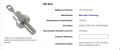
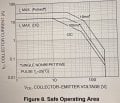
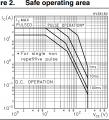
The reason is the transistor secondary breakdown. You’ll be exceeding the safe operating area. See the attached graph. At 1 amp collector current, the transistor can only survive about 80 volts. And the plot is for a single, no repetitive pulse with a case temperature of 25C. Steady state at actual operating temperature it will perhaps be only half of that value, depending on the thermal management.

EDIT: one of the issues of relying solely on simulation without actually reading and understanding data sheets, is that virtual components don’t burn.
 

Attachments

Thread Starter

Dankov

Joined May 27, 2025
10
Dankov: Your schematic and your assumptions contain several fatal mistakes. Eric has addressed one of them, I will address another and allow others to point out the others.
If you actually build the circuit, and actually power it up and then apply the rated load, you’ll immediately hear a pop, followed by a hiss, and a bunch of magic smoke coming out from the transistor and IC. Followed by smoke and hissing coming out from the load itself. Very likely, given the available power, a small fire too.

The reason is the transistor secondary breakdown. You’ll be exceeding the safe operating area. See the attached graph. At 1 amp collector current, the transistor can only survive about 80 volts. And the plot is for a single, no repetitive pulse with a case temperature of 25C. Steady state at actual operating temperature it will perhaps be only half of that value, depending on the thermal management.

EDIT: one of the issues of relying solely on simulation without actually reading and understanding data sheets, is that virtual components don’t burn.

I see. But then can’t I just lower the Zener voltage to something like 15 V? Also, because I suspect the formula I wrote above should add Vz instead of Vo, the minimum input voltage comes out to 69 V. This would make VCEV_{CE}VCE about 21 V and the total power dissipation about 22 W. However, this does not work either.


I understand now that the Zener is really a low-power device, so from now on I will try to simulate with an “ideal” Zener (using .model MYDZ D(BV=15 type=zener)) purely for simulation purposes. But I still have the same problem: the output refuses to go above 45 V.


I am new to this, and I am not sure that I fully understand all of your suggestions. However, if I use an ideal Zener and the power dissipation in Q1 does not exceed 21 W, I don’t see why this should not work.

1765810686035.png
1765810783935.png
 

panic mode

Joined Oct 10, 2011
4,864
yes, 20+ W is expected from linear regulator for high output voltage...

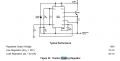
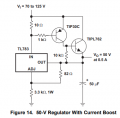
based on IC pinout it looks like you are using TO-100 variant. and other thanadded R11/R12 your circuit pretty much matches reference design for floating positive regulator.
1765814116157.png
Since V1 = 69V, and Vout=48V, voltage across Rz1 and DZ1 is 21V.
But zener voltage of that diode is 36V which is more than calculated difference of 21V.
Therefore zener does not draw any current and should not be getting hot.
how are you testing this? is the load really resistive and really drawing max 1A? did you increase value of the filter cap?
 

ronsimpson

Joined Oct 7, 2019
4,645
In my opinion making a power supply right off the power line is a very bad idea. I have seen Line and Neutral mixed up in too many places. This will get you hurt.
In my opinion using a capacitor drop supply is a bad idea. I have made many and put them in production for very small amounts of power. Doing it with two 100uF 250V caps scares me for many reasons.

Get a transformer of the right voltage and isolate yourself from the power line. Remember a transformer is rated in RMS voltage not peak. A 100V transformer will give you 140Vdc filtered.

I have done the floating LM723 supply. One early supply that is still working on my bench works like that. But I used a transformer to get off the power line for the main power. The I added a very small 12V 50mA transformer just to power the LM723. Connect from V+ to V-. It sets on top of the output voltage. I would get a small "wall wort" supply to power the LM423.
 

Thread Starter

Dankov

Joined May 27, 2025
10
yes, 20+ W is expected from linear regulator for high output voltage...

based on IC pinout it looks like you are using TO-100 variant. and other thanadded R11/R12 your circuit pretty much matches reference design for floating positive regulator.
View attachment 360573
Since V1 = 69V, and Vout=48V, voltage across Rz1 and DZ1 is 21V.
But zener voltage of that diode is 36V which is more than calculated difference of 21V.
Therefore zener does not draw any current and should not be getting hot.
how are you testing this? is the load really resistive and really drawing max 1A? did you increase value of the filter cap?
Oh I didn't know that uA and LM have different datasheets. I though it was only different naming conventions. So that's why on 200 Ohms works.

But still there is the problem with the power of Q1. Because this is for my university project. And they want us to use the formulas in the textbook which finds the minimum required input voltage. But there it is for basic regulators. Not ones with floating ground. That's why I add Vout at the end because Vout is the ground and that's how I get 100+Volts at the input.

This is the reason why I can't increase the filter cap. Because you first assume that the rectifier will have some kind of efficiency in my case i took n=90%, and assume that you want 10% ripple after the filter. Then based on output voltage and current you find some parameters A,B,D,F,H. And from them you calculate the filter.

In the textbook it is shown how to calculate basic regulator. Not floating and I am not sure if the same formulas take place here.
 

Thread Starter

Dankov

Joined May 27, 2025
10
In my opinion making a power supply right off the power line is a very bad idea. I have seen Line and Neutral mixed up in too many places. This will get you hurt.
In my opinion using a capacitor drop supply is a bad idea. I have made many and put them in production for very small amounts of power. Doing it with two 100uF 250V caps scares me for many reasons.

Get a transformer of the right voltage and isolate yourself from the power line. Remember a transformer is rated in RMS voltage not peak. A 100V transformer will give you 140Vdc filtered.

I have done the floating LM723 supply. One early supply that is still working on my bench works like that. But I used a transformer to get off the power line for the main power. The I added a very small 12V 50mA transformer just to power the LM723. Connect from V+ to V-. It sets on top of the output voltage. I would get a small "wall wort" supply to power the LM423.
This is completely my fault that I haven't clarified but. No this is not the power line. This is the output of the second winding of the transformer. I am in europe where Vrms=230V.
 

Thread Starter

Dankov

Joined May 27, 2025
10
55V 3A simple voltage regulator.
60V 1.5A linear voltage regulator HV type.
60V 1.5A note these are HV type not normal!
120V 700mA very simple. By changing to the right transistor this could easy make the 1A you want. There is a way to add current limit if you want it.
View attachment 360577
I can't find the part number right now, but I have some 450V 100mA linear regulators that are no longer in production. The are like the TL783 but higher voltage.
Yes I found other regulators that can work as well but I need to make fallback current protection as well. Which 723 is build in with Rsc R5,R6. But I don't have the knowledge to make it on some other regulator. I found LT3012 which can work as well but still can't think of a way to make fallback current protection.
 

panic mode

Joined Oct 10, 2011
4,864
Oh I didn't know that uA and LM have different datasheets. I though it was only different naming conventions.
there are many parts that are common - and often they get made by different manufacturers. they may have different specs too, different pinout etc.

But still there is the problem with the power of Q1.
what is the problem with power of Q1? if we are talking about efficiency, you can reduce losses by making input voltage only a little bit higher than output voltage.

Because this is for my university project. And they want us to use the formulas in the textbook
i find it odd that university projects would have a textbook. individual courses will have them of course but project is usually something that students choose to do and use to demonstrate skills. also 723 is really old, there are so many implementations already out there. i find it odd that someone would not update or change requirements.

But there it is for basic regulators. Not ones with floating ground.
That's why I add Vout at the end because Vout is the ground and that's how I get 100+Volts at the input.
not sure what you mean there... or why would you want high input voltage and linear regulator. if that is the case, why not use switching regulator?

This is the reason why I can't increase the filter cap. Because you first assume that the rectifier will have some kind of efficiency in my case i took n=90%, and assume that you want 10% ripple after the filter.
you are loosing me... efficiency?
size of cap, line frequency and load current will affect ripple. but i would not conflate filtering efficiency with rectifier efficiency. if your rectifier was 90% efficient, it would get smoking hot. rectifier losses are much better than 10%.

In the textbook it is shown how to calculate basic regulator. Not floating and I am not sure if the same formulas take place here.
i have no idea what book or equations we are talking about so cannot comment.
 

panic mode

Joined Oct 10, 2011
4,864
I need to make fallback current protection as well. Which 723 is build in with Rsc R5,R6. But I don't have the knowledge to make it on some other regulator. I found LT3012 which can work as well but still can't think of a way to make fallback current protection.
fallback = backup plan or alternative when primary plan fails. if you are on a cruise ship that is on fire, primary plan is to get to safety boats. but if that does not work, jumping into water and swimming away from a burning wreck is a fallback option.

current foldback = feature that in case of overload limits output current to a value less than rated.

if you have textbook covering this, it should first explain it based on first principle, and then use practical example such as 723 regulator. you should be able to use first principles and (by adding more components) accomplish the same on any regulator.


ronsimpson

Joined Oct 7, 2019
4,645
Which 723
I have not used that part in 40 years. It worked well years ago.
I would remove Rx1 and DZ1 and put a 12V supply there. (not connected to ground) That solves many problems. I get old cel phone chargers for $1 at the used junk store.
1765819332080.png
As stated before, the safe operating area for the 2SC5200 is shown below. You are just inside the area.
1765819707276.png
 
Top