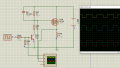
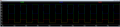
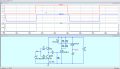
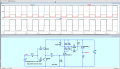
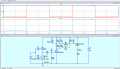
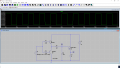
Am I testing this circuit correctly? 100KHZ D=50%
if i make real circuit like simulation is ok? 100KHZ or 50KHZ D=50%
Why is the pulse skewed?how to make it balance again D=50%?
Two more reasons it could be skewed:
Bipolar transistors take longer to switch off from saturation than to switch on, that’s why we use the anti saturation clamp.
The switch-on impedance is 50Ω, but the switch-off impedance is 100Ω, so the gate capacitance charges in half the time it takes to discharge.
but @ericgibbs ’s answer seems the most likely.
If you are satisfied with 3Watt losses….You can use a simulator with real transistors models like LTspice, etc..
It will show you the delay between input pulse (from Mcu) and load current. I prefer the delay to be less than 1/20 of pulse width, but some folks may have no problem with 1/10.
In numbers:
If pulse width is 20us i tolerate a 1us delay.
Also the simulator shows you the mosfet turning off transition, how much switching losses on mosfet you can expect.
Roughly, from my practice with 100 ohms in gate you can go up to 10khz.
Because my MCU code needs to control high speeds, not always 100kHz, but some code segments require it, for example, when I need a delay of 10us to 50us.
Is there a better circuit?
At a glance, the main issue is that the push-pull BJTs (Q11/Q10) feeding the MOSFET gate don’t have a clear, well-defined bias path, so the MOSFET gate may float or switch slowly. The zener (D7) can also clamp too high/too low depending on your intended gate voltage, and R19 = 47 k is far too large for fast or reliable gate pull-up.
If you say what function you expect (level-shift? constant current? soft-start?), I can point out the exact fixes.
hi AK,
This is one method for this circuit, in an actual circuit it would require an S.O.T. [ select on test] selection of one or two of the added components in order to ensure 50/50%.
Please post a complete specification for the project.
E
hi AK.
Are you trying to build a universal circuit that will operate on frequencies of 50Hz through to 100kHz and also have a variable Mark/Space ratio over that full frequency range???
What is the purpose/application of this circuit, how will it be used??
E
This a 50Hz version, note the value of C1 capacitor.
As I posted earlier, some components will require selection for a particular frequency
hi AK,
I am sorry, but I do not understand why you are asking for a 50Hz through 100kHz pulse generator, when you are using a 500Hz scanning frequency.??
hi AK,
I am sorry, but I do not understand why you are asking for a 50Hz through 100kHz pulse generator, when you are using a 500Hz scanning frequency.??
switch(Scanled)
{
case 0: Select_7SEG4_B(1,0,0,0,0,0,0); break;
case 1: Select_7SEG4_B(0,1,0,0,0,0,0); break;
case 2: Select_7SEG4_B(0,0,1,0,0,0,0); break;
case 3: Select_7SEG4_B(0,0,0,1,0,0,0); break;
case 4: Select_7SEG4_B(0,0,0,0,1,0,0); break;
case 5: Select_7SEG4_B(0,0,0,0,0,1,0); break;
case 6: Select_7SEG4_B(0,0,0,0,0,0,1); break;
}
delay_us(150);
Scanled++;
if(Scanled >= 7) Scanled = 0;
TScanled = 0;
}
Select_7SEG4_B(0,0,0,0,0,0,0); anti-ghosting
delay_us(3); // dead-time 3us->20us
If the circuit is stable, we can later create an H-bridge circuit to control the motor.

 Facebook
 Google
 GitHub
 Linkedin