fast horses

Ron H

Joined Apr 14, 2005
7,063
Ok barelracer, I think this should do it for you, the turn on/turn off times of the optocoupler I chose is in microseconds, so the switching times should be pretty fast.....

You can get the optocoupler from here >> http://search.digikey.com/scripts/DkSearch/dksus.dll?Detail&name=751-1342-5-ND

the CDS Photocell I used in my test setup was this one >>http://search.digikey.com/scripts/DkSearch/dksus.dll?Detail&name=PDV-P5001-ND, you might have to double check your laser output to see what it is rated for, this particular CDS is in the 520nm range....


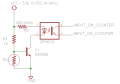
here is the circuit....

View attachment 15791
Are you saying you tested this? The rise and fall times of the photocell are spec'ed in tens of milliseconds. The on resistance is spec'ed as 8kΩ-16kΩ with 10 lux illumination. I have no idea power of the laser is, of course. If the resistance never drops below 8k, you will probably have trouble getting enough current through the optocoupler input to switch it.
 

Thread Starter

barrelracerdad

Joined Jan 29, 2010
92
Hi. when I shoot the photocells I get 18 ohms with the green laser and zero ohm when its off, but the reaction time of my fluke isn't great at all (the LCDs don't change that fast) so I can't measure the rise and fall of the curcuit, but even 10s of milliseconds should produce the result I need. The events last a minimum of 6 seconds (Keyhole race), up to about 18 seconds for a long barrel pattern. I haven't wired the curcuit yet (I just placed the order from digikey now for the optocoupler). One of the other curcuits I gleaned from another site was an anti-bounce curcuit, that would Ignore a repeated signal within a certain parameter (say a second signal within a second or two) If anyone know this curcuit and an easy schematic I may try to incorporate that into the detector. thanks Jon
 

BMorse

Joined Sep 26, 2009
2,675
Are you saying you tested this? The rise and fall times of the photocell are spec'ed in tens of milliseconds. The on resistance is spec'ed as 8kΩ-16kΩ with 10 lux illumination. I have no idea power of the laser is, of course. If the resistance never drops below 8k, you will probably have trouble getting enough current through the optocoupler input to switch it.

It seemed to switch fine to me when I tested it, (Yes I tested it on a breadboard...)
 

BMorse

Joined Sep 26, 2009
2,675
One thing I did notice though BarrelRacer, is that I had the "switch" modes swapped on the first circuit, meaning, when laser is on, the output is low, and when the laser is off, the output is high.... that was my fault I was in a hurry to take my boy to his basketball game so I was not even thinking clear...


I did have to add a couple of other components to the circuit, but they are easy enough to get even at Radio Shack....

here is the new circuit, this one should work the way you want, when the laser is on the photocell, the output stays high, when the laser is blocked, the output goes low.... which is what the counter module calls for on its input..... I am not sure how much the 2N3904 transistor would slow the switch times down.... you will have to do some testing with it, since all I have are red lasers and they are weak! I have a HeNe Laser, but that would just burn the CDS :rolleyes:.....


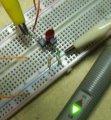
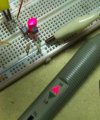
and I also attached a couple of pics showing the circuit with a logic probe attached to the optocouplers output, so people can see it does switch... (the red "thing" on the breadboard is the CDS wrapped with some red heat shrink tubing to block out some ambient light....)
CDS Laser Triggered Optocoupler 2.png

laser trigger off.jpg

Laser trigger On.jpg
 

Thread Starter

barrelracerdad

Joined Jan 29, 2010
92
So this circuit is wired so the optocoupler (I ordered a bag of 10 from Digikey today) will close the switch when the laser beam is broken, does it draw current when not in use? (when the laser is not shining at it) I suppose I can just take out the BAtteries or wire in a switch in line. Did you see my post about the "bounce" curcuit. I don't remember where I saw that curcuit, but it had to do with skateboarding and tape switches. (The front wheels of a board would trigger the timer and it would ignore the rear wheels input signal)Thanks again for your help:)
 

BMorse

Joined Sep 26, 2009
2,675
Do you have the digikey part number of the transistor? I see the 2N3904FS-ND is first on their site?

Yes that should work....

As for the debounce circuit..... I have seen a few based on a 555 timer IC, I will see what I can find or put together for you....

B. Morse
 

BMorse

Joined Sep 26, 2009
2,675
So this circuit is wired so the optocoupler (I ordered a bag of 10 from Digikey today) will close the switch when the laser beam is broken, does it draw current when not in use? (when the laser is not shining at it) I suppose I can just take out the BAtteries or wire in a switch in line. Did you see my post about the "bounce" curcuit. I don't remember where I saw that curcuit, but it had to do with skateboarding and tape switches. (The front wheels of a board would trigger the timer and it would ignore the rear wheels input signal)Thanks again for your help:)

Unfortunately the way the circuit works, is it draws the most current when the laser is off, since the transistor is switched on and the optocoupler would also be "on"...... but the current draw is minimal, but a on/off switch when not in use would be a good idea.

the circuit could change again if a timer for the debounce was incorporated into it, may not need the transistor but it would add a few more passive components (555 Timer, some capacitors, and some resistors, the values would depend on the "time" delay for the debounce) but the debouncing can also be accomplished using an RC circuit (RC = Resistor capacitor circuit....)
 

Thread Starter

barrelracerdad

Joined Jan 29, 2010
92
I don't know if there is a need for the Debounce curcuit, but if the beam is broken by a tall horses legs you would get 4 very rapid triggers. So after I get this thing to work, I may try to glorify the the whole apparatus. This stuff is fun!! (LIke I said, my background isn't electronics, but I can assemble just about anything from anything if I have something to follow) Thanks again, Jon
 

3ldon

Joined Jan 9, 2010
82
4 very rapid triggers
not so rapid... At 60 mph, 4 inches is 3.7msec. or about 1 inch per millisecond. This is within what you wanted to measure.
If the photocell time constant is indeed too long, might look into finding a faster one.
http://www.windmeadow.com/audio < sending audio over a laser beam.
a photo cell is not the same as a light dependant resistor.
 

3ldon

Joined Jan 9, 2010
82
They are the same thing. If he needs more speed, he should use a phototransistor.
If they were the same thing, why do they vary by a few orders of magnitude in rise time?

As evidenced by the tens of schematics that hundreds of people have built, there are several cadium sulphide cells that are good to audio frequencies.

"tens of milliseconds" is on the order of 1x10^2 hz
 

BMorse

Joined Sep 26, 2009
2,675
If they were the same thing, why do they vary by a few orders of magnitude in rise time?

As evidenced by the tens of schematics that hundreds of people have built, there are several cadium sulphide cells that are good to audio frequencies.

"tens of milliseconds" is on the order of 1x10^2 hz

Most of these modulated "Laser" audio transmitters are based around Solar Cells...... Solar cells respond better to audio frequencies than CDS....
 

Ron H

Joined Apr 14, 2005
7,063
If they were the same thing, why do they vary by a few orders of magnitude in rise time?

As evidenced by the tens of schematics that hundreds of people have built, there are several cadium sulphide cells that are good to audio frequencies.

"tens of milliseconds" is on the order of 1x10^2 hz
Photocell seems to be a term that is pretty general, and may include different types of light sensors, but if you do a little Googling, you will find that the terms "photocell", "light dependent resistor", and "photoresistor" are often used synonymously.
The time constant I quoted ("tens of milliseconds") was off the datasheet of the part number quoted by BMorse.
If you want to specify a faster light sensor, I think you have to be more specific than "photocell".
 

Thread Starter

barrelracerdad

Joined Jan 29, 2010
92
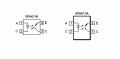
Hi, again, I recieved my order of octocouplers today, but I am having tropuble with the numbering of the pins. I was able to identify pin 1 from the data sheet, but thier illustration was very ambiguous as to the numbering of the other pins. Any help on number order of a sfh610a-2? Thanks Jon
 

Ron H

Joined Apr 14, 2005
7,063
Hi, again, I recieved my order of octocouplers today, but I am having tropuble with the numbering of the pins. I was able to identify pin 1 from the data sheet, but thier illustration was very ambiguous as to the numbering of the other pins. Any help on number order of a sfh610a-2? Thanks Jon
Looks to me like they are numbered counterclockwise, when viewed from the top.
 

AllVol

Joined Nov 22, 2005
55
Hi, again, I recieved my order of octocouplers today, but I am having tropuble with the numbering of the pins. I was able to identify pin 1 from the data sheet, but thier illustration was very ambiguous as to the numbering of the other pins. Any help on number order of a sfh610a-2? Thanks Jon

Here ya go, bro:
 

Attachments

Thread Starter

barrelracerdad

Joined Jan 29, 2010
92
On the data sheet they just numbered 1 and showed a square picture at an angle, I didn't know if the diagram was linking no 1 along the long side or across the short side (the counter clockwise thing helps me out):)
 

hgmjr

Joined Jan 28, 2005
9,027
If you want to get the fastest rise and fall times from your sfh610a opto-coupler then you need to avoid saturating the phototransistor. If you build a classical two transistor current mirror and then use the phototransistor as the current setting element you will avoid saturation. Another benefit of such an approach is that the output transistor in the current mirror allows you to use a large valued resistor without adversely affecting the switching speed of the photo-transistor. This will give you plenty of output signal.

hgmjr
 

Thread Starter

barrelracerdad

Joined Jan 29, 2010
92
:confused:I have this thing wired up by the diagram (I think) but can't get continuity across 3/4 of the octocoupler when I turn it on and hit the Photocell with light (I should get continuity across the outs shouldn't I?)
 
Top