Electromagnet waveform

Thread Starter

cmartinez

Joined Jan 17, 2007
8,762
Found it! I think you did I typo, so I tried a different search and found the TK40E06N1 (toshiba N-FET)... and it's only $0.96 at digikey... nice!
 
Last edited:

Thread Starter

cmartinez

Joined Jan 17, 2007
8,762
Questions:
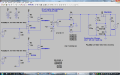
  1. Why did you place a 10K resistor (R7) between V4 and M5's gate, but not between V3 and M4's gate?
  2. Is there a way to protect M1 and M2 in case V4 and V5 stop oscillating and somehow freeze high?
  3. Say I used an NPN bipolar transistor to switch M4, and a PNP to switch M5, and I tied both transistor's gates together, so that they turned on and off in a complementary way, depending on the signal sent to the gate. Would this be wise? I ask this because if the circuit didn't immediately start switching the bipolar's gates then either M4 or M5 would freeze high and M1 or M2, and the transformer would go kappoooothhhh!
I'm mainly interested in the first question. Question's 2 and 3 are just out of curiosity so don't waste your time answering if takes too long.

Thanks!
 

Thread Starter

cmartinez

Joined Jan 17, 2007
8,762
Mhhhh.... I think R7 shouldn't be there... since it's acting as a voltage divider and allowing only 2.5 V from the MCU to reach M5's gate, and since the max VGS(th) of the 2N7000 is 3V, that might cause some trouble.
So maybe I should just remove R7, right?
 

ronv

Joined Nov 12, 2008
3,770
Right you are on all counts.
I think the micro wakes up in tri-state?
So the resistors from gate to source should really be from gate to +5.
Same problem with Q1 on the controller schematic. That one probably won't hurt anything, but we should do it anyway.
Make R10 2.2k to +5 and remove R11.
Now you have 2 things to worry about.
Never leave it in high power and never stop the oscillator. :rolleyes:
You will have to forgive me, I've had a few bad experiences with hangs that resulted in smoke. :D
We could do it in hardware if you like.
 

Thread Starter

cmartinez

Joined Jan 17, 2007
8,762
Right you are on all counts.
I think the micro wakes up in tri-state?
So the resistors from gate to source should really be from gate to +5.
Same problem with Q1 on the controller schematic. That one probably won't hurt anything, but we should do it anyway.
Make R10 2.2k to +5 and remove R11.
Now you have 2 things to worry about.
Never leave it in high power and never stop the oscillator. :rolleyes:
You will have to forgive me, I've had a few bad experiences with hangs that resulted in smoke. :D
We could do it in hardware if you like.
MMMhhhhh... didn't quite get you on the nonexistent R10 and R11... but I think I got what you meant, and here's the file with my mods in it for M4 and M5's gates. But I didn't understand what you meant for Q1 (M1?)
How can protection against oscillator freeze be implemented in hardware? Just curious, you don't have to make a circuit for me... yet.. ha ha ha...
 

Attachments

ronv

Joined Nov 12, 2008
3,770
MMMhhhhh... didn't quite get you on the nonexistent R10 and R11... but I think I got what you meant, and here's the file with my mods in it for M4 and M5's gates. But I didn't understand what you meant for Q1 (M1?)
How can protection against oscillator freeze be implemented in hardware? Just curious, you don't have to make a circuit for me... yet.. ha ha ha...
I was talking about the other schematic for the Q1.
Hardware would probably be a multi-vibrator like a 4047 with complementary outputs.
http://www.alldatasheet.com/datasheet-pdf/pdf/22340/STMICROELECTRONICS/4047B.html
 

Thread Starter

cmartinez

Joined Jan 17, 2007
8,762
I was talking about the other schematic for the Q1.
Hardware would probably be a multi-vibrator like a 4047 with complementary outputs.
http://www.alldatasheet.com/datasheet-pdf/pdf/22340/STMICROELECTRONICS/4047B.html
Very interesting, and very old, chip. So we set it up to a 50% duty cycle, and use pins 10 and 11 to drive the gates of M3 and M4, which will output a pulse width of 4.40*R*C
Your circuit works at 62.5 Hz on the inputs of M3 and M4, so if we want a pulse width of 1/(2 * 62.5) = 8 ms (16 ms total period) then all I have to do is start with a value of C and solve for R, right?
Here's your circuit again, but a bit more de-cluttered, and with the gates of M3 and M4 connected through 2.2K to +5V as you had told me to. M3 is still being driven as you designed it.
 

Attachments

ronv

Joined Nov 12, 2008
3,770
Yes, I think so.
You would need to remove the gate pull up from M4 & M5 because that poor old chip can't drive much current.
 

Thread Starter

cmartinez

Joined Jan 17, 2007
8,762
Yes, I think so.
You would need to remove the gate pull up from M4 & M5 because that poor old chip can't drive much current.
Thanks!... I see that it can sink and source around 1 mA only (when working at +5V). I just hope we won't need to use a driver to drive the small mosfet that drives the larger mosfet... and the new version is so new that digikey doesn't have it available yet. Anyway, its outputs still work at the same low current.
I think this pretty much wraps up the power supply then. I'll start re-studying the solenoid valve driver and get back to you tonight with maybe a few more questions, and a tentative part list.
Thanks again!
 

ronv

Joined Nov 12, 2008
3,770
Thanks!... I see that it can sink and source around 1 mA only (when working at +5V). I just hope we won't need to use a driver to drive the small mosfet that drives the larger mosfet... and the new version is so new that digikey doesn't have it available yet. Anyway, its outputs still work at the same low current.
I think this pretty much wraps up the power supply then. I'll start re-studying the solenoid valve driver and get back to you tonight with maybe a few more questions, and a tentative part list.
Thanks again!
You can run it off the +12 and it will do better.
 

Thread Starter

cmartinez

Joined Jan 17, 2007
8,762
Bear in mind that the 4047 doesn't itself provide a deadband, which would seem essential for your inverter.
Deadband? You mean that a symmetrical squarewave of positive and negative swings needs to be generated? I guess it's clear that I don't know what a deadband is...
 

ronv

Joined Nov 12, 2008
3,770
You would like to have a time where neither of the big FETs were on when they switch. This is called a dead band. If you look close you can see there are some pretty high currents right when the FETs change state. I used the pull up resistors on the 2N7000 to make this a little smaller. The gate of the big FETs have capacitance so you can "tune" the turn on and turn off time to some extent. So when the gate is going positive the gate capacitance is charged thru the 1.8k, but when it goes minus it discharges thru the low resistance of the 7000. The net result is it turns off faster than it turns on. If you want to reduce the current some more you can make the 1.8ks a little bigger, but the high current is only a couple of microseconds long, so not to bad.
 

Thread Starter

cmartinez

Joined Jan 17, 2007
8,762
You would like to have a time where neither of the big FETs were on when they switch. This is called a dead band. If you look close you can see there are some pretty high currents right when the FETs change state. I used the pull up resistors on the 2N7000 to make this a little smaller. The gate of the big FETs have capacitance so you can "tune" the turn on and turn off time to some extent. So when the gate is going positive the gate capacitance is charged thru the 1.8k, but when it goes minus it discharges thru the low resistance of the 7000. The net result is it turns off faster than it turns on. If you want to reduce the current some more you can make the 1.8ks a little bigger, but the high current is only a couple of microseconds long, so not to bad.
Oh... DEADBAND! ... yes, of course I know what deadband is. Remember that english is not my birth language, so there are certain (especially technical) words that I'm not familiar with. But yes, you did mention earlier that the addition of the small mosfets to drive the bigger ones would contribute to prevent them from shutting down and firing up at the same time, adding some "leisure time" (that's my term... :D) between events.
 
Top