Electromagnet waveform

Thread Starter

cmartinez

Joined Jan 17, 2007
8,762
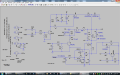
Ok, here's my cleaned up and de-cluttered version of your coil driver circuit.

I have a few questions before I order all parts from Digikey:
  • Can BZX84C12L be substituted for any 12V 1/2W zener diode?
  • I could not find the REP10G (D3) diode, can I use a high speed UF4004-TP diode?
  • Can the IRF9234N (actually IRF9Z34N, I think you did a typo) be substituted for the FQA9P25?
  • Are D6 and D5 a single DPG20C300 diode?
  • I'm getting a strange reading for current flowing through D5, is this normal?
  • What's the rating for R4? is 1W ok?
 

Attachments

Alec_t

Joined Sep 17, 2013
15,119
All those Amps being switched, in both the inverter and the coil driver circuits, are likely to generate some serious RFI unless you include suitable suppression components. I'm no expert in that department, but at the very least I think you'll need chokes in the supply rails and lots of decoupling.
 

Thread Starter

cmartinez

Joined Jan 17, 2007
8,762
All those Amps being switched, in both the inverter and the coil driver circuits, are likely to generate some serious RFI unless you include suitable suppression components. I'm no expert in that department, but at the very least I think you'll need chokes in the supply rails and lots of decoupling.
Thanks for the advice.
I believe that is the reason why @ronv placed C1 and R7, then again I'm not the expert here.
What sort of decoupling did you have in mind?
 

ronv

Joined Nov 12, 2008
3,770
Ok, here's my cleaned up and de-cluttered version of your coil driver circuit.


  • Can BZX84C12L be substituted for any 12V 1/2W zener diode?


  • Yes
    [*]I could not find the REP10G (D3) diode, can I use a high speed UF4004-TP diode?
    Yes
    [quote[
  • Can the IRF9234N (actually IRF9Z34N, I think you did a typo) be substituted for the FQA9P25?


  • I think Digikey has the FQA9P25

    [*]Are D6 and D5 a single DPG20C300 diode?
    Yes
    [*]I'm getting a strange reading for current flowing through D5, is this normal?
    It is an artifact of the simulation. Uncheck the skip operating point under Edit Spice analysis.
    [*]What's the rating for R4? is 1W ok?
    Maybe 5 watt would be better. (Good catch)
[/QUOTE]
 

Thread Starter

cmartinez

Joined Jan 17, 2007
8,762
Yes, Digikey does have the FQA9P25, but can I use the FQA9P25 instead of the IRF9Z34N ? That way we'd end up with two FQA9P25 in the circuit and things would be simpler.
Also, what about @Alec_t 's concern about EMI? Do you think that might be an issue?
 

Thread Starter

cmartinez

Joined Jan 17, 2007
8,762
You're right, R4 is running at 2.0391W RMS ... I didn't measure it right the first time. So yes, I'll use a 5W resistor per your suggestion.
 

ronv

Joined Nov 12, 2008
3,770
Ah, I see. OK I think.
It is going to be a noisy little guy.
Let's add an electrolytic and a ceramic to the center tap of the transformer on the 12 volts.
On the controller we have some on the 12 and 120 volts, but try to have them close to the source of the FETs.
Maybe add another .1 across the op amp.
Edit:
You probably had it right the first time when we had some back emf in there. It probably won't be that high in real life because the current will be lower than what we show now.
 

Thread Starter

cmartinez

Joined Jan 17, 2007
8,762
Ah, I see. OK I think.
It is going to be a noisy little guy.
Let's add an electrolytic and a ceramic to the center tap of the transformer on the 12 volts.
On the controller we have some on the 12 and 120 volts, but try to have them close to the source of the FETs.
Maybe add another .1 across the op amp.
Edit:
You probably had it right the first time when we had some back emf in there. It probably won't be that high in real life because the current will be lower than what we show now.
Ok... great... but I'm adding the electrolytic and ceramic to the center tap of the transformer on the power supply anyway, right? And if so, of what values?
Also, is the FQA9P25 a good substitute for the IRF9Z34N?
And finally, can I use an UF4004 instead of the REP10G (D3) that I can't find anywhere?
 

ronv

Joined Nov 12, 2008
3,770
Yes, It's all good.
Maybe 220 Ufd. and another .1 Ufd. for the caps.
I try to use 105C, low ESR ones. They are more expensive and bigger, but last longer. One of the few electronic parts with life problems.
 

Thread Starter

cmartinez

Joined Jan 17, 2007
8,762
Yes, It's all good.
Maybe 220 Ufd. and another .1 Ufd. for the caps.
I try to use 105C, low ESR ones. They are more expensive and bigger, but last longer. One of the few electronic parts with life problems.
Excellent!
Now I can order the complete set of parts and design the PCB, and then I'll get back to you.
Thank you so much!
 

Thread Starter

cmartinez

Joined Jan 17, 2007
8,762
Yes, It's all good.
Maybe 220 Ufd. and another .1 Ufd. for the caps.
I try to use 105C, low ESR ones. They are more expensive and bigger, but last longer. One of the few electronic parts with life problems.
One last question, what voltage should I use for the caps?
And should I add a TVS for the caps too? Say one with a rating just below the cap's voltage?
 

ronv

Joined Nov 12, 2008
3,770
I would use 200 volt electrolytics on the ones on the 120 volt lines and 25 volts on the 12 volt ones.
I think 200 volt ceramics are fairly inexpensive.

Edit:
No TVS needed.
 
Last edited:

Thread Starter

cmartinez

Joined Jan 17, 2007
8,762
I would use 200 volt electrolytics on the ones on the 120 volt lines and 25 volts on the 12 volt ones.
I think 200 volt ceramics are fairly inexpensive.
Thanks! those same voltages are the ones I had already picked!
The only thing I'm finding kind of difficult is finding affordable 220 µF and 470 µF high reliability electrolytics
 

Thread Starter

cmartinez

Joined Jan 17, 2007
8,762
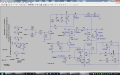
Question, for the RC filter in the coil driver circuit (R7 and C1) you specify values of R7=250 @ 1/2W and C1 of 0.1 µF (and I assume C1 should be rated for at least 150V). I can't find ceramic caps of that value that work at voltages greater than 50V. Can I use a polyester cap of 0.22 µF @ 250V instead? If so, of what value should R7 then be?
Better yet, what's the equation governing the relationship between R7 and C1?
 

Attachments

Top