No, it doesn't have an A2D converter. But we don't really need one, we could use a comparator for that purpose, which we can perfectly adjust in real time using a simple pot configured as a a voltage divider. And if we end up needing an A2D converter anyway, I'm very familiar with several standalone types (8 bit to 16 bits) that we could use. As for the PWM, I know how to generate those pulses, no problem.It doesn't look like it has an A to D converter. You will need one to do the pwm.
Seems plausible. But care would have to be taken that the cut-offs were very brief, otherwise the valve would close prematurely. And if a lower current can still keep the valve open, why not use that lower current throughout the plateau for greater power saving? It's a mystery.Since this machine sometimes works 24/7, my guess is that those small voltage cutoffs are there to keep the valve's coil at a low temperature as possible. And by the way, the plateau in my original measurements has several bumps going to 0 volts
Play some more? Your circuit is working perfectly, at least from my perspective.Hmm, I had forgotten about that one.
It's a stretch, but it might work.
For the inductor - the number after the value is the saturation current. So you need to change that one too.
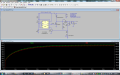
What I did was add a load to see what happens to the voltage when you hit it with the 5 amp pulse for 1/2 ms. As you can see it falls to 0.
The 120 volt supply only needs to deliver about 1/2 the total current the other 1/2 comes from the 12 volts when the 120 is off. Very cleaver.
Anyway I changed the inductor and the frequency to get the current up to recharge a larger cap in 20 ms.
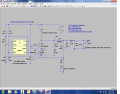
When I did that it needed a delay in the start up because the inductor saturated charging the cap. So I added a delay in the reset line of the 555.
Then the start up current was still to high for the inductor I found, so I added a current limit - 2nd 547.
I'll play some more tomorrow.
Alec, The pwm works on current, so the current is still flowing thru the flyback diode during the off time of the pulse. So it is just on at like 3.3 amps and off at 3.5,
The thing that worries me is that it is kind of on the edge. Notice the voltage doesn't have time to fully recover to it's starting value.Play some more? Your circuit is working perfectly, at least from my perspective.
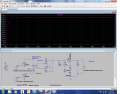
I think I got this a little better, but I would still buy the next size up in the inductor - They say they have 1 in stock.[*]RMS at the inductor is 3.5A, with 9A peaks, except for a peak of 72A in the first few microseconds on startup.
If you look at the average current it's only about 375mw once it is started, so a 1 watt is probably ok. It's purpose is to sense the current thru the FET (and inductor) to keep the inductor from going into saturation and blowing the FET. Once the voltage across it gets above about .6 volts the transistor turns on and holds the duty cycle there to limit the current. So it works the same way as the other one except for current instead of voltage.[*]R8 seems to be dissipating 3.4A RMS, that's about 1.16W (right?) so a resistor of at least 2W (preferably 5W) is in order (right?) What's R8's purpose, anyway?
Good idea.[*]Shouldn't we add a TVS to M1 to protect it a bit?
Yes, they have one good for 15 amps before it saturates.Yup... startup is definitely better, peaking now at only 40A.
What do you mean pick a larger size inductor? You mean larger in its current handling capability?
OMG... you're the man! ha ha ha... let me study it more carefully, and then I'll get back to you with some questions.Yes, they have one good for 15 amps before it saturates.
But have a look at this one.
Post deleted
Thanks... also, the sim is taking forever to run in LTspice
| Thread starter | Similar threads | Forum | Replies | Date |
|---|---|---|---|---|
| A | Electromagnet | General Electronics Chat | 92 | |
| R | Electromagnet Turns And Same Field generated?? | General Electronics Chat | 5 | |
| S | Electromagnet wpt magnetic core | General Electronics Chat | 59 | |
| B | Super capacitors for electromagnet? | Power Electronics | 27 | |
| E | Building an electromagnet | General Electronics Chat | 3 |