EHT power supply design and construction

<<link to latest version of current tutorial>>

1) The product is described as 'Fiberglass, Silicone Elastomer' (Emphasis added) -- Good?, Bad?, Non-issue???
We're G to G if glass is the only adulterant! Clamping range might suffer though.
I have been unable to locate a source for > 250μm stock?
Ok, well.. There appear to be two formulations. We've tested the "blue". Your exhibit is a sample of the "gray". It's a question in need of further investigation for sure.

Example of acceptable capacitors -- inexpensively purchased new or readily salvageable (in good condition) from multi-killowatt power conversion systems (e.g. inverters/UPSs).
Are those capacitors salvaged from the 8 KVAR UPS your ex picked up last weekend? Or simply Mouser stock? Crazy but, for the count, used industrial electrolytic capacitors (pulls) score higher on the reliability index.

Because you and Theo (especially you) persist in belabouring the issue!
Yeah, well.. Thanks for qualifying that. I haven't "belabored" anything! @HP, in case you missed it, my allusion to my VPN was an explanation for early publication of our findings (Re: silicone HT matting). So I don't know how it was growing up in Duluth and "Old Blighty" but back in "my little town" (Chicago;)) we have a word for keeping stakeholders up to speed with changes in plan! Namely, courtesy! Give it a whirl sometime! Who knows? You might even like it!

I've connected through Zenmate's gratis HK location most of the day and experienced zero difficulty!
Ah! That explains the flagged e from you! You should know that all web access (including items sent with your OS anchored mail client) is through the VPN! And I don't know anyone in Hong Kong!:D If VPNs were restricted to browser traffic they'd hardly be worth the bother under the best conditions!

I'll be back with you as soon as I research the 'blue'-'gray' silicone conundrum.

Thanks!
 
<<link to latest version of current tutorial>>

Ok, well.. There appear to be two formulations. We've tested the "blue". Your exhibit is a sample of the "gray". It's a question in need of further investigation for sure.
I'll be back with you as soon as I research the 'blue'-'gray' silicone conundrum.
@theodoravain, @Aleph(0) et al -- While your and your team's not inconsiderable efforts and undeniable progress in this matter are greatly appreciated -- IMO it's time we move on! -- Over two years' experience and your study amply demonstrate that the relevant properties of PTFE exceed our (immediate) requirements!

But then it seems I'm preaching to the choir?:cool:

Yeah, well.. If you ask me, what you're in need of is Anafranil. Well then, @HP? Who knows? Maybe your obsession with perfection...
HP like I'm saying that's basically Theo's bid! So since ur asking my opinion I say PTFE isn't perfect but it's as good as it gets for material easily sourced in small qtys!
But hey! Your efforts weren't/aren't in vain (npi)! -- Spacer material selection will be revisited where warranted by increased stringency/criticality of application (e.g. LOPTs, drive splitters/combiners, etc...)

Please note -- This is not by way of a 'mandate' -- merely a strong suggestion! -- Thoughts?

Best regards
HP:)
 

Thread Starter

Aleph(0)

Joined Mar 14, 2015
597
IMO it's time we move on!
Over two years' experience and your study amply demonstrate that the relevant properties of PTFE exceed our (immediate) requirements!
HP all I can say is AMEN:cool:!
Now I SO hope that's 100% recovery from tutorial's horrendoma of choking on choke:rolleyes:!

HP So I say we'll be on with it just as soon as YOU move rationale for winding & gaping instructions to public view and add it to tutorial! Also since non-resonant Royer has already been introduced as test circuit all you need are practical instructions plus a few more pics to finish up lopt tutorial:)!

Spacer material selection will be revisited where warranted by increased stringency/criticality of application (e.g. LOPTs, drive splitters/combiners, etc...)
HP I agree cuz temp and chemical properties will be way more important for that:)!
 
<<link to latest version of current tutorial>>

Re: Reluctance gap spacer material discussion
HP all I can say is AMEN:cool:!
HP So I say we'll be on with it just as soon as YOU move rationale for winding & gaping instructions to public view and add it to tutorial!
Thank you!:cool:

As a matter of courtesy I think it only fair that we first hear from @theodoravain prior to proceeding-- (Inasmuch as she and her team have invested significant time and effort researching spacer material selection) --effort which will be most valuable later in the series!--

Re: Low EMF PSU inrush management:
@Aleph(0) While your suggestion of a current-triggered scheme (whereby the ballast-resistance is bypassed at such time as mean current falls below a preset value - and, hence, more 'precisely' accommodates varying states of filter cap charge/formation) has undeniable merits -- It would seem to suffer from the principal objection to my phase-sync/requiter circuit (apart from my circuit's neglect of filter-inrush) -- To wit:
fewer semiconductors = more bulletproof:)!
;)

Hence my proposal of a basic timing circuit consisting of 'bone-generic' components (e.g. a 'tweakable' monostable lm555 circuit, a 2n222 relay driver, and a real [i.e. electro-mechanical] relay as the bypass switch) -- Note that the requirement of an 'active timer circuit' owes to the desirability of 'zero' off-time latency...

Very best regards
HP:)
 
Thanks for that, HP! Well.. As you know I just can't find any spare time before the weekend. Get back with you then.

Thanks!
Hey Theo - Thanks for the post!

To be clear -- My proposal is merely that we fabricate the 'choke' and LOPT reluctance-gap spacers from PTFE sheet stock for the nonce - then revisit our (curiously:confused::rolleyes:) convoluted 'quest' for 'the optimal spacer material' when it matters! -- Granting that the LOPT spacers could be argued to 'matter', IMHO the rather low clamping force involved render said consideration a non-issue?...

Best regards
HP:)
 
<<link to latest version of current tutorial>>

Update:


Kind friends, avid readers, casual lookers-on and otherwise 'interested' parties.

Please be advised that the 'EHT Tutorials' project is on a brief hiatus pending @Aleph(0)'s, @theodoravain's (and several other Core Development Team member's return from holiday, etc... -- At which time we (i.e. the CDT and AT) will have a face-to-face 'conference' thence continue series development here (and on ProvoSrv):)

I apologize for any inconvenience/annoyance owed our sporadic --I daresay, at times, even 'syncopated'-- conduction this effort! -- 'Tho I'm bound to confess that my 'attendance record' affords me little room for criticism of others!:oops:

In our defense I point to the fact that our S/N (i.e. on-topic to off-topic) 'ratio' has improved radically over the last few months:cool:

See y'all mid July!

Best regards and many thanks for your patience!
HP:)

PS
Despite my dubiety as regards necessity - feedback would seem to demand the following:

By 'Core Development Team' (aka CDT) we refer to the 'central' (tutorial series) development staff -- as opposed to dedicated proofers, testers, etc... --- FYI, CDT staff active on AAC include @Aleph(0), @theodoravain, @Jazz2C, myself and certain others not wishing to disclose their usernames (could it be my breath?:oops:;)).

Significantly: 'Core Development Team' does NOT reference a 'team' charged with 'development' of magnetic cores!:rolleyes:

That said: 'ESLers' and others legitimately labouring under said misapprehension please be advised that you have our sincere apologies!:)
 
Last edited:
@theodoravain

Theo, While I fully understand that you are 'keeping tabs' here (via 'lurk mode') pending our return to full posting activity -- I respectfully request that you occasionally logon that your continued interest/involvement in this effort remains evident to those 'outside the loop' as it were (e.g. certain members of the Alpha Team, etc...) --- Thanks!:)

Best regards
HP:)
 
<<link to latest version of current tutorial>>

@theodoravain

Theo, While I fully understand that you are 'keeping tabs' here (via 'lurk mode') pending our return to full posting activity -- I respectfully request that you occasionally logon that your continued interest/involvement in this effort remains evident to those 'outside the loop' as it were (e.g. certain members of the Alpha Team, etc...) --- Thanks!:)

Best regards
HP:)
Yeah! Sorry about that! Well, I lurk here at least once a week. Not much to do until you and Julie bring it back, though!

Getting back to the choke spacer
@theodoravain, @Aleph(0) et al -- While your and your team's not inconsiderable efforts and undeniable progress in this matter are greatly appreciated -- IMO it's time we move on! -- Over two years' experience and your study amply demonstrate that the relevant properties of PTFE exceed our (immediate) requirements!
HP all I can say is AMEN:cool:!
As a matter of courtesy I think it only fair that we first hear from @theodoravain prior to proceeding-- (Inasmuch as she and her team have invested significant time and effort researching spacer material selection) --effort which will be most valuable later in the series!--
My proposal is merely that we fabricate the 'choke' and LOPT reluctance-gap spacers from PTFE sheet stock for the nonce - then revisit our (curiously:confused::rolleyes:) convoluted 'quest' for 'the optimal spacer material' when it matters! -- Granting that the LOPT spacers could be argued to 'matter', IMHO the rather low clamping force involved render said consideration a non-issue?...
Well you know I'm cool with letting material selection slide for now but..

HP So I say we'll be on with it just as soon as YOU move rationale for winding & gaping instructions to public view
Hey look @HP! I know you're afraid of spooking mathphobes but no need! I don't know anyone scared of middle school algebra and anyway you're not asking anything of them! It's just "Hey, in case anyone is interested, here's how I arrived at the figures".

Thanks!
 
Re: Decoupling inductor design exposition:

Hey look @HP! I know you're afraid of spooking mathphobes
Well indeed I am -- but hardly with that!?:confused:

I don't know anyone scared of middle school algebra and anyway you're not asking anything of them!
Exactly!:)

The delay owes merely to finding time for some minor re-writing/proofing in deference to 'science-phobes' --Which being in no way a 'dumbdown' -- merely a bit of 'de-jargoning', as it were:)

Please expect it here (along with my 're-wind' demo of @Aleph's toroid on her thread in Power Electronics) on or prior to the weekend (ie. Ca. Jul 14)!:)

Very best regards
HP:cool:
 
Which being in no way a 'dumbdown' -- merely a bit of 'de-jargoning', as it were:)
Wonder where I heard that before?:p:D:rolleyes:o_O
Hi, Shortbus:)

I have some insight into this (@HP, other team members and I have discussed it at length).

So here's an explicit example of the sort of thing she's talking about:

HP said:
"μ0='Magnetic Constant' (i.e. permeability of free space) [H/m]"


So she defined "magnetic constant" for the benefit of readers unfamiliar with the term but who otherwise comprehend the subject matter. Sure it's a tough call! Though, in my opinion, it's a clarification of terms, not a "dumb-down".

Thanks!
 
@The Electrician @Aleph(0) @HP

Yeah, ok I'm a magnetic imbecile so in keeping with that theme here's a pragmatic suggestion:eek: We could do this with a single 3 position switch.

1. Off (line disconnected).
2. Ballasted (line connected through a resistor in series with the variac).
3. On (resistor shunted, o/c you know it's vital the resistor is actually shunted without interruption of power to the variac)

Well now there are two obvious expressways to f'upsville;
1. Prolonged ballasting = overheated resistor.
2. Abbreviated ballasting = excessive inrush.

So.. Use of a line-voltage incandescent lamp as the ballast resistor (for inherent burnout immunity and visual inrush current indication) sounds like the fix. How about it?

Thanks!
Here's a reasonable solution to the surge problem using a single rotary switch. This switch actually has 11 positions, but we need use only the first 3. The contacts are rated for 12 amps, but it has two decks and we can parallel the contacts on the two decks to get a 24 amp capability:

https://www.digikey.com/products/en?keywords=360-3042-ND

and a suitable knob: https://www.digikey.com/products/en?keywords=1722-1145-ND

Halfway down the page showing the rotary switch there's an attribute called "Contact Timing" whose description is "Shorting (MBB)". That's the property I described as make-before-break. This guarantees that the resistor will be shunted without interrupting the power to the variac.

Prolonged ballasting won't matter if there is no load on the DC output of the power supply and the ballast resistor is a 10 to 20 watt resistor. To take care of the case where the switch is left in the ballasting position with a substantial load on the output of the power supply, connect a 1 amp slow blow fuse in series with the ballast resistor, and tell the user "Don't do that!".

Abbreviated ballasting shouldn't be a problem since as I showed in the other thread the surge only occurs at the 300 amp level for the very first pulse. Subsequent current pulses are an order of magnitude smaller, and won't cause a problem. The first large surge is over with in a few milliseconds and it shouldn't be possible to turn the switch fast enough to short the ballast resistor before the surge is over unless one is attempting deliberate high-speed sabotage! ;)

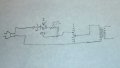
Crude schematic:

Antisurge.jpg
 
Last edited:

shortbus

Joined Sep 30, 2009
10,049

Thread Starter

Aleph(0)

Joined Mar 14, 2015
597
Here's a reasonable solution to the surge problem using a single rotary switch. This switch actually has 11 positions, but we need use only the first 3. The contacts are rated for 12 amps, but it has two decks and we can parallel the contacts on the two decks to get a 24 amp capability:

https://www.digikey.com/products/en?keywords=360-3042-ND

and a suitable knob: https://www.digikey.com/products/en?keywords=1722-1145-ND

Halfway down the page showing the rotary switch there's an attribute called "Contact Timing" whose description is "Shorting (MBB)". That's the property I described as make-before-break. This guarantees that the resistor will be shunted without interrupting the power to the variac.

Prolonged ballasting won't matter if there is no load on the DC output of the power supply and the ballast resistor is a 10 to 20 watt resistor. To take care of the case where the switch is left in the ballasting position with a substantial load on the output of the power supply, connect a 1 amp slow blow fuse in series with the ballast resistor, and tell the user "Don't do that!".

Abbreviated ballasting shouldn't be a problem since as I showed in the other thread the surge only occurs at the 300 amp level for the very first pulse. Subsequent current pulses are an order of magnitude smaller, and won't cause a problem. The first large surge is over with in a few milliseconds and it shouldn't be possible to turn the switch fast enough to short the ballast resistor before the surge is over unless one is attempting deliberate high-speed sabotage! ;)

Crude schematic:

View attachment 156460
Electrician Tnx:)! That's basically what we had in mind except to use timer and EM relays cuz that way we can also compensate for filter cap and load inrush (fwiw I give more detail abt that here).

So two definite requirements:
◊1 Like you're saying ballast has 2b just bypassed (or bypassed b4 it's disconnected) at close of ballast interval cuz even just brief disconnection of xfmr from line would put it back to Sq. 1 with inrush!

So that's easy to do by just connecting relay for N.O. across ballast resistor so it closes after interval elapses.

◊2 One-shot has to be _monolateral_ by which I mean ballast bypass enable signal needs to remain _reset_ following power-up during _ballasting interval_ but be INSTANTLY reset on power down!

So o/c that's no problem to implement with an active monostable config EXCEPT that noise immunity is totally necessary cuz PSU _cutting out_ cuz of noise causing _restarting_ of inrush protection circuit would be totally too annoying and maybe dangerous in some situations!

So anyhow it gives me something to think on:)


@Hypatia's Protege, @Aleph(0) , @theodoravain , and the rest of your team.


While looking for something else in my old "print" McMaster-Carr catalog, guess what I found? Mica available and inexpensive!! In many small thicknesses, starting at 0.004 inches. Link to the web page of all they carry - https://www.mcmaster.com/#mica-sheets/=1ds4kyl
Shortbus HUGE tnx! Mineral rel-gap spacers are totally perfect! So now all we need is good way of cutting and shaping it. Maybe grinding with fine grit emery board type tool (like just Dremel cut off wheel) or Al2O3 tools? Cuz when u think on it, mica is basically just stone so jeweler's techniques are prolly the solution:) Anyhow super kudos finding that! Cuz we looked everywhere for sheet mica in vain:oops::)

Now just so everybody knows what's going on, I've extended my vacation for a few more weeks (So it's not really a _vacation_ but it's how they say _a change is as good as a rest_:cool:) So I'll prolly be scarce around here until sometime next month but HP should be back at it soon and Theo checks in on a regular basis.

So this is important! For ppl who want to reach us but don't have our home email addys you can contact us through @theodoravain from this site but since she lurks more than logs in plz post message to her here on EHT thread cuz o/c guests don't have access to PM and don't receive alerts! So if you want to PM her plz make sure to notify her that you left her a PM with post on here:cool:!
 

shortbus

Joined Sep 30, 2009
10,049
Shortbus HUGE tnx! Mineral rel-gap spacers are totally perfect! So now all we need is good way of cutting and shaping it. Maybe grinding with fine grit emery board type tool (like just Dremel cut off wheel) or Al2O3 tools? Cuz when u think on it, mica is basically just stone so jeweler's techniques are prolly the solution:) Anyhow super kudos finding that! Cuz we looked everywhere for sheet mica in vain:oops::)
I wasn't even looking for it! That is why I keep my decades old print catalog, sometimes they call things by a different name and having it in print allows me to look around till I find something. For some reason the mica just jumpped out at me off the page.

While mica is a mineral/stone it is one of the softest. Down around talc if I recall right. So just standard cutting tools will work, scissors, exacto knives what ever. If I was doing this, I'd try the one they call flexible or muscovite mica first.
I've used mica for a window in an old wood burner I restored and it was the raw mineral type, pretty crumbly and flaky to work with but that is what was used in the old days.:)
 

Thread Starter

Aleph(0)

Joined Mar 14, 2015
597
While mica is a mineral/stone it is one of the softest. Down around talc if I recall right.
Shortbus so ur saying mica is on hardness index of like soapstone and American jade? That's good to know cuz only _hard rock_ I can get passionate in good way abt is music genera:D!

So just standard cutting tools will work, scissors, exacto knives what ever. If I was doing this, I'd try the one they call flexible or muscovite mica first.
Shortbus tnx for advice abt mica variety which we'll definitely be heeding:)!

So abt scissors and knives, only thing I'm worried abt with that is like _ply separation_ so I know that sounds like I'm confusing mica with tires:oops::D but being totally serious cuz mica is basically like onion or maybe more like planar _Russian doll_ I say we'd have to keep areas we don't want removed under compression (so I'm asking for your advice and input not arguing!):)?

I've used mica for a window in an old wood burner I restored and it was the raw mineral type, pretty crumbly and flaky to work with but that is what was used in the old days.:)
Shortbus fwiw they use it for windows in portable kerosene stoves too:)
 

shortbus

Joined Sep 30, 2009
10,049
So abt scissors and knives, only thing I'm worried abt with that is like _ply separation_ so I know that sounds like I'm confusing mica with tires
While I haven't used it, that muscovite mica sounds like it may be some type of a mica composite to get around the layering/flaky problem with natural mica. A quick Google shows that it is natural, not a composite after all, the most common form of mica.

https://en.wikipedia.org/wiki/Muscovite
 
@HP
RE: Design of the low voltage power supply.
How about, instead of a 30 millifarad shunt capacitance, intervene the 15 millifarad caps with a choke (to make a PI-section filter)? For the choke, electrically paralleled pri/sec windings of a 15A, 120V, 1:1 metallic iron-core toroid would turn the trick (as I understand it, the paralleled windings' inductance would equal that of a single winding due to their strong mutual coupling).

According to "common wisdom" (and Manu Lit) such a transformer optimizes at 300-400mA magnetizing current. So we're looking an inductance of around 1H. 750Ω (bridge output is 120Hz pdc) is good medicine for bad ripple! Yeah! Well.. I guess saturation is my personal reality check, huh?

Just playing with what's left of my braino_O

Thanks!
 
Last edited:

Thread Starter

Aleph(0)

Joined Mar 14, 2015
597
@HP
RE: Design of the low voltage power supply.
How about, instead of a 30 millifarad shunt capacitance, intervene the 15 millifarad caps with a choke (to make a PI-section filter)? For the choke, electrically paralleled pri/sec windings of a 15A, 120V, 1:1 metallic iron-core toroid would turn the trick (as I understand it, the paralleled windings' inductance would equal that of a single winding due to their strong mutual coupling).

According to "common wisdom" (and Manu Lit) such a transformer optimizes at 300-400mA magnetizing current. So we're looking an inductance of around 1H. 750Ω (bridge output is 120Hz pdc) is good medicine for bad ripple! Yeah! Well.. I guess saturation is my personal reality check, huh?

Just playing with what's left of my braino_O

Thanks!
Theo I totally agree that would give way better ripple attenuation but you're missing a vry important point of LVPSU design critera which is economy for builders!

I guess saturation is my personal reality check, huh?
Theo I say filter-choke core saturation wouldn't be big issue in that circuit using component ur describing but basically asking them to buy 2 xfmrs (one for pwr xfmr and another for filter choke) is exactly the type of thing our polls say can chase readers off at early stage! Some ppl are vry fussy abt vry small expenses so it's good to meet them on their own turf when we can do it w/o compromising projects! So LVPSU doesn't have 2b supper filtered! Just bullet-proof, continuously voltage-variable high current DC supply! Load circuits needing vry low ripple voltage will have their own _on board_ regulators so no problem:)!
 
Top