Optimizing MOSFET Thermal Dissipation in 120W AC-DC Power Supply PCB Design

Thread Starter

MattPosner89

Joined Dec 11, 2025
7
Hello everyone,


I’m with XJK Power, where our engineering team is designing a 120W AC-DC power adapter PCB.


Currently, we’re focused on thermal management challenges related to the placement of two N-channel MOSFETs (rated 30V, 20A) used in the primary switch stage. The PCB is a 4-layer board with the following stack-up:


  • Top layer: Components and high-current traces
  • Inner layers: Ground and power planes
  • Bottom layer: Signal routing

Our current layout places the MOSFETs close to the transformer with thermal vias under the MOSFET pads connecting to a large copper pour on the inner layers.


The MOSFETs dissipate around 8-10W each under typical load, and we want to avoid bulky heat sinks for cost and size reasons.


My question:
What are the best practices or design techniques for optimizing MOSFET placement and PCB thermal vias to maximize heat dissipation in this scenario? Are there recommended copper pour sizes, via counts, or thermal pad designs that have proven effective in similar 120W power adapters?


We have followed general guidelines from datasheets but would highly appreciate any practical insights, example layouts, or advice from your real-world experience.


Thanks very much!

MOD NOTE: Company link removed.
 
Last edited by a moderator:

ronsimpson

Joined Oct 7, 2019
4,645
Please show us the layers in the PCB.
Please show your pads for the hot MOSFETs. (include VIAs)
What is the input voltage? " 120W AC-DC power adapter " you are using " 30V, 20A" transistors on the primary?
Transformers usually run hot, they block airflow, and your transistors are near the transformer. I also do that, but it is hard.
" The MOSFETs dissipate around 8-10W each ", " 120W power adapters" You are losing 16 to 20 watts in the MOSFETs plus maybe 10 watts in the transformer and more power in diodes and inductors. What is your efficiency? Power in and power out.
 

MisterBill2

Joined Jan 23, 2018
27,159
Certainly Ron asks good questions. Here are more: How much heat is your multi-layer PCB able to dissipate to the surrounding air??
If your transistors are ever in the linear mode, not saturated or cut-off, they are producing a lots of heat and they need actual heat sinks.
 

Irving

Joined Jan 30, 2016
4,996
You;d be well advised to move the ground plane to both top and bottom layer (min 2oz) and put power and signal routing (1oz) on internal layers. PCB heatsinks critically rely on heat transference to air and you won't get much of that from an internal layer. Size and distribution of thermal vias is also critical. I found the recommendations in this TI paper helpful.

Having said that, 16 - 20W losses in a 120W PSU seem rather excessive; I would expect no more than 12 - 15W losses in total. Could you share your schematic and component values for critique?
 

Thread Starter

MattPosner89

Joined Dec 11, 2025
7
You;d be well advised to move the ground plane to both top and bottom layer (min 2oz) and put power and signal routing (1oz) on internal layers. PCB heatsinks critically rely on heat transference to air and you won't get much of that from an internal layer. Size and distribution of thermal vias is also critical. I found the recommendations in this TI paper helpful.

Having said that, 16 - 20W losses in a 120W PSU seem rather excessive; I would expect no more than 12 - 15W losses in total. Could you share your schematic and component values for critique?
Thank you very much for your insightful advice and for pointing me towards the TI paper — I’ll definitely review it in detail. Moving the ground plane to both top and bottom layers with 2oz copper sounds like a good approach, and separating power and signal routing to internal 1oz layers makes sense for reducing thermal resistance.


Regarding the losses, I appreciate your observation. We are currently seeing around 16-20W losses, which does feel a bit high, so I’m very interested in any feedback on our design that might help reduce this. I’m happy to share the schematic and component values for your critique. Would you prefer me to upload the full design files or just a simplified version focusing on the power stage?


Thanks again for your help!
 

Thread Starter

MattPosner89

Joined Dec 11, 2025
7
Certainly Ron asks good questions. Here are more: How much heat is your multi-layer PCB able to dissipate to the surrounding air??
If your transistors are ever in the linear mode, not saturated or cut-off, they are producing a lots of heat and they need actual heat sinks.
Thanks for the questions. Our PCB uses 2oz copper on both top and bottom layers with thermal vias to improve heat spreading. We know PCB cooling to air is limited, so we’re considering additional heatsinks and airflow optimization.


The MOSFETs are designed to operate fully in switching mode to avoid linear losses, but we’ll verify gate drive signals to prevent any linear operation.


If you have recommendations on heatsink integration or via patterns for better thermal performance in 120W adapters, I’d appreciate your input.
 

Thread Starter

MattPosner89

Joined Dec 11, 2025
7
Please show us the layers in the PCB.
Please show your pads for the hot MOSFETs. (include VIAs)
What is the input voltage? " 120W AC-DC power adapter " you are using " 30V, 20A" transistors on the primary?
Transformers usually run hot, they block airflow, and your transistors are near the transformer. I also do that, but it is hard.
" The MOSFETs dissipate around 8-10W each ", " 120W power adapters" You are losing 16 to 20 watts in the MOSFETs plus maybe 10 watts in the transformer and more power in diodes and inductors. What is your efficiency? Power in and power out.
Thanks for your questions. Due to confidentiality, I can’t share detailed PCB info right now. We follow standard practices with multi-layer boards and thermal vias for 120W adapters. Any general tips or references on MOSFET placement and cooling are welcome. Appreciate your understanding!
 

ronsimpson

Joined Oct 7, 2019
4,645
I can’t share detailed PCB info right now.
This makes it very hard. Can you share the area around the MOSFETs.
Any general tips or references on MOSFET placement and cooling are welcome.
Some of us do not follow general tips from a book that is old. I also do not follow what manufacturing knows from their old book.
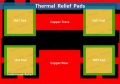
Example, for high power and high heat, I do not use "thermals" on any hot part. I want the heat to go from the part, from the lead, to the copper, then move out and away. Thermals are made to keep the heat in the lead.
1766065016822.png
Most of my boards, all layers are 90% copper. I use wide traces if the heat is high or the current is high.
Maybe I can send some pictures today.
RonS.
 
Top