Power supply design using centre tapped transformer

Thread Starter

Eartian

Joined Sep 16, 2021
58
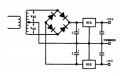
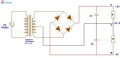
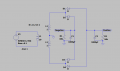
Hey all, I was wondering can we design positive and negetive rail power supply using 4 diodes and a centre tapped transformer? It worked on lt spice and just wanted to know in real life how exactly it is done or is it bad or good. As of now I am not considering about the filtering or voltage or current. Just considering bout the rectification method. Can some one guide me here? thank you
1756480755375.png
 

Attachments

jaclement

Joined Apr 15, 2009
60
works fine . use a potted bridge rectifier for convenience which may show ac input and + ,- outputs, but your ohm meter will show you the right ports.
 

MrChips

Joined Oct 2, 2009
34,714
It is called a full wave bridge rectifier with centre tap transformer.
All you have done is set the 0V reference to the middle of the output voltage range.

1756482526295.png
 

MrAl

Joined Jun 17, 2014
13,686
Hey all, I was wondering can we design positive and negetive rail power supply using 4 diodes and a centre tapped transformer? It worked on lt spice and just wanted to know in real life how exactly it is done or is it bad or good. As of now I am not considering about the filtering or voltage or current. Just considering bout the rectification method. Can some one guide me here? thank you
View attachment 355033
That looks right. The only thing you have to check is the ground connection if you have an imbalance in the plus and minus output loads.
 

MrAl

Joined Jun 17, 2014
13,686
And how is that related to the "ground connection"?
Obviously you always need a low impedance ground for any power supply, whatever its design.
It would depend on the external connections. If the ground reference changes it could be a problem for circuits. I think audio circuits are affected because of this, maybe because of the so-called 'hum' problem. I'll see if I can find an example.
 

crutschow

Joined Mar 14, 2008
38,423
It would depend on the external connections. If the ground reference changes it could be a problem for circuits. I think audio circuits are affected because of this, maybe because of the so-called 'hum' problem. I'll see if I can find an example.
Okay.
But I don't see how this problem is unique to this dual supply configuration. :confused:
 

MrAl

Joined Jun 17, 2014
13,686
Okay.
But I don't see how this problem is unique to this dual supply configuration. :confused:
Well for one, if we had two separate windings and four diodes for each winding, we could run the positive of one to the ground and from the negative of the other to the ground, and that ground can be a mile away from the two sets of diodes. With a center tap, the ground is common immediately out of the transformer, and we can't separate it without separating the common connection inside the transformer. With some CT transformers you can actually do this though, and I've done it before to create two separate windings although they are still magnetically coupled (depending on the degree of coupling).
I suppose we could possibly get away with it if we separate the two windings and run the two leads separately to the four diodes. I'm not sure if that would solve all the problems though.

We should really do some simulations I guess to find all the possible problems. I can't remember how this works exactly except that part above. For example, without having two actually separate transformers (not just separate windings) does that solve any net DC problems or at least improve that.
 

crutschow

Joined Mar 14, 2008
38,423
if we had two separate windings and four diodes for each winding, we could run the positive of one to the ground and from the negative of the other to the ground, and that ground can be a mile away from the two sets of diodes. With a center tap, the ground is common immediately out of the transformer, and we can't separate it without separating the common connection inside the transformer.
True.
But you can make the center-tap the single-point ground for both voltages, and then the only factor affecting the two voltages would be the unbalanced current into the center-tap winding resistance.
Since the two voltages would typically go to voltage regulators, I don't see how that likely small voltage change would be a problem.
 

MrAl

Joined Jun 17, 2014
13,686
True.
But you can make the center-tap the single-point ground for both voltages, and then the only factor affecting the two voltages would be the unbalanced current into the center-tap winding resistance.
Since the two voltages would typically go to voltage regulators, I don't see how that likely small voltage change would be a problem.
If I understand you correctly, that's not the way power circuits work. Power circuits have to have very carefully laid out ground connections. It's like when using digital and analog together the grounds have to be carefully planned out. If you have the common ground over there and the power draw over here, then there is a drop in the ground lead. If you wait to place the common ground over here then every circuit has the same ground.
It probably does not matter if the loads are balanced, but if the loads are not balanced then there could be a different voltage drop for each section.

I think it would be better to do some simulations than just talk about it because sometimes it is hard to visualize this kind of thing without drawing a circuit and working it all out. I'll try to get to that soon.

Audio circuits in high quality stuff are more particular than a lot of other circuits are, except maybe those with high resolution ADC components.
 

MrAl

Joined Jun 17, 2014
13,686
And again, if the voltages are regulated from each rectified output, then I don't see it as a problem.
...and if they aren't regulated? Just a thought though.

I'll see if I can get to a simulation to see what actually happens. I have other things ahead of that through right now.
 
Top