EHT power supply design and construction

shortbus

Joined Sep 30, 2009
10,049
Everyone please! If you must use wire brushes stay with large bristle diameters in all cases - and never-but-never use on or near food handling areas/appliances!
Just assuming here. Your working in an emergency room? Or removing said bristles from a digestion system? I always leave the grill part in the cooker to burn up any food that's stuck and then use a standard "paint scraper " type brush to clean it off. Usually comes off with little or no exertion since the residue is just 'charcoal' at that point.
 

Thread Starter

Aleph(0)

Joined Mar 14, 2015
597
I always leave the grill part in the cooker to burn up any food that's stuck
Shortbus I say that's excellent idea cuz besides making it easier to clean, those high temps also totally kill pathogens and denature their toxins:)! But I agree with HP that it's dangerous to use any kind of bristle brush on food prep equipment cuz it's just not worth the risk:eek:!

A highly vocal and disruptive minority are questioning the necessity of an isolation transformer following the variac. That is, they don't see the value of line isolation. My detailed explanation of the safety and versatility issues leaves them cold!
As would an earth-referenced output/load at mains potential in the hands of a newbie (following a brief 'hot-flash', as it were);):rolleyes:
ROFLMAO:D!


( @Aleph(0) ) is very busy vacationing (by any description):rolleyes:
Theo I say now your greenhouse needs glazier too cuz you have totally paid REAL vacation from June to September of every year:p!

Ditto for 'light guide' panels used in Dell CCFL displays:)
HP when u have it done plz post pix of high current rectifier/filter circuit mounted to acrylic panel! Cuz ppl are asking and like you say pic can be worth way more than just description:cool:!
 
HP when u have it done plz post pix of high current rectifier/filter circuit mounted to acrylic panel! Cuz ppl are asking and like you say pic can be worth way more than just description:cool:!
I'm not certian I understand your request? Do you wish me to post images of the assembled rectifier and filter 'board' prior to publication of the LVPSU 'TIHIDI' -- Can do, but...?:confused:

Very best regards
HP:)
 

Thread Starter

Aleph(0)

Joined Mar 14, 2015
597
I'm not certain I understand your request? Do you wish me to post images of the assembled rectifier and filter 'board' prior to publication of the LVPSU 'TIHIDI' -- Can do, but...?:confused:
HP that's right! They just want to see how it's all mounted on acrylic panel! So I told them how u used single heatsink for negative end of bridge (so anodes connected together) and two heatsinks for positive end to avoid using insulating hardware which would be PITA for diodes with 3/4" anode mounting studs:)!

HP I say it's vry good u made b4 and after pix of positive end heatsink cuz some ppl didn't believe me that you just cut it in half to get two! So Plz post those pix too:cool:!
 
HP that's right! They just want to see how it's all mounted on acrylic panel! So I told them how u used single heatsink for negative end of bridge (so anodes connected together) and two heatsinks for positive end to avoid using insulating hardware which would be PITA for diodes with 3/4" anode mounting studs:)!

HP I say it's vry good u made b4 and after pix of positive end heatsink cuz some ppl didn't believe me that you just cut it in half to get two! So Plz post those pix too:cool:!
Good deal! -- Upon completion of assembly, I'll 'up' a few images of the conversion deck as well some detail images illustrative of heat-sink prep -- That said, comprehensive description must needs await the TIHIDI -- There are just so many hours on the clock/pages in the calendar/grains of sand in the hourglass or what have you!:rolleyes:

Best regards
HP

PS -- Next time you're on please check my comments to your 'feedback' post (Re: uploading difficulty)...
 

Thread Starter

Aleph(0)

Joined Mar 14, 2015
597
@Hypatia's Protege

Ok so you're totally not going 2 believe this but I told team abt source for 20Ω 250W metal jacketed resistor you found for _startup ballast_ but consensus is that just $300 is too expensive:rolleyes:!

HP I'm sry but between totally skinflint baby readers and non-responsive AAC admin (Re: upload problem) my patience is totally used up on this site and this project! So abt tutorials my advice to you is to just do projects for ppl who are interested enough to divert some of their _beer money_ to parts!

Anyhow I'm out of here for right now until I get my patience back cuz its like they say _if you can't say anything nice, keep your peace_ and now I'm definitely on verge of saying things I know I'd regret:(!
 

cmartinez

Joined Jan 17, 2007
8,788
Ok so you're totally not going 2 believe this but I told team abt source for 20Ω 250W metal jacketed resistor you found for _startup ballast_ but consensus is that just $300 is too expensive:rolleyes:!
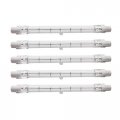
Aleph, halogen bulbs such as these have an impedance of between 3.8 and 4.0 ohms (I know, because I just measured it) and 5 of them (connected in series, of course) will cost you a bit short of $10.00 dlls in Amazon:

41OZSFTvrPL.jpg

Of course, the impedance will change once they heat up a bit. But it might not matter, because you want them only for startup purposes, if I'm not mistaken.

Word of advice: Speak no ill of beer money! ... the holy consumption of fermented barley is sacred for some of us! ... do not tread in vain into a discussion of the economics of spirits without an exceptionally good reason! ... :p:D

Hope my suggestion helped ... the one about the light bulbs, that is ... ;)
 
Last edited:

Thread Starter

Aleph(0)

Joined Mar 14, 2015
597
Aleph, halogen bulbs such as these have an impedance of between 3.8 and 4.0 ohms (I know, because I just measured it) and 5 of them (connected in series, of course) will cost you a bit short of $10.00 dlls in Amazon:
Cmartinez huge tnx:)!

Of course, the impedance will change once they heat up a bit. But it might not matter
Cmartinez that's not problem at all! Actually it's saving grace cuz it means builders only need one lamp for ballast resistor cuz it's just to hold current to safe level when variac and isolation xfmr basically act like dead short during initial magnetizing from zero-crossing startup! So using lamp, worst case would be same as lamp inrush which is totally acceptable. So as example for 120V service, 300W lamp would limit current to like 2.5A (300W/120V) once up to temp and 30A lamp inrush (120V/4Ω) is way too short to cause damage cuz incandescent flood lights which use that type of lamp usually have just 10A switch:) So lamp is basically _swinging resistor_ which has advantage of automatically adjusting to soften inrush demand of not just xfmrs but filter and load cuz greater current demand = greater ballast (lamp) resistance over range of like 4Ω cold to like 48Ω (120V^2/300W) full temp. Also being totally practical, lamp would prolly last life of builder (even vry careful builders;)) cuz even 100W incandescent just briefly flickers to like 1/4 power brightness during worst case startup! So I say life of linear incandescent like ur suggesting could last as long as high quality pwr resistor:cool:!

do not tread in vain into a discussion of the economics of spirits without an exceptionally good reason! ... :p:D
Cmartinez ur funny but being totally serious I shouldn't have shamed ppl for economics at all:( Cuz I say it's basically same as politics and anyhow it was our decision to make courses and projects accessible to broad range of ppl of different skill levels and financial means!

So I totally apologize to ppl who were offended by my remarks cuz I know for some ppl just $300 isn't trivial at all and going on like that just makes me look like spoiled brat:oops: I totally promise that ALL interested ppl are totally welcome! So as just explanation (but definitely NOT excuse) my 'tude was just cuz of my having lousy week making me impatient abt everything:oops:

Hope my suggestion helped
Cmartinez it definitely has:)!
 

Thread Starter

Aleph(0)

Joined Mar 14, 2015
597
The "austerity army" strikes again.:)
Shortbus UR funny but just to explain, _austerity cult_ (who actually call themselves after _Samaritans_) is totally JC's so called problem:rolleyes:! Cuz they're definitely not around here where I live! Cuz around here ppl don't object to offers of payment for _good deeds_ and they're not shy abt asking either:eek:!

So anyhow I absolutely agree that my whiny post 1563 was totally lame cuz I was involved with decision to make courses accessible to ppl with vry limited funds and I'm still totally committed to that:)!

So being clear it's ppl who have plenty of resources but still insist on saving pennies at expense of time and quality that were annoying me! But even for them my attitude was wrong cuz part of my _mission_ here is making courses and projects comfortable and inviting for prospective participants which definitely doesn't mean getting _snippy_ when my idea of a bargain doesn't match theirs:oops:!

So thanks to @cmartinez we have full-quality alternative for ppl who don't want to just buy pwr resistor:)!
 
Kind friends

Please note -- the following represents a grossly 'over-engineered' rectifier/filter unit! -- My motives for same being ease of 'up-grade' to higher current/EMF operation (via mere re-fitting of larger/multiple isolation transformers).

The reader may rest assured that a PSU capable of 30A at 50V (intermittent) will be quite satisfactory for all projects in this series! -- Note also that (as demonstrated by @The Electrician) high current handling capability may be attained via paralleling of commonly available 'potted' bridge rectifier modules (current 'equalization' being achieved by adjustment of interconnecting lead length)...

Furthermore, please be advised this post is offered merely as a highly cursory 'pictorial' illustrating physical construction of the 'AC to DC conversion assembly' -- I plan a 'TIHIDI' on the entire Low EMF Linear PSU (aka 'LVLPSU') featuring detail/discussion)...

HP that's right! They just want to see how it's all mounted on acrylic panel! So I told them how u used single heatsink for negative end of bridge (so anodes connected together) and two heatsinks for positive end to avoid using insulating hardware which would be PITA for diodes with 3/4" anode mounting studs:)!

HP I say it's vry good u made b4 and after pix of positive end heatsink cuz some ppl didn't believe me that you just cut it in half to get two! So Plz post those pix too:cool:!
Very well -- To begin at the beginning:

The drilled 'magic' perspex panel (magic because it can be casually drilled, sawed, etc sans fracture) -- Note that while @Aleph(0) 's panels were salvaged from Acer monitors I've discovered that those from Dell products are equally 'workable':cool:


Appearance of the 'converter board' following mounting of the rectifier components but prior to installation of the filter.


Detail of the diode protection components
(i.e. transient bypass capacitors across each diode and an MOV across the bridge input) - Owing to diode geometry, 'close mounting' of the caps was not possible - hence my expedient of Ag plated 'strip-line' conductors with the aim of reducing interconnection inductance and resistance...


Side view of assembly
(offered as perceptual aid).


Appearance of converter board following mounting of filter components.


Image of the surface (aluminium chassis) to which the assembly will be mounted.


Assembly placed upon chassis well-nigh as it will be mounted... (BTW Yes! that is a variac seen to the left - No! it will not be directly connected to the converter assembly -- please relax!:D


(Attempt) to illustrate converter board to chassis clearance.


Another (attempted) interstitial view


Rough schematic of completed converter circuit.


HP I say it's vry good u made b4 and after pix of positive end heatsink cuz some ppl didn't believe me that you just cut it in half to get two! So Plz post those pix too:cool:!
Here ya go!:)

Before:


And after...


And of course this presentation would be incomplete sans images of the 'under appreciated' resistor having cost @Aleph(0) her (ostensible) amiable nature (albeit temporarily):p


Aleph, halogen bulbs such as these have an impedance of between 3.8 and 4.0 ohms (I know, because I just measured it) and 5 of them (connected in series, of course) will cost you a bit short of $10.00 dlls in Amazon:


Of course, the impedance will change once they heat up a bit. But it might not matter, because you want them only for startup purposes, if I'm not mistaken.

Word of advice: Speak no ill of beer money! ... the holy consumption of fermented barley is sacred for some of us! ... do not tread in vain into a discussion of the economics of spirits without an exceptionally good reason! ... :p:D

Hope my suggestion helped ... the one about the light bulbs, that is ... ;)
an excellent suggestion indeed!:) - -And one I'm certain will relieve many readers of cost and sourceability issues -- many thanks!:cool:
One (minor) caveat -- all incandescents are copious IR emitters - a consideration of little to no significance as regards the proposed application - unless untill 'do-do' happens (i.e. a failure in the ballast-bypass circuitry causes protracted lamp illumination) -- hence my suggestion that the lamp be mounted in a segment of 3/4" Dia aluminium tube stock...

Gotta dash!

Very best regards
HP:)
 

cmartinez

Joined Jan 17, 2007
8,788
And of course this presentation would be incomplete sans images of the 'under appreciated' resistor having cost @Aleph(0) her (ostensible) amiable nature (albeit temporarily):p
A minor observation: I strongly advise you use a $300.00 dlls bill to properly orient the target reader as of the true economic scale of this last post of yours ... otherwise, a $10.00 dlls bill will serve just fine as a proportional reference to my suggestion ... :D:p
 

shortbus

Joined Sep 30, 2009
10,049
The drilled 'magic' perspex panel (magic because it can be casually drilled, sawed, etc sans fracture) -- Note that while @Aleph(0) 's panels were salvaged from Acer monitors I've discovered that those from Dell products are equally 'workable':cool:
Are you sure you mean "Perspex"? Isn't perspex the same as acrylic/plexiglas? Again coming from my years in the machine trade, acrylic will shatter when you put too much pressure on it while drilling or when you bolt something to it. Wouldn't "polycarbonate" or "Lexan" be the better choice in this? and Lexan is getting easier to find in the hardware stores now over plexiglas. https://www.homedepot.com/b/Buildin...stic-Sheets-Polycarbonate-Sheets/N-5yc1vZc9ws

Also is there as reason that you need a Dale type resistor? Wouldn't a regular wire wound resistor ,like the more common 'corrib' type work? They are much easier to find and cheaper in the surplus market. And they are both wire wound. https://www.ohmite.com/280-series/
 
Are you sure you mean "Perspex"? Isn't perspex the same as acrylic/plexiglas?
Correct! -- The panels test as acrylic (Re: 'burn tests', etc...) -- then too (as noted by @Aleph(0)) there's no mistaking that 'acrylic odour' when cut or heated (à la freshly polymerized 'Super Glue')...

Again coming from my years in the machine trade, acrylic will shatter when you put too much pressure on it while drilling or when you bolt something to it.
Such has long been my experience as well (Re: 'building-center grade' acrylic):mad: -- Hence my reference to LCD 'light guide' panels as 'magic acrylic':)

Wouldn't "polycarbonate" or "Lexan" be the better choice in this?
I must agree that polycarbonate is practically perfect in most every way;) -- but then our readers are demanding economy - and obsolete monitors are cheap (often free) and abundant:)

FWIW discovery of 'light-guide grade' acrylic's favourable properties (over 'standard perspex') was a bit of a 'happy accident' -- Please see this thread for specifics including analysis procedures, etc...:)

Also is there as reason that you need a Dale type resistor?
I grant that it's largely down to aesthetics/personal preference:oops: - But then, on an objective note, I like the 'built-in' heat sink and inherently lower IR/fire risk -- That said, wire wound are perfectly acceptable granting well-considered mounting location/practice:) -- It goes without saying that, at the frequencies involved, inductance is a non-issue...

So cast Al cased resistors are termed 'Dale style'? - Thanks for that!:)

Very best regards and many sincere thanks!
HP:)
 
A minor observation: I strongly advise you use a $300.00 dlls bill to properly orient the target reader as of the true economic scale of this last post of yours ... otherwise, a $10.00 dlls bill will serve just fine as a proportional reference to my suggestion ... :D:p

While the jocular intent of your remarks does not escape me -- I am, nonetheless, intrigued:cool:

How's about this:

Our preferred component choice (15 US $20 banknotes [i.e. $300] included for monetary perspective)...


---VS---


Your (excellent) suggestion of a linear incandescent lamp (US $1.80 [i.e. the cost of a single lamp] included for monetary perspective)...


Um... I begin to see your point:oops:o_O

Chastened and rebuked (well, rebuked anyway;))

Very best regards
HP:D
 
Last edited:

cmartinez

Joined Jan 17, 2007
8,788
While the jocular intent of your remarks does not escape me -- I am, nonetheless, intrigued:cool:

How's about this:

Our preferred component choice (15 US $20 banknotes [i.e. $300] included for monetary perspective)...


---VS---


Your (excellent) suggestion of a linear incandescent lamp (US $1.80 [i.e. the cost of a single lamp] included for monetary perspective)...


Um... I begin to see your point:oops:o_O

Chastened and rebuked (well, rebuked anyway;))

Very best regards
HP:D
:D ... thanks for the laugh ... you've made my day... have yourself a most excellent weekend :)
 

shortbus

Joined Sep 30, 2009
10,049
But then, on an objective note, I like the 'built-in' heat sink and inherently lower IR/fire risk
Not really. The ribs on the Corrib type are just as effective as the Dale type. The Dales are usually a slight amount smaller in length and easier to mount though. And most Dales depending on value, are double layer wound to get them in the smaller housing. Another advantage of the Corribs is they can be "fine tuned" by using the wiring collar that comes with new ones.

I've gotten the corribs used on Ebay for as little as $1. And new as low as $4.
 
Top