You just showed a picture of the tap blaster not a link. The answer I gave was based on the ones I had used 40 years ago, and the ones I've seen plans for on the internet.
Didn't mean completely just that partial schematic. Did you see the second one in post #116? I'll have to think about what you were saying and try to understand what you mean in this last post.
To be honest I did not look at the schematic in post #116. I had saved your schematic EDM2.pdf on my computer to save going back to previous posts to look at it. I now see you have used two sets of changeover contacts and one of them is holding the set input high on the charge flipflop when the contacts are in the stopped state. I intended you to also have it connected to the set input of the discharge flipflop. (NOTE you should have a resistor to pull the set inputs down to ground when that relay contact is open.)
What I've been trying to do with the comparator for output"C" is detect when the gap is 2 diode drops above ground and then shut down the 'charge' mosfet. doing this allows the full open circuit voltage to ionize the dielectric. I found this in a paper online about EDM.
I've understood from early on in the thread the sequence of events from you text description. The difficulty I am having is undestanding why you want the "C" signal floating when there is no current through the gap.
The software I'm using is called DipTrace, and is free for non profit use. I have tried to learn or understand how to use every one of the free software out there with little effect. But DipTrace was the easiest for me.
Trying to learn all of this stuff starting around age 58 is not easy. Now 70 and slowly getting the hang of things. Knew what I wanted and needed to do, but not having the knowledge on how to get there has been a struggle. Your the only one that has stayed with me this long, and I thank you more than I can ever explain! Most people have tried to send me down other paths because I'm not able to speak the 'language' or it doesn't match their idea of how electronics work, and it's not there fault. Mainly because what I'm doing isn't how most people use logic/digital. But then again EDM isn't like any thing most electrical engineering people ever come across. Other than the Tesla coil people or electronic ignition people who would intentionally want to make sparks, and controlled sparks at that?
I have played round with electrical and mechanical thing for most of my life. (I am now 74) It was using valves (Tubes as they are called in the US) at first. Transistors only became available when I was in my middle to late teens. You have a reasonable knowledge of electronics so it is easy to try to explain things. After being on the ETO forum and this forum I am amazed how some people with no electrical knowledge want to start to repair something as complicated and dangerous as switch mode power supplies. Also there are so many of them that won't answer questions about their problem. I will now go and try to download "Dip Trace.
Hi SB,
I have downloaded "Dip Trace" and installed it. My initial impression is that it is easier to use than "Eagle" This should make it easier to discuss schematic changes.
To be honest I did not look at the schematic in post #116. I had saved your schematic EDM2.pdf on my computer to save going back to previous posts to look at it. I now see you have used two sets of changeover contacts and one of them is holding the set input high on the charge flipflop when the contacts are in the stopped state. I intended you to also have it connected to the set input of the discharge flipflop. (NOTE you should have a resistor to pull the set inputs down to ground when that relay contact is open.)
I only copied the top part of the circuit. I know you meant to use what I showed connecting the relay contacts to the 'set' on both FF's. Was just trying to see if I had it correct before redrawing. Didn't know there should be a resistor on the NC terminal to ground. Will add that.
I've understood from early on in the thread the sequence of events from you text description. The difficulty I am having is undestanding why you want the "C" signal floating when there is no current through the gap.
Remove U3.1 Connect the signal that went to the lower input pin of U3.1 to the lower input pin of U4.1 (I can't read all of the pin numbers on your PDF file clearly) Keep the falling edge detector and use the output of U1.3 to reset the charge flip flop by connecting it straight to the reset pin.
So far in all of this I've, it seems been making a big mistake in the schematics i've shown, they are very hard to see. Couldn't just down load them from Diptrace, because of the propietary file type Diptrace uses. But found out how to change the file type to .JPEG, and it is right in the Diptrace program, if you know what to look for. I have been printing them out, scanning them then attaching them. A lot of loss in quality. Hopefully they will be easier to read in the future.
That the only PDF I have left. I cant correct or making a new one unless I pay for license. I am also thinking about selling the blue print on the internet. Not a good idea to leave the plan open to public , the site not allow member to erase or even edit file. For last ten years, I have brought a lot junk books from net. This time my book will let no body down if it has ever finished.
Now you do understand the threshold I was talking about.
In the PDF I present to you. there are two mistakes I cant change, not allow to use editor any longer, First, some diode must be 4148 only, second I reduce DC voltage that driving gates from +_20V to +_17V cause +_20V burn MOSFET once in a while. I don't know for sure if that cause the problem but since I reduce the voltage, my generator run cool all the time.
I just like you start learning electronic when I was 50 that was seven years ago. I have more advantage a little by having a degree in physics. By the time, I finish my experiment I will need someone to proof(verify) my book. Someone with experience and credible. Could it be you? Of cause I pay. And perhaps my name wont sell. I am just some stupid from Vientiane. I need one or two more years to test the machine.
Two days ago, I looked at your circuit. It is quite interesting. It is of discharge type, Surface quality must be excellent. I thought about going to that path once. But instead of using FAN7390, Which for me difficult to understand I would have chosen two separate 12AC transformers to drive high level gate and low level gate.
Hi SB,
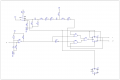
I have drawn a slightly modified version of the top part of the schematic with Dip Trace.
It only uses one set of changover contacts on the relay. I will email the .dch file to you.
Les.
I hear what your saying there, I too have too much money invested in books/plans that are basically useless. And now on the internet you can't even trust a lot of what is shown, even if it is freely given.
I just like you start learning electronic when I was 50 that was seven years ago. I have more advantage a little by having a degree in physics. By the time, I finish my experiment I will need someone to proof(verify) my book. Someone with experience and credible. Could it be you? Ofcause I pay. And perhaps my name wont sell. I am just some stupid from Vientiane. I need one or two more years to test the machine.
While I'm very flattered that you think I'm credible, many even in this forum don't feel that way toward me. And I just know enough about real electronics to be dangerous. But do have common sense in many things.
My back round doesn't include any college, but just from a young age a need to know how things work, especially mechanical things. I spent my life as a die/mold maker and machinist.
To look at that one page PDF, you are wrong calling yourself stupid. And in this day and age it makes little difference where you are from. Or it shouldn't. But selling a book or plans is not where I'm at when it comes to this EDM thing, it's to put something out into the community of home machinists that will work and work good.
Two days ago, I looked at your circuit. It is quite interesting. It is of discharge type, Surface quality must be exellent. I thought about going to that path once. But instead of using FAN7390, Which for me difficult to understand I would have choosen two seperate 12AC transformer to drive high level gate and low level gate.
The reason I picked the Fan7390 is that it is one of the highest current mosfet drivers and it is also one of the simplest. The low side mosfet can just be driven by the 12V circuit that is powering the logic. And that is the biggest reason for using the 4000 series logic instead of one of the other types, it just makes the whole circuit easier for me. And hopefully for anyone that wants to build it in the future. The high side mosfet is where it gets more complicated, it need to have more voltage on the gate than what is at the source when it is on. This is easiest with a dedicated gate driver, they are made to do that.
@roong, I've been thinking about your circuit. Using zener diodes for the sensing of the the gap voltage will work after a fashion. If your going to make a tap burner like you showed. It will work for something like that when the electrode is always in a specific size. But in a real EDM they use varied sizes of electrodes. So then you need to be able to adjust the gap voltage, and if you have different amperage levels in the discharge you also need adjustability to compensate. To get the best burn for all circumstances.
The high side Mosfet is where it gets more complicated, it need to have more voltage on the gate than what is at the source when it is on. This is easiest with a dedicated gate driver, they are made to do that.
I do understand the paradox of cascading two NPN Mosfets. But I think you can have two set of circuits one at high side another at low side, these two circuit use separate supply source. so totally you must have three transformers 2's 12V, 0,-12V and one 98Vdc. And two circuits on high and low side can communicate to each other via voltage divider or opto-coupler. For our machine extra weigh from one more small transformer is not important. And instead of driving gate with 0 and 12v you can better driven by -12 and 12v which can bring the Mosfet pass transition region faster when turning off. I use common emitter circuit to drive mosfets. That chip is good for aviation electronic where weigh is very importance.
I also think you should emphasis on NOR and NAND gates rather than AND or OR gates. Because NAND and NOR are more basic inside. AND gate is made by putting a NOT gare behind NAND gate not vise versa and you can accquire a NOT gate from a NAND or NOR but not from a AND or OR. Also NAND is cheaper and faster.
Next week or so, I can show you some picture and video in case you might be interested.
@roong , I'm in no way trying to criticizing your circuit, just that it's not how I would do it. And from spending many years on forums that are EDM related, the average person wanting to build an EDM has little or no electronics back round. Just seeing the one page you posted would scare the daylights out of most people. I know it would have done so to me in the beginning. Just my opinion and not worth very much at that, but if your aim is to market your plan as a book simpler is better. It makes no difference how well it does the job if it is too complicated for the person it's meant for to make. Again just my opinion, and not a criticism.
Looking at your schematic again it made me smile. It looks like you're using the SG3525to create a PWM in the design. I smiled because many years ago that was the first thing I was going to use. But the more I learned about all of this, decided that wasn't the way forward. Using PWM is more applied to a Wire EDM power supply. Wire can get away with it because it isn't any way near the power that a sinker needs. This is due to the area that wire is sparking compared to a sinker. Sinker needs either caps or inductors. I would have used inductors but couldn't figure out a way to switch them into the gap. They need to have a path to ground to charge that I couldn't figure out how to do when the gap wasn't ionized. So settled on caps, since the RC oscillation power supply is proven to work, and my circuit just makes it digital.
Auto industry use zener diode to detect voltage inside voltage regulator. It use to control output of alternator to 13.8V.
With zenor diode you can adjust voltage sensing a little by using dip switch and many 6volt diodes you can have a few increment in 6 volt steps. I dont know how to adjust the amp but you can play with pulse width
No I am not stupid, but you need a name like Ian Fleming or Guitrau as for a book to sell. By the way, ShortBus is a pretty good name.
Sg3525 only allow you to have miximun
Duty cycle of 49% but Sg3524(which is bipolar version of SG3525) you can have as much ad 98% duty cycle.
Auto industry use zener diode to detect voltage inside voltage regulator. It use to control output of alternator to 13.8V.
With zenor diode you can adjust voltage sensing a little by using dip switch and many 6volt diodes you can have a few increment in 6 volt steps. I dont know how to adjust the amp but you can play with pulse width
Hi Roong, I have to think through some of what you say before giving my answer, this is one of those times.
I'm not sure that is how they do it in an alternators voltage regulator. Most modern built in regulators are a IC, probably a type of micro controller. And probably that micro is doing just what I'm doing in my circuit, a window comparator.
I don't understand how zeners, dip switches and extra diodes, are a better way? With a window comparator and a panel mounted potentiometer you can adjust the gap voltage very easy, and it makes the whole circuit much simpler.
Like your use of a big circuit to turn the output off and on, many diodes, resistors and transistors taking up a big area of PCB to do the same thing that a 8 pin mosfet driver chip can do. Just my opinion but, simple is better. Especially if you want to market your circuit.
Like your use of a big circuit to turn the output off and on, many diodes, resistors and transistors taking up a big area of PCB to do the same thing that a 8 pin mosfet driver chip can do. Just my opinion but, simple is better.
Yes you are right that I may as well using 8pin instead of many transistors and diodes. In the PDF I gave, you can see that beside two sets of zenor diode ,pair with a transister. I also need a Flip-flop, an AND and a NOT gate. My implementation is like this. I have two boxes of electronic for my EDM. One I call "Pulse generator" the other "Logic&IO" I want minimum wire hook up between these two. So far I have only two twist pair form two opto-coupler. Then problem arises when I need to shut down SG3525. Sometime mistake happen I dont want generator to run hot. It need command from logic&IO box so it need an extra wire between two boxes. Then I decide that the pulse generator box should have some logic on it own. And that one Flipflop and a NOT gate can be implement with a single 8pin NOR or NAND gate. Then I need one more chip to make AND gate. But I also need 5v supply rail for the box, I have only +_17v rail. So this is the reason I decide to use discrete components to implement.It looks quite mess but not I can save two 8pin chips and one 7805+ 1 6.3v capacitor.
I have video how it work in water in MP4 around 1 minute. Allaboutcircuit not allow MP4.
I got your PM, but could not open it, sorry. Maybe post the video to Youtube and link it here? Putting it on Youtube would also be a start toward your book/plans marketing in the future.
Again I know you have put much time and effort into you system, and I'm really not trying to discourage you. I've been down that road of both being discouraged by people and the one in using the SG3525. Could never find a way to make it work. But maybe you can.
Most people don't understand there is a difference between a sinker and wire EDM power supply. The wire doesn't use energy storage and discharge, it sends the power directly into the wire. It can do this because of the small area of discharge. The sinker has a much larger area involved when burning, so it needs to store large amounts of power then discharge them. The SG3525 and similar chips are more for a wire EDM. That type, PWM, will work but never as good as a capacitor or inductor discharge for sinker. The brute force needed in sinker is just not available. But like I said above I hope you can prove me wrong.

 Facebook
 Google
 GitHub
 Linkedin