EDM - Electrical discharge machine

roong

Joined Feb 11, 2017
59
How did you come to conclude that 3525 didnt work. 3525 just generates pulse to gates of Mosfet. And I have 4 IRFP250N in pararell. I have tried to send you my email so that I can send vedio show that it has already worked but seem like this against allaboutcir.. policy which want us to use text comunicate just right here in the thread only. I have seen an old real machine, they use opamp 741 to generate frequency and a pair of conjugate transistors
(like you would find in class D amplifier) to expand the strenght of the signal. The pair makes emitter follower circuit. And the amplified signel either go to base of transistors or gate of Mosfets.
So far my machine work with kerosene. I tried on diesel it also works (i dont have submerge system) and I have found out the diesel can also catch fire. The explosion at the middle of electrode can create high pressure which can ignite diesel. I have just started trying a little bit with water. But problem I found so far is this your generator have to work a bit harder because leak of electricity due to electro-plating. And debris particle seem to be bigger as I sit a magnet close to spark iron dust is traped. So flushing with water is more important than ever. Good side with water is that you can leave the machine work unattend.
Have you tryed your system yet, I reckon the surface quality must be good.
 
Last edited:

Thread Starter

shortbus

Joined Sep 30, 2009
10,050
How did you come to conclude that 3525 didnt work. 3525 just generates pulse to gates of Mosfet.
I have seen an old real machine, they use opamp 741 to generate frequency and a pair of conjugate transistors
I didn't say it won't work, it's just not going to work well for anything but small electrodes. For a wire or just a tap burner it will work just fine. but if one wants something better that isn't the way. A RC relaxation oscillator is much more effective and easier to build. That type of machine is often called a first generation EDM, because that's where EDM started.

The type of machine you're describing and seems like what you are doing is often called a second generation EDM. Second generation machines weren't as good as the first and work was done to improve EDM. The second gen machines didn't get any type feedback out of the gap, it's condition. Because they just focused on the frequency of the pulses, like you seem to be doing, and not the gap conditions they have problems with shorting out and bad finishes in the burn. Many of the oldest machines I ran were of that type, and the company ended up getting rid of that type power supply and just buying third generation power supplies for them.

A third generation machine is what I've been trying to develop. One that uses the voltages measured on different parts of the system to control the sparking. I've probably made it too simple, would never be something people in industry would consider, but that's not why I'm doing it. It is an improved way for DIY machinists to have a machine that will work good. I'm not in this to make money or be famous, but just to help myself and others.

Have you trird your system yet, I reccon the surface quality must be good.
No, I haven't tried mine yet. That's the purpose of this thread, to get a better circuit before building it. I'm self taught in electronics. With LesJone's patient and willing help in this I can now see this actually getting to the point I will build it. Will it work right from the get go? I hope, but at least I can improve it from here.
 

roong

Joined Feb 11, 2017
59
Hi Mr. ShortBus .Thanks for the lecture about third generation machine. I would have not known without your lecture.
Again I know you have put much time and effort into you system,
Yes, It is worthed. I now have a bastard file full of holes I can show(brag) to friends. Apart from knowing a lot of electronic stuffs, fun though.
I look at your circuit, the way you use to detect breakdown voltage by using two diode. I am so doubt. Is this from Ben book?
 

Thread Starter

shortbus

Joined Sep 30, 2009
10,050
Hi Mr. ShortBus .Thanks for the lecture about third generation machine. I would have not known without your lecture.
Hi Roong, a lecture is not what I wanted it to be. It may just be our difference in language though. When I see the word "lecture", I think, "something you get from a parent for doing something wrong". I see us as two friends with a common interest, talking to each other. And to me that is important, because not to many people 1 have an interest in EDM and 2 if more of the world would just talk to each other things would be better.

On that note please don't call me "Mr. Shortbus". Just shortbus or SB is fine. Or should I be addressing you as "Mr. Roong"? I don't know the culture in your country so I may be disrespecting you by just writing "Roong"? Like above I consider us and hope we are friends.

I've lived and researched this EDM topic for so many years now that most of what I said in my last post won't be found in just one place. It is just from all of my research and reading that I said it like I did. Even when working with EDM in industrial situation most of my coworkers could have cared less about what the machine was doing, it was just a job to them. But it fascinated me and I wanted to learn all I could about it.

I look at your circuit, the way you use to detect breakdown voltage by using two diode. I am so doubt. Is this from Ben book?
No, it isn't in any book or set of plans. I saw it in one of the many PHD thesis papers I read, a way to detect the flow of electricity in the gap. I guess it could have been done by other means, like a 4 wire resistor type of measurement. But it makes it easier to just compare 2 diode drops verses 1 diode drop, to give an output from the comparator to shut off the upper mosfet. I knew that is what I wanted to do, but until seeing it in that thesis paper, I couldn't figure out how to do it. That I guess was the turning point in my design, the missing piece. And it is so simple, but when your like me with no training it seemed like the hardest thing in the world.
 

roong

Joined Feb 11, 2017
59
Hi SB, Differential amp is my week subject, What is your missing piece I still dont understand. At what cercumstance that output of LM339 can be logically zero or goes low(correction sorry).
I wonder if Mr. Lesjones can understand that. Seem to me like if you switch invert and noninvert input of LM339 in your diagram then it might work. Should it be a good idea for you to assemble only that small part of circuit and put current of external source via the two diodes and see changing at output of LM339.
 
Last edited:

LesJones

Joined Jan 8, 2017
4,511
Hi roong,
The output of an LM339 cannot go negative. The output is an open collector (NPN) transistor. This must be connected via a resistor to a positive voltage. This voltage can be higher or lower (Or the same) as the supply voltage to the LM339 (Pin 3). If the + input is more positive than the - input then the outpt transistor does not conduct so the voltaage at the output pin is at the voltage that the top end of the resistor is connected to. If the - input is more positive than the + input then the transistor conducts anf the output is close to zero volts. This comparitor works with the inputs close to ground and up to 1.5 volts less than the positive supply to the chip. The output resistor must be chosen so the transistors collector current is less than 20 mA.

Les.
 

roong

Joined Feb 11, 2017
59
Sorry, Mr. LesJones, I confused with op-amp which need negative supply rail. I meant zero when I said negative.
The scenario is like this when no spark occur, invert(-) polarity of LM339 (the one with negative sign) would leak more current compare to non-invert one because one more diode at non-invert terminal.
So non-invert(+) one leak less current. This equivalent to higher voltage at + terminal ---> output go high. When spark occur voltage at non-invert leak even lesser current due to higher voltage pass through the two diodes which in-turn keep output stay at positive. I don't see any scenario that output of LM339 can become low.Or may be he just put the +- sign wrong way.
 
Last edited:

LesJones

Joined Jan 8, 2017
4,511
Hi roong,
I assume you are referring to SB's schematic. There should be a resistor in parallel with the two diodes so that when there is no current through the gap the voltage on the + input of the LM339 will be zero volts. When there is current passing through the gap and the two diodes (Which will be tens or even hundreds of amps.) the voltage across the two diodes will be between about 1.4 and 2 volts .(Depending on the characteristics of the diodes.) As the voltage on the - input of the LM339 is about +0.6 volts (The forward voltage drop across D1) So when there is current through the gap (And two diodes.) the LM339 output will be high. when there is no current through the gap the output will be low. (Close to zero volts.) You don't need to call me "Mr. LesJones" Just Les will do.

Les
 

roong

Joined Feb 11, 2017
59
Les, That will fix the problem, How brilliently you are!. You told once but at the time I didnt look at the circuit carefully and didnt understand. I thought about swop the two inputs. That will do too but not as good as your way. I also think that the three diods can be schottky diode. So to save heat.
 
Last edited:

LesJones

Joined Jan 8, 2017
4,511
Hi roong,
The diode that sets the +0.6 volt reference on the inverting (-) input only needs to be a signal diode as it is only carrying a few mA. I see no point in using a schottky diode as all it would do is set a lower reference voltage. The two diodes in series with the gap must be very high power diodes as they will have to carry hundreds of amps. Again I see no point in using schottky diodes (Even if shuch high current ones exist.)
To save generating a small amount of heat you could just use one diode in series with the gap and use a schottky diode (Or a potential divider across a normal diode.) for the reference voltage.

Les.
 

roong

Joined Feb 11, 2017
59
Hi roong,
The diode that sets the +0.6 volt reference on the inverting (-) input only Les.
Why cant you change to 0.5v, . And also that two diodes. You can reduce Loss=VI = 2diode x (.6v-.5v) x 20 Amp = 4Watts.
I just check from ebay Vishey 100V 60A 3.99£ three legs.but with 20V schottky you can save 10Watt.
 
Last edited:

Thread Starter

shortbus

Joined Sep 30, 2009
10,050
This article https://www.irjet.net/archives/V3/i5/IRJET-V3I5581.pdf might get some of us up to speed, but I don't think this is the principle used in your design. It does, however, describe the process well.
That is what Roong is doing basically. And while it does/will work, just not too good. That is based on a Second generation type, from ~1970's, (post #143) and was one of the shortest lived of the generations of sinker EDM. Because of the problems involved in the cut or burn finish and time in an already slow process.

Haven't seen that paper though, thanks.
 

Thread Starter

shortbus

Joined Sep 30, 2009
10,050
Hi Roong, you are correct I put my + and - connections wrong in the schematic. Had it correct in my hand drawn version, but mixed them up when using a drawing program. Thank you for seeing that and it will be fixed.

.Or may be he just put the +- sign wrong way.
 

roong

Joined Feb 11, 2017
59
Hi Les, Refer to yours' Feed_Servo_02.
I need some knowledge on comparator . What is purpose of D1 D2 and R5.
And if voltage level is in window what is output of LM393.
Because you dont use a half of L298 then should you bring it to pararell to the used half to be able to handle more current.
 
Last edited:

LesJones

Joined Jan 8, 2017
4,511
Hi roong,
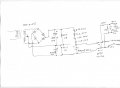
IC1 and IC2 (Together with D1 D2 R5 and or the other components in that area form an active rectifier. This is so the comparitor part can work with either positive or negative input voltages. In some situations it is beat to have the electrode positive and in other situations it is best for the electrode to be negative. So the output at IC2 pin 7 is the same with say - 5 volts input as it would be for + 5 volts input. Below is the schematic of the power supply for the discharge part. The DPDT switch on the output allows the polarity to the electrode to be reversed.

Image1Spark_power.jpg
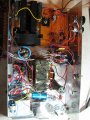
This is a picture of the unit. In the top left hand corner you can see the power resistors mounted on a heat sink with a cooling fan.
IMG_1236.JPG
The outputs of the two halfs of the LM393 control thedrive to the motor. If the voltage from the gap is less than the voltage on input pin 2 then output pin 1 is low and output pin 7 is high which drives the motor in the direction to increase the gap. If the input voltage is between the voltages on pins 2 and pin 5 then both outputs are high so the motor is stopped. If the input voltage is above the voltage on pin 5 then the output on pin 1 is high and the output on pin 7 is low so the motor rotates in the direction to close the gap. R11 sets the voltage at which starts to increase the gap. R12 sets the width of the dead zone. (The range of voltages that does not cause the motor to move.) You could parallel the outputs of the LM298. One half was enough to drive the motor that I used.

Les.
 
Last edited:

Thread Starter

shortbus

Joined Sep 30, 2009
10,050
Hi guys. so Les you have built an EDM? Your design or someone else's? Roong mentioned the L298 chip, but isn't that an old inefficient chip, kind of like people still using the 741 as an opamp? The SN754410 is pin compatible and doesn't have the voltage drop issue that the L298 has.

If it is your design Les, would you like to post it here in the thread? Since it is my thread I have no problems with doing it, many thread "owners" don't want others doing it but to me the more the merrier. Having more ways of doing EDM only helps the people wanting to build one, if not now then in the future.
 
Top