Dynamic test for mosfet and IGBT

Thread Starter

gaber2611

Joined Mar 14, 2013
324
Welcome to AAC!

If you're repairing equipment for pay, you should only use components from reputable sources.
I don't think it's practical for you to test all parameters.

You need to test as the manufacturer specifies.

Using IRLZ44 as an example.
  1. Gate leakage is measured at +/-16V.
  2. I used a PWM to test drain current at 6A. I wasn't able to test at a higher current. I used that circuit to get an estimate of on resistance.
  3. On resistance is measured using a pulse width ≤ 300us with a duty cycle of ≤ 2%. This is to prevent junction heating from affecting (increasing) resistance.
  4. Threshold voltage is measured with Vds=Vgs and Id=250uA. I had read that drain voltage and short channel effects caused threshold voltage to read low. That didn't turn out to be the case. I initially measured threshold voltage by using the MOSFETs as a current sink/source. Then designed a circuit to measure with the drain and gate shorted together. Doing it correctly gave slightly lower threshold voltages, which was the opposite of what I was lead to believe.

I bought 4 types of MOSFETs from AliExpress and had to test 100% of the devices for gate leakage (because they were all packaged in plastic bags), on resistance, current up to 6A, and threshold voltage. I used 3 different circuits and just used an ammeter to measure gate leakage.

I know the dubious origins of these parts and they won't be used in any critical applications (hobby circuits only). I bought them because I was looking for affordable power MOSFETs. I'm retired and it was worth my time to pay a fraction of what the parts would have cost from a reputable source and have to test them.
CAn you share the circuit you have used for testing the mosfets?
 

dl324

Joined Mar 30, 2015
18,355
CAn you share the circuit you have used for testing the mosfets?
Read this thread on using LM317 and this thread on MOSFETs.

In the LM317 thread, I posted a current sink circuit that was used for testing power dissipation and I discussed a modification to make it a 250uA current sink to get an approximate threshold voltage (both for N channel devices).

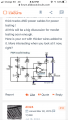
In the MOSFETs thread, I posted a PWM circuit. It can be used to do "high" current testing and getting an approximate on resistance.

The PWM circuit was implemented with a single comparator. That causes frequency and output voltage to vary with duty cycle. I added some CD4049 inverters/buffers on the output to make gate drive voltage constant and don't care that the frequency changes. I operated at about 10% duty cycle so I didn't have to put heat sinks on the MOSFETs.

With slight modifications, the circuits can be adapted for P channel MOSFETs.

For more accurate on resistance measurements, you need to use a PWM that follows the manufacturer specs for duty cycle and period. For more accurate threshold voltage measurements, you need to measure with the gate and drain shorted.
 

dl324

Joined Mar 30, 2015
18,355
This circuit?
Yes.

I added CD4049 inverters to address the gate voltage varying with duty cycle.
Is it only for mosfets?
No. I've used it for load testing transformers, LM317, power testing for BJTs, and getting approximate threshold voltages for the MOSFETs I bought from AliExpress.

I discussed the so-called short channel effect when trying to measure threshold voltage without shorting the gate to source. The difference wasn't large and wasn't in the expected direction.

To measure gate leakage current, I just used a bench meter and a power supply.
 

Thread Starter

gaber2611

Joined Mar 14, 2013
324
I set my bench meter on the 200uA scale and apply the maximum gate voltage allowed for the device; both polarities.
Okay, and how you know if there is leakage or no?, as this way will switch the mosfet on , so how gate leakage measurements?
 

ronsimpson

Joined Oct 7, 2019
4,704
double pulse testing
This link is not my group. Double pulse testing is what I did for the last four years.
It gives you a picture of three edges.
>Turn on at 0 current (inductive load turn on)
>Turn off at full current.
>Turn on at full current.
Double pulse testing gives you much of the AC numbers that goes into the data sheet. It does not heat up the part because the two pulses are not repeated. The data is captured and stored.
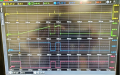
Here is an example of waveforms.
Yellow = Gate Current
Green = Drain current (small part only 20A)
Blue = Gate Voltage
Red = Drain voltage. (500V)
Keysight software looks at the waveforms and calculates numbers like gate charge, rise and fall time, etc.
1723414226504.png
 
Top