Dynamic Strain Gauge Amplifier Constant Current Cicuit

Thread Starter

jannerfish

Joined Jan 21, 2016
22
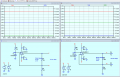
I'm building a dynamic strain gauge (only measures changes in strain). I want to drive 10 mA through a 350R gauge for 3.5V across it. I was planing to use the 1st circuit below (SG_CC) which drives the gauge directly from the opamp O/P. I assumed this would be ok with only 10mA required.
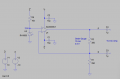
SG_CC.png

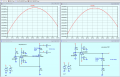
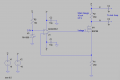
However, in TI's SNOAA46 Precision Current Sources and Sinks Using Voltage References, they suggest driving transistors from the the opamp instead. There are various circuit suggestions using BJTs, JFETS & MOSFETS in the text. I simulated this cicuit below (SG_CC_MOSFET) and it seems to work as well as the one above,
SG_CC_MOSFET.png

My questions are,

1) Do I really need to use a transistor at all, if I only need to drive 10mA through a 350R gauge?
2) How do I calculate the voltage produced at the opamp O/P, which is biasing the Base/Gate? My simulation above obviously has a value for this voltage but I don't know how it's calculated.

Thanks
 

ericgibbs

Joined Jan 29, 2010
21,420
hi jan,
Those two asc files are the same SG CC circuit?
E

Update:
Why are you AC coupling the Drain/350R SG output to the INA, is the Gauge measuring an alternating load?

EG57_ 2508.png
 

Thread Starter

jannerfish

Joined Jan 21, 2016
22
Yes, sorry I posted same file with different names. Circuit with mosfet now posted.

And yes, the gauge will only be measuring changes in strain or alternating loads.

hi jan,
Those two asc files are the same SG CC circuit?
E

Update:
Why are you AC coupling the Drain/350R SG output to the INA, is the Gauge measuring an alternating load?

View attachment 339229
 

Attachments

Thread Starter

jannerfish

Joined Jan 21, 2016
22
Attached both versions

opamp driving gauge directly, SG_CC_INA_CAL.asc
via mosfet SG_CC_MOSFET_INA_CAL.asc

Circuit includes a calibration signal.

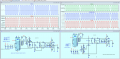
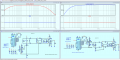
This calibration signal switches a resistance across the gauge at 25Hz. With the indicated INA gains, an INA O/P of 1Vpp or 0.2Vpp is produced. This simulates strains of 1000uE and 200uE respecitvely (uE = microstrains).

i.e for the 350R gauge.

162K6 in // with 350 gives 349.2482R.
dR = 350 - 349.2482 = 0.7518R
0.7518R x 10mA x 132.86 INA gain = ~1V

Calibration signal of mosfet circuit is ~@750mVpp, smaller than desired 1V. This version of circuit contains a cap across the gauge as the cal signal is spiky without it. Not sure why.

Input to INA contains filtering to producing bandpass of 1 Hz - 100 kHz.

Questions

1) why is the cal signal ina output reduced using the mosfet circuit?

images
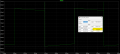
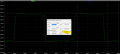
1Vpp CAL OUTPUT 350R_opamp-into-gauge.png750mVpp CAL OUTPUT 350R_opamp-into-mosfet.png
 

Attachments

ericgibbs

Joined Jan 29, 2010
21,420
hi jan,
The difference in the INA voltage outputs is due to the difference in the voltages developed across the 350R SG. refer to this image.
There is unequal loading on the 350R voltage/current source.
I am still looking for the cause.
E
EG57_ 2511.png
 

ericgibbs

Joined Jan 29, 2010
21,420
hi jan,
That 1uF cap across the 350R SG is reducing the GBW and as you using a 25Hz square wave will have an effect on the signal at the INA inputs.
E

Could you confirm what the 25Hz signal 'shape' you are expecting to see across the 350R SG. ?

This image shows the problem.
EG57_ 2514.png
 
Last edited:

Thread Starter

jannerfish

Joined Jan 21, 2016
22
That 1uF cap across the 350R SG is reducing the GBW and as you using a 25Hz square wave will have an effect on the signal at the INA inputs

Thanks. This makes sense

Could you confirm what the 25Hz signal 'shape' you are expecting to see across the 350R SG. ?

I wasn't sure how cleanly the 25Hz would appear across the gauge. The non-mosfet version does also has spikes. But it also has the expected voltage at the INA O/P of ~1Vpp (slightly reduced from 1.05V without the 1u cap to 1.02 with the cap across the gauge).

The difference in the INA voltage outputs is due to the difference in the voltages developed across the 350R SG. refer to this image.
There is unequal loading on the 350R voltage/current source.


Yes, in both circuits I've always seen an offset in the INA O/P. I'm not sure what's causing this either. I haven't actually built this circuit yet, only modelled. I will protoype it in the new year and see if the offset is there.
 

MisterBill2

Joined Jan 23, 2018
27,362
OK, I will start with some questions: Is this application using a full four element strain gage, a half-bridge strain gage with only two elements, or a quarter bridge, with only one element??? For a full bridge or a half bridge. it makes more sense to use a constant voltage, especially if using AC coupling to only see changes. OR, is the strain gage in an area with a changing temperature that changes the resistance?
 

Thread Starter

jannerfish

Joined Jan 21, 2016
22
OK, I will start with some questions: Is this application using a full four element strain gage, a half-bridge strain gage with only two elements, or a quarter bridge, with only one element??? For a full bridge or a half bridge. it makes more sense to use a constant voltage, especially if using AC coupling to only see changes. OR, is the strain gage in an area with a changing temperature that changes the resistance?
Quarter bridge.
Gauge will not be used in extreme environment or any rapidly chaging temps.
 

MisterBill2

Joined Jan 23, 2018
27,362
OK, so there are either three bridge completion resistors or maybe just one. If you are using a fast responding current regulator then it may not affect the frequency response at all.
BUT, for the best frequency response and the greatest accuracy, I recommend using three resistors plus the resistance leg in a full-bridge arrangement, along with a voltage regulated supply and a differential input instrument amplifier. That arrangement will remove the power supply from affecting the frequency response, and greatly reduce the effect of any supply noise on the signal. With an almost constant load on the supply the regulation should be quite good, and small voltage variations will produce very small changes in system gain.
Besides that, regulated voltage supplies are easier than regulated current supplies.
 

ericgibbs

Joined Jan 29, 2010
21,420
I will start with some questions: Is this application using a full four element strain gage,
#
Bill,
NO, read and try to understand the previous posts and check the TS's circuit diagram.!

OK, so there are either three bridge completion resistors or maybe just one.
The TS's text and circuit diagrams show CLEARLY there is only sensor element.

If you are using a fast responding current regulator, then it may not affect the frequency response at all.
The TS has already posted this comment
Gauge will not be used in extreme environment or any rapidly changing temps.

Why did you insist on posting statements that are not related to what the TS is asking and just serve to confuse the TS and disrupt threads?

E
 

MisterBill2

Joined Jan 23, 2018
27,362
The current regulator circuits do show only one resistive element, BUT a whole lot of strain gage applications use a full bridge, including most pressure transducers and most load cells. And not everybody shows the complete bridge when they are discussing the power supply.
In addition, the normal arrangement for providing the best stability with a single resistive element and an instrument amplifier is to use three resistors to provide a bridge circuit and use the differential inputs. This does allow the use of a regulated voltage supply.
If all of that is likely to confuse the TS, then there are other issues. Some arrangements are much easier to keep stable and accurate than some other arrangements.
 

MisterBill2

Joined Jan 23, 2018
27,362
#
Bill,
NO, read and try to understand the previous posts and check the TS's circuit diagram.!


The TS's text and circuit diagrams show CLEARLY there is only sensor element.


The TS has already posted this comment
Gauge will not be used in extreme environment or any rapidly changing temps.

Why did you insist on posting statements that are not related to what the TS is asking and just serve to confuse the TS and disrupt threads?

E
I add things that are not always directed at the specific question because sometimes an alternate scheme may offer some actual benefits.

Looking at an issue with a microscope may not reveal some of the larger picture information.
 
Top