Designing an AVR for Diesel Generator

Thread Starter

eng1223

Joined Mar 29, 2025
10
I am in the process of designing an Automatic Voltage Regulator (AVR) for a diesel generator's alternator, utilizing a microcontroller-based approach.

Currently, I do not have access to the specific generator to provide detailed specifications, but my general design framework is as follows:
  • Rotor Excitation Control:
    • An IGBT is employed to regulate the rotor excitation current.
    • The IGBT is driven by a TLP350 optocoupler, which interfaces with the microcontroller for control purposes.
    • The PWM pin of the TLP350 is directly connected to the microcontroller.
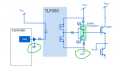
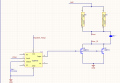
The schematic diagram of my proposed circuit is this:

1743293346439.png


Inquiries:
  1. Circuit Validation:
    Does the attached circuit effectively control the rotor excitation current? Are there any improvements or considerations I should be aware of?
  2. Initial Rotor Excitation Strategy:
    Upon startup, is it necessary to supply a higher-than-nominal excitation current to the rotor for a brief period before transitioning to the nominal current? If so, what magnitude and duration are recommended for this initial over-excitation?
  3. Implementation of Initial Excitation:
    What circuit configurations or methodologies are advisable to achieve the initial rotor excitation current boost during startup?
  4. PWM Signal Considerations:
    Since the PWM pin of the TLP350 is directly connected to the microcontroller, is this setup sufficient for generating the required duty cycle and PWM signal, or are there additional considerations I should take into account?

appreciate your help.
 

Thread Starter

eng1223

Joined Mar 29, 2025
10
Why are you using an optocoupler in the first place if you’re tying both (input and output) grounds together?
I understand that connecting both grounds together isn't the safest approach, but I had to do it because the microcontroller supply comes from a lm2596 module which supplies from BAT and all of them share the same ground.
I used the TLP350 specifically because I need to drive the IGBT with a Vgs between 12V and 15V, while my microcontroller operates at 3.3V, and the TLP350 allows for proper level shifting.
my main concern is how to handle the initial rotor excitation current.
Would appreciate any insights on this.
 

schmitt trigger

Joined Jul 12, 2010
2,027
But, YOU ARE still connecting the two grounds together.
I mean, if you still want to use it, go ahead and use it.
Otherwise use of the many non-isolated IGBT drivers. All of them provide the required level shifting from logic levels to the correct IGBT drive levels.
 

michael8

Joined Jan 11, 2015
472
How are you powering the TLP350? It seems to require a 15 to 30 volt supply?
datasheet: https://www.digikey.com/en/products/detail/toshiba-semiconductor-and-storage/TLP350-F/1641612

Also I believe that the "normal" way to regulate the rotator current is via switching scheme using the inductance
of the rotator as part of the switching circuit (and the load). So there don't need to be resistors in the current
path to the rotator. When the IGBTs switch on the current in the rotator increases over time, when the IGBTs
switch off the current in the rotator decreases (it flows through the diode). It's up to the PWM control to
adjust to the needed rotator current (as well it' be good to have some failure mode check so that the
rotator current doesn' t get too high).
 

Thread Starter

eng1223

Joined Mar 29, 2025
10
But, YOU ARE still connecting the two grounds together.
I mean, if you still want to use it, go ahead and use it.
Otherwise use of the many non-isolated IGBT drivers. All of them provide the required level shifting from logic levels to the correct IGBT drive levels.
I see that I should use an isolated DC-DC converter for the microcontroller supply, like the B2403S-1WR3, to keep the grounds separate. Now, my main question is: how should I handle the initial rotor excitation current? Should I apply a higher current for a short period at startup, then regulate it to the normal operating level? What’s the best circuit or approach for this?
 

Thread Starter

eng1223

Joined Mar 29, 2025
10
How are you powering the TLP350? It seems to require a 15 to 30 volt supply?
datasheet: https://www.digikey.com/en/products/detail/toshiba-semiconductor-and-storage/TLP350-F/1641612

Also I believe that the "normal" way to regulate the rotator current is via switching scheme using the inductance
of the rotator as part of the switching circuit (and the load). So there don't need to be resistors in the current
path to the rotator. When the IGBTs switch on the current in the rotator increases over time, when the IGBTs
switch off the current in the rotator decreases (it flows through the diode). It's up to the PWM control to
adjust to the needed rotator current (as well it' be good to have some failure mode check so that the
rotator current doesn' t get too high).

Thanks for the explanation on controlling rotor excitation using switching. I would like to clarify a few things:

  1. Is it better to add resistors in the current path, or is the switching method alone sufficient?
  2. Can the switching method handle the initial rotor excitation current, or should additional circuitry be used?
Also, if possible, could you share a schematic or block diagram of the ideal circuit for this approach?

Thanks for your help!
 

MisterBill2

Joined Jan 23, 2018
27,164
Probably you will need a different scheme to provide enough charge and discharge capability to rapidly switch the transistors on and off rapidly. Power mosfets have a fair amount of capacitance and a low current drive will not switch them fast enough to avoid spending time in the linear segment of the curve with resultant heating.
Consider that "M8" is right in post #5. Usually alternator output is regulated by RAPID on/off switching of the field excitation current. That includes running in a variable voltage mode.
 

Thread Starter

eng1223

Joined Mar 29, 2025
10
Probably you will need a different scheme to provide enough charge and discharge capability to rapidly switch the transistors on and off rapidly. Power mosfets have a fair amount of capacitance and a low current drive will not switch them fast enough to avoid spending time in the linear segment of the curve with resultant heating.
Consider that "M8" is right in post #5. Usually alternator output is regulated by RAPID on/off switching of the field excitation current. That includes running in a variable voltage mode.
I am using the FGA25N120ANTDTU IGBT and driving its gate with 12V DC. Is this voltage sufficient for efficient switching, or should I adjust it? Additionally, I’m operating at a kHz frequency for controlling the rotor excitation current—do you think this frequency range is appropriate, or should I modify it?
Lastly, I need to handle the initial excitation current, which is typically several times higher than the nominal rotor current. What is the best approach to manage this high initial current during startup?
I’d appreciate your insights.
 

panic mode

Joined Oct 10, 2011
4,864
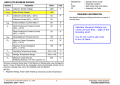
the manufacturer has info on the optcoupler and recommended ways to use it. for example it does show separate circuits as well as buffer transistors.
1743429555263.png
 

panic mode

Joined Oct 10, 2011
4,864
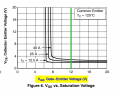
1743430138644.png

so 12V is sufficiently far from 20V but does it allow transistor to turn on?
looks like it... there is next to no change for Vge in range 8-20V.
So do you see what would happen if instead of 12V you used 7.5V here?
IT would still work but transistor would not be able to turn fully on if load current is large (more than some 25A).
1743430311212.png
 
Last edited:

MisterBill2

Joined Jan 23, 2018
27,164
Not one bit of the datasheet shown mentions either gate drive capacitance nor switching speed.
The point I am making is that switching speed is quite important for the reason that SWITCHING IS NOT INSTANT. AND the problem becomes that the time spent in the linear mode, between cutoff and saturated conduction is the time when a lot of heat is generated. AND, with one kilohertz PWM, the mosfet will be switching a lot. So the driver circuit must be able to quickly charge and discharge that capacitance to avoid excessive heat.
Also, that "initial current surge" will be happening every PWM cycle.
 

Thread Starter

eng1223

Joined Mar 29, 2025
10
View attachment 345763

so 12V is sufficiently far from 20V but does it allow transistor to turn on?
looks like it... there is next to no change for Vge in range 8-20V.
So do you see what would happen if instead of 12V you used 7.5V here?
IT would still work but transistor would not be able to turn fully on if load current is large (more than some 25A).
View attachment 345764
Dear friend

Thank you for your guidance. Based on the suggestion from the user schmitt trigger, I now understand that I should use an isolated DC-DC converter to supply the microcontroller from the battery.

My main question is how to handle the initial excitation current, which is typically several times higher than the nominal rotor current. I’ve seen an approach that uses a relay: during startup, the rotor pin (common) is connected to the NC pin of the relay, which is connected to the battery. After startup, the relay switches, and the rotor pins connect to the NO pin of the regulator, where the battery current is limited by the IGBT.

I understand that the initial current is much higher than the nominal rotor current, and it should be supplied for the first second. I’ve also read that directly connecting the battery to the rotor at startup is not recommended due to the risk of damage.

I don’t know what’s the best way to handle it. I would appreciate your guidance.
 

Thread Starter

eng1223

Joined Mar 29, 2025
10
Not one bit of the datasheet shown mentions either gate drive capacitance nor switching speed.
The point I am making is that switching speed is quite important for the reason that SWITCHING IS NOT INSTANT. AND the problem becomes that the time spent in the linear mode, between cutoff and saturated conduction is the time when a lot of heat is generated. AND, with one kilohertz PWM, the mosfet will be switching a lot. So the driver circuit must be able to quickly charge and discharge that capacitance to avoid excessive heat.
Also, that "initial current surge" will be happening every PWM cycle.
Thank you for your explanation.
so I need to find the value of the gate drive capacitance in order to determine the best switching frequency range for the IGBT?
Also, I understand that the freewheeling diode provides a safe current path when the IGBT is off, preventing the initial current surge from occurring in every PWM cycle. Could you please clarify why you said that the initial current surge happens in every cycle?
Thank you again for your insights.
 
Last edited:

michael8

Joined Jan 11, 2015
472
where does this requirement come from:

Initial Rotor Excitation Strategy:
Upon startup, is it necessary to supply a higher-than-nominal excitation current to the rotor for a brief period before transitioning to the nominal current? If so, what magnitude and duration are recommended for this initial over-excitation?


I don't believe it is true (or a good idea), instead it seems to me to slowly (from an electronic point of view, say 1 mS to 100 mS?)
to ramp up the current at start up. Also at start up, not providing power to the alternator rotator is like a mechanical unload -
the alternator will be easy to turn at startup while if it had rotator current (and thus the alternator was generating output power)
this would add to the diesel load at start. For a mechancial unload you might want a longer delay, possibly several seconds.
 
Last edited:

michael8

Joined Jan 11, 2015
472
Here's an article on buck down converter operation. Typically switching
alternator voltage regulator control circuits control rotator current
in a similar way, only the inductor in the down converter is replaced
by the rotator itself and the output is the magnetic field created by
the rotator so the other side of the rotator/inductor is connected to
ground. During the switching the current in the rotator ramps up and
down slightly around the nominal target determined by the on/off timing
of the switching device.

Buck Converter: Basics, Working, Design and Operation
https://components101.com/articles/buck-converter-basics-working-design-and-operation
 

MisterBill2

Joined Jan 23, 2018
27,164
Certainly the previous comments are good.
One error of yours is the concept of an alternator needing a start-up surge. That is simply a basic error!!
Not only is it incorrect, it is TOTALLY WRONG.
For starters, as has been already mentioned, the engine should be allowed to start and get up to speed BEFORE the alternator is energized to start producing power. Aside from that, the alternator output is regulated by switching the field power on and off, which is the same as PWM, Pulse Width Modulation. In a car electrical system that was originally done with a mechanical voltage sensing relay, then with a transistor switch, which could be more accurate and last much longer. That still operates in the ON/OFF switching mode. So the alternator is constantly getting that initial current applied.
In fact, many automotive systems intentionally delay engaging the alternator field supply until after the engine is done with the startup process, which may be several seconds. That is done to avoid a high voltage surge while the starter motor is still drawing current.
 

Thread Starter

eng1223

Joined Mar 29, 2025
10
Certainly the previous comments are good.
One error of yours is the concept of an alternator needing a start-up surge. That is simply a basic error!!
Not only is it incorrect, it is TOTALLY WRONG.
For starters, as has been already mentioned, the engine should be allowed to start and get up to speed BEFORE the alternator is energized to start producing power. Aside from that, the alternator output is regulated by switching the field power on and off, which is the same as PWM, Pulse Width Modulation. In a car electrical system that was originally done with a mechanical voltage sensing relay, then with a transistor switch, which could be more accurate and last much longer. That still operates in the ON/OFF switching mode. So the alternator is constantly getting that initial current applied.
In fact, many automotive systems intentionally delay engaging the alternator field supply until after the engine is done with the startup process, which may be several seconds. That is done to avoid a high voltage surge while the starter motor is still drawing current.
Thank you for your guidance! I initially didn’t know about the mechanical unload state, but after reading more, I understand that the engine should reach stable RPM before fully energizing the alternator.
From what I’ve learned, the approach is to start with a small excitation current so the stator doesn’t generate power, then gradually increase it. For example, setting PWM duty cycle to 10% at startup, 30% after 2 seconds, 60% after 4 seconds, and 100% after 10 seconds.
is this approach correct?
I also wanted to ask about choosing the best switching frequency. What factors should I consider, and is there an optimal frequency range for this application?
 
Last edited:
Top