Dampen Inductive Kickback using Flyback Diode or RC Snubber?

Status
Not open for further replies.

Thread Starter

Equinox_76

Joined Jul 11, 2024
8
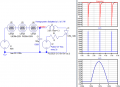
I am pulsing a 38mH coil (16 AWG wire wrapped around a small tube) with a IRFB4115pbf MOSFET at 66.6v (3 lipo 5200mAH "50C" battery's in series). It's a lot of juice! Using Lt spice I simulated this and found that the voltage spikes can reach up to 20kv. I am trying to figure out if I should use a flyback diode across the coil, or a RC snubber to absorb the the extra voltage.
Iv'e been using a 10 amp diode as a flyback for testing and it seems to work just fine, but I've heard an RC snubber works better.

Which one should I use???
 

Thread Starter

Equinox_76

Joined Jul 11, 2024
8
A snubber will likely cause the coil current to decay faster, if that's a consideration.
But the snubber R and C values must be properly selected to give a damped response with the maximum voltage you want.
Yes, I would like the coil to be de-energized as fast as possible.
Thanks for the response!
 

panic mode

Joined Oct 10, 2011
4,937
it is the release time that is affected by snubber...
and as stated - use zener... (in anti-series series with regular diode or another zener)

this allows you to select breakdown voltage your circuit can tolerate. for example you have a relay driven by transistor that has breakdown voltage 60V. you can pick zener that is under that 60V limit of transistor (so transistor survives). the higher the voltage the larger the spike and shorter the release time... so... nothing stops you from using transistor rated for 450V and zener for 400V...
 

Ian0

Joined Aug 7, 2020
13,114
Don't forget that the initial current through the zener will be the same as the coil current at the point of switch-off.
The maximum power dissipated in the zener will be the zener voltage multiplied by the initial current.
 

Ian0

Joined Aug 7, 2020
13,114
And the total energy dissipated in the Zener will be near the energy stored in the inductance.
And that is true regardless of the method of damping.
Power x time = energy
and initial power is proportional to zener or diode voltage.
So the reduction in de-energising time will be approximately in proportion to the zener voltage divided by the diode voltage.
(The resistance of the inductor comes into it as well, but that is assumed to be small)
 

MisterBill2

Joined Jan 23, 2018
27,319
First, what is the rate of change of that coil current? And what is the purpose of the pulsing??? Slowing the falll time will reduce that pulse voltage quite a lot.So that might reduce the problem.
 

Thread Starter

Equinox_76

Joined Jul 11, 2024
8
First, what is the rate of change of that coil current? And what is the purpose of the pulsing??? Slowing the falll time will reduce that pulse voltage quite a lot.So that might reduce the problem.
This circuit is a coil gun, so the purpose of pulsing is to launch a metal projectile. The fall time of the mosfet is pretty much at the best it can be, mosfet driver circuit, plus low value gate resistor, ect.
 
Status
Not open for further replies.
Top