Then you should filter at 10kHz.
I would suggest using a differential amplifier configuration and the Kelvin connection, then you can avoid any attenuation, and any error caused by resistance between the ground side of the shunt and real ground.
The recommendation is to use 300KHz, not sure how the value arrived? Can you please tell how you chose 10KHz in future i can understand for other circuits.
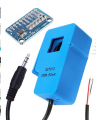
If you mean 3-phase MAINS currents, then you would be better off with current transformers.
If you are using shunts, then how are you coping with a 400V difference in voltages on each shunt.
The recommendation is to use 300KHz, not sure how the value arrived? Can you please tell how you chose 10KHz in future i can understand for other circuits.
The recommendation from whom? Must be someone completely ignorant of sampling theory and the Nyquist criterion,
You sample at 20kHz. What is going to happen with a signal at 30kHz? On the first sample it is at zero. The second sample is A cycle and a half later, so you will get it at peak. The third sample is 3 cycles after the start, so you will see it at zero, The fourth sample is 4.5 cycles so you will see a negative peak.
This is exactly what you get if you have a 10kHz signal.
So you can see you get a completely erroneous result.
This is known as "aliasing". For all frequencies above the sampling frequency, you will read a frequency at (Fsample-f).
Is that important?
If the signal you are interested in is 50Hz, and you have an interfering signal at 19950Hz, your A/D will read that signal as if it were 50Hz. Any signal above half the sampling frequency will make a mess of your readings unless you filter it out in ANALOGUE before you sample it.
If you are using resistors to measure current, there is line voltage on each resistor. I have used TC like this one. It hands you (in this case 50mA for 100A of line current). There is no line voltage to worry about. 100A CT
Your simulation does not seem to go up high enough in frequency to see the -3db point.
Try going up to about 1200kHz.
Remember the -3db point of a regular filter is 3db 'down' from the passband amplitude which is around -1.9db, so the -3db point has to be 3db lower than that.

 Facebook
 Google
 GitHub
 Linkedin