Current measurement - floating current source or high common mode current sensor?

Thread Starter

sirch2

Joined Jan 21, 2013
1,069
Following up on this thread* https://forum.allaboutcircuits.com/...veral-hundred-volts-dc-from-batteries.208972/
I need to measure current and voltage. High side current measurement would be at around 100V and I'm looking to measure say 50 to 200mA. There are chips, e.g. INA281 that can handle that common mode voltage but are there other approaches?

So I need something like

Code:
      ┌───────────────────┐
      │    CURRENT Source     │
      └────┬─────────┬────┘
             |         ┢------------┌────────┐
             |     [Rshunt]         |  Sense   |
             |         ┢------------└────────┘
             |         | 100V
      Electrode A   Electrode B
              \       /
                Earth
Can I float the current source, it will be running from a battery as will the ADC/MCU circuit, could I make the current source float with just one battery?
If the current source is floating how do I isolate it from the sensing amp/ADC ?


(*) As an aside, having done some tests I get reasonable results at around 100V so I don't need several hundred volts as initially suggested in that thread

Moderators note: used code tags to get monospaced font and preserve spaces
 
Last edited by a moderator:

ronsimpson

Joined Oct 7, 2019
4,647
INA281 that can handle that common mode voltage but are there other approaches?
Because you have a 100V supply use the INA281A4 or B4.
– INA281A1, INA281B1 : 20 V/V
– INA281A2, INA281B2 : 50 V/V
– INA281A3, INA281B3 : 100 V/V
– INA281A4, INA281B4 : 200 V/V
– INA281A5, INA281B5 : 500 V/V
There are many different IC like this. current sensor amplifier Here is a list of some more like it.

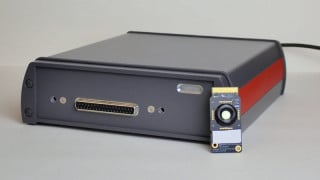
There are IC like this that measures the current and gives you a voltage that is isolated from the current. There are many like this. I think 5A is about the smallest I know of.
1770574319279.png
 

Ian0

Joined Aug 7, 2020
13,097
If your battery is floating, it will generally float so that the two terminals are the same voltage from ground, one positive and one negative.
If your circuitry connects to the negative side of the battery, you can measure the current in the negative lead to earth.
 

Thread Starter

sirch2

Joined Jan 21, 2013
1,069
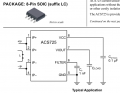
@ronsimpson - As I understand it, hall effect devices such as the ACS725 are not so good at smaller currents but we agree INA281 is an option anyway
 

panic mode

Joined Oct 10, 2011
4,864
correct... hall effect current sensors like ACSxxxx are meant for larger currents and the lowest ones are for 5A range. this is order(s) of magnitude different from what you are asking for. so you will be better of using shunt based measurement. does it matter for your application measurement is done on high side?

some sensors rely on external resistor for gain but INA281, INA293 etc have it built in. choice of gain depends on application. suppose you are using variant with 20V/V and expecting 0-5V output. so at max output (5V) input voltage across shunt would need to be Vdiff=5V/(20V/V)=0.25V across the shunt, and shunt resistance would need to be
Rshunt=Vdiff/Imax = 0.25V/0.200A = 1.25 Ohm

note, for units with higher gain, Vdiff is smaller and errors are larger. INA293 is more precise.
 

ronsimpson

Joined Oct 7, 2019
4,647
you can measure the current in the negative lead to earth.
This is the simplest. You must understand that the battery (-) is not at ground anymore. Which is OK.
and
The voltage you will get is negative. (below ground) You will need a simple circuit to invert the signal or lift it off of ground.
 

panic mode

Joined Oct 10, 2011
4,864
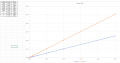
using hall sensor offers isolation (a very nice feature) but you would be operating at the bottom of the intended range. i have used ACS7xx from Allegro. for example 5A and 10A units performed quite well even at the low currents (ACS724LLCTR05AUT and ACS724LLCTR10AUT). here are actual bench results for currents up to 5A. note that measurements are not taken directly at the sensor output, i had an opamp after each sensor to scale the sensor output 0.5-4.5V (in this case to 0-5V). in this case i did not trim the circuit, just used 1% resistors and LM358.
1770762047474.png


but if you want higher accuracy for fraction of an Amp using shunt is a way to go. some ICs like LTC6102HV allow high side measurement in circuits 5-100V (max 105V). but if possible to use low side, there should be more candidates to consider (perhaps something like INA180/INA181 or similar).
 

ronsimpson

Joined Oct 7, 2019
4,647
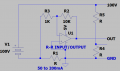
100V Battery, 50 to 250mA current.
op-amp has a gain of 10.
R4,R5 is voltage divider.
Op-amp must have an input range to GND or slightly negative. I would use a (Rail to Rail input and output amp.)
Under load the negative end of the battery heads down, causing the OUT to head up by 10x.
1770768002148.png
 

MisterBill2

Joined Jan 23, 2018
27,181
There are also isolation amplifiers available!. Atone job, with applications that drew many amps, we used a shunt resistor and a "BURR-BROWN" total isolation" amplifier module. It was powered by 15 volts, which was isolated from both the input and the output and iit could be set up with gains to 100X as I recall. It was quite linear, accuracy was always closer than 1%, and we never had one fail.
You should be able to find it on their website. We put them in a 20 pin socket that attached to the "meter" terminals of shunt resistor.
 

MisterBill2

Joined Jan 23, 2018
27,181
The product from Burr BROWN that I mentioned includes a single isolated supply that powers both side of te isolation barrier.
I would not even consider a supply that requires power separately for each side, nor a module that has a non-isolated power input.
Possibly for some less demanding applications, maybe.
 

Thread Starter

sirch2

Joined Jan 21, 2013
1,069
100V Battery, 50 to 250mA current.
op-amp has a gain of 10.
R4,R5 is voltage divider.
Op-amp must have an input range to GND or slightly negative. I would use a (Rail to Rail input and output amp.)
Under load the negative end of the battery heads down, causing the OUT to head up by 10x.
View attachment 363328
Thanks for this, are R4/R5 intended to provide 5v?
 

ronsimpson

Joined Oct 7, 2019
4,647
Thanks for this, are R4/R5 intended to provide 5v?
No. The op-amp should be powered by the same voltage that runs your computer.

It is to measure the 100V. Probably it will divide the 100V down so you can measure it.
Most computers can measure from 0 to 3.3V or 0 to 5V. Some time to 1/2 the supply voltage.
To make the math simple lets say your ADC can measure 0 to 5V. It is probably the 100V battery might be at 110V during charging. Make a divider so 120V divides down to 5V.

In the same way the current cense resistor needs to be sized correctly. You want to measure 200mA but I think you need some head room. The ADC input is 0 to 5V. The opamp has a gain of 10. The voltage across the resistor should be 0 to 0.5V for a current of 0 to 250mA.
 
Top