Inrush Current Measurement

Status
Not open for further replies.

Thread Starter

emirhankse

Joined Jul 4, 2022
12
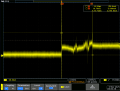
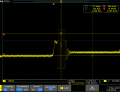
As you can see in the images, when measuring the inrush current of a circuit, I believe I’m capturing the actual inrush value when using a 4 ms time scale. However, when I switch to a 100 µs time scale, I notice oscillations in the current waveform, which I’m having trouble explaining. I'm not quite sure how to interpret this. What would be the correct measurement approach in this case?
1746776533910.png

1746776522747.png
 

crugorocks

Joined May 1, 2025
31
Use Two Timebase Measurements:
Long Timebase (e.g., 4 ms/div): Measure total inrush duration and peak current over time.
Short Timebase (e.g., 100 µs/div): Examine fast transients, verify component stress (e.g., MOSFETs, diodes), and identify potential EMI issues.
 

Thread Starter

emirhankse

Joined Jul 4, 2022
12
Use Two Timebase Measurements:
Long Timebase (e.g., 4 ms/div): Measure total inrush duration and peak current over time.
Short Timebase (e.g., 100 µs/div): Examine fast transients, verify component stress (e.g., MOSFETs, diodes), and identify potential EMI issues.
There is a common mode choke (CMC) and some capacitors at the input of my circuit, followed by an eFuse.
How significant are the frequency and duration of the transients observed in the short time scale (e.g., 100 µs)?
Also, is it normal to see a negative current during this period?
 

schmitt trigger

Joined Jul 12, 2010
2,027
If your scope has a long sampling memory, like most modern scopes do, set it up at the longest available memory, and then set up the scope at a slower timebase to capture the whole transient period.
Then you can zoom in to view the short-interval transients. In your case the timebase ratio is only 40X. Should be a piece of cake.
To your question, yes it is common to see a fast oscillatory behavior, due to all the stray inductance and capacitance.
 

Thread Starter

emirhankse

Joined Jul 4, 2022
12
If your scope has a long sampling memory, like most modern scopes do, set it up at the longest available memory, and then set up the scope at a slower timebase to capture the whole transient period.
Then you can zoom in to view the short-interval transients. In your case the timebase ratio is only 40X. Should be a piece of cake.
To your question, yes it is common to see a fast oscillatory behavior, due to all the stray inductance and capacitance.
Thanks for the response :)
Can I ignore this kind of oscillation as long as it doesn’t affect the eFuse at the output of the filter? Or should I consider damping it?
 
Status
Not open for further replies.
Top