Inrush current imact on Circuit breakers upstream of motor

Thread Starter

ahmed.javed

Joined Apr 9, 2025
3
Hi All,


I'm an electrical engineering student and currently working on a problem where I need to size the circuit breaker upstream of an escalator control panel.

Swithboard feeds Escalator control panel which inturn feeds Motor

The escalator motor has:


  • An inrush current of 88 amps
  • A maximum running demand of 65 amps

I'm struggling to determine whether the circuit breaker's trip setting should be based on the maximum demand or the inrush current.


If I size the breaker only for the maximum demand, won't that risk nuisance tripping during motor start-up due to the inrush?
Or do standard circuit breakers automatically tolerate temporary inrush currents?


Could you please advise on the correct approach to breaker selection in this case?
 

Ian0

Joined Aug 7, 2020
13,097
The upstream circuit breaker protects the cabling. The circuit breaker in the control panel protects the control panel.
You should calculate the prospective fault current based on the supply voltage, supply impedance, cable gauge and cable length, and choose a circuit breaker that will clear in an appropriate time to prevent any damage to the cable.
If the breaker size you calculate is too small for the operating current, you need thicker cable,
If it is too small to deal with the inrush, then you can opt for a type C (motor start) or type D (even greater inrush capability) circuit breaker.
 

LowQCab

Joined Nov 6, 2012
5,101
Wire-Gauge, and Run-Length, deserve some consideration,
as well as what type of Motor is being used.

3-Phase-Motors tend to "hit" the Breaker harder and sharper than a Single-Phase-Motor on start-up.

Longer Wire-Runs, ( anything over ~100-feet ),
need to be increased to the next larger standard-gauge of Wire,
this means that You can increase the Breaker-Current-rating to match the larger Wire-size,
this may be enough of a Current-capacity-increase to alleviate any
nuisance-tripping from a "common" Magnetic-plus-Thermal-Circuit-Breaker.
( sometimes referred to simply as a "Magnetic-Circuit-Breaker" )
( Magnetic-Circuit-Breakers are generally extremely FAST to respond to over-Current, and trip easily )

As Ian0 stated,
there are Breakers available specifically designed for heavy-Motor-Duty,
these are sometimes referred to as HACR-Breakers ( Heating-Air-Conditioning-Refrigeration ),
which will allow larger, and longer, "Start-up-Current-Spikes" produced by large-Motors,
to pass through, unchallenged, while still providing adequate protection for the Wiring-Insulation.
.
.
.
 

MisterBill2

Joined Jan 23, 2018
27,181
IF you have access to the escalator controller panel specifications then it will include the external protection requirements.
Consider that an escalator is never started at maximum speed!
What I HAVE DONE for motor supplies is used time-lag fuses and MOTOR STARTING RATED circuit breakers. Those devices allow higher than rated currents for some specific short time interval. In a very cautious scheme you would use "dual protections" That would be a fast acting 90 amp circuit breaker at the distribution panel and a "motor starting rated" 70 amp rated fused disconnect at the escalator controller panel. The wiring would probably need to be rated for 70 or 75 amps constant load.
 

meth

Joined May 21, 2016
298
Inrush current lasts only for a short period of time, that is why you use fuse specifically designed for motors (slow).
The fuse should match the motor ratings.
If there are other calculations you need to make, this is a dynamic system that needs some period of time to enter some balanced state (from t0 applying voltage until some time t when the current, voltage and motion is "constant"), so you would have to analyze multiple scenarios.
 
Last edited:

GetDeviceInfo

Joined Jun 7, 2009
2,270
Code will drive your selection, and is typically based on the motors FLA. As mentioned, the equipment manufacturer will recommend upstream protection.
 

LowQCab

Joined Nov 6, 2012
5,101
Larger Motors are usually protected by what is called a "Motor-Starter".

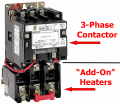
A Motor-Starter is simply a large Contactor which has "Heaters" built-in to it,
these "Heaters" come in a wide variety of exchangeable sizes so that
they can be matched almost exactly to the Full-Load Current of the Motor they are protecting.

Charts are available indicating the Ampere-Rating of each of the available Heater-Sets.

They are normally very slow in reacting to Motor-Overloads and are designed to
attempt to somewhat duplicate the Internal-Temperature of the Motor-Windings.

These Heaters are NOT designed to protect external-Wiring
in the same manner as a Fuse or a Circuit-Breaker

A Motor-Starter, may, at first glance, look just like a large Contactor with a few extra parts added-on.

The Heaters are small coils of heavy solid Wire, which heats-up a Thermostatic-Switch which
will interrupt the Power going to the Contactor's-Coil, shutting-down the Motor.

The Wiring of this type of Protection-Scheme is normally designed
so that a manual-re-start is required.

Other similar Schemes ..........

Some Motors may have a tiny Thermostatic-Switch built-into the Windings of the Motor which
can replace the function of the Heaters in a Motor-Starter type Contactor,
and, unfortunately, if one of these "built-in" Thermostatic-Switches fails,
the Motor must be disassembled to replace it,
which is not the case with a "Motor-Starter" type Contactor, since it is external to the Motor.
.
.
The picture below is an "old-school" "Square-D" brand Motor-Starter-Contactor
with an optional, detachable, "Heater-Module", shown without pre-selected Heaters installed.
This particular Motor-Starter is rated up to 7.5 or 10-Horsepower, depending on the Voltage used.
These are also available in a 2-Pole, Single-Phase, model, and with various Horsepower ranges.

More modern Motor-Starters tend to look like a non-descript, beige-colored-Plastic-Cube,
so I am providing a picture of an older model for a little better understanding.
.
.
Old-School Motor Starter .png
.
.
A properly implemented "Motor-Starter" provides the best protection against large Motor damage.
These are "usually" installed inside a "Motor-Control-Panel",
but can also be used "stand-alone" in it's own separate Junction-Box.
.
.
.
 

MisterBill2

Joined Jan 23, 2018
27,181
Considering the number of safety functions that an escalator (in the USA) must have, I am certain that the "control panel" will be equipped with a SOFT START motor speed controller so that there will not be any hint of the slightest starter inrush. There might be some small transient as the control system charges it's filter capacitors, but NOBODY is ever going to risk a jerky start tumbling folks down the steps. So there will be no motor inrush current.

IF the motor were driving a large grain auger in a flour milling plant, that would be a totally different situation completely. Then the control would be a lot like the ones that L.Q.C. pictured in post #8. But still the wiring will probably be sized to avoid the full-load starting current, which will be equivalent to the locked rotor current often specified for some applications.

So this exam question is a trick question. That has not changed in all these years. They still appear.
 

LowQCab

Joined Nov 6, 2012
5,101
Another point which should be addressed .............

The Motor, and the Control-Panel can, ( and usually should have ),
separate, dedicated, AC-Circuits assigned to them.

I have even changed the Wiring in a HUGE Water-Chiller Control-Panel to reflect the above philosophy,
where all of the "Controls" were powered by
one 3-Phase-Leg of the Main-Power-Feed into the Control-Panel, ( 500-Amps ).

The original Wiring did NOT include an Isolation-Transformer,
only a SINGLE, Non-UL-approved, Fuse-Holder, connected with a 12-Gauge Wire.

I don't know how they were able to get away with such a bad practice.
This was a big-name manufacturer too, "The Trane-Corporation".
Although, I did discover that this is actually "technically" allowed
according to the National-Electrical-Code at the time, ( early '90's ).
.
.
.
 
Last edited:
Top