Constant Current Constant Voltage Battery Charger

MrAl

Joined Jun 17, 2014
13,709
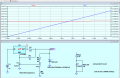
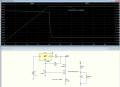
Still get 2A with a 16V input (below):
The difference may be in the model used.

View attachment 339317
"Better" in what way?
Do they have short-circuit and over-temperature protection?
Do they require more parts?
Oh sure that would require one more small NPN and a resistor or two. Apparently we don't need that though.

Yes it's not about the input voltage it's about the internal reference voltage and the value of the current limit resistor.

Your circuit has 0.6 Ohms mine has the original 0.45.
1.25/0.45=about 2.77 amps
1.25/0.60=about 2.08 amps.

That's not exactly too bad. It's then just a matter of the power dissipation in the resistor (and the linear regulator of course).

 

Thread Starter

Arcan3

Joined Nov 19, 2024
28
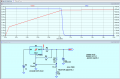
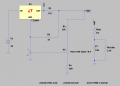
1735731830336.png

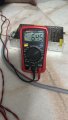
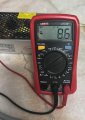
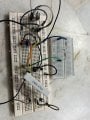
This is the latest circuit that i have been using. I also have conducted hardware testing with this circuit. Voltage obtained from Rbat is 6.5V and current is 8.6uA. the circuit does not get the targeted 12.6V.
1735731903321.jpeg 1735732035886.jpeg1735732211863.jpeg
 

Attachments

ericgibbs

Joined Jan 29, 2010
21,448
hi Arc,
Please confirm the voltage, capacity and type of battery you are planning to charge.

The circuit posted is for a 6V .
E
EG57_ 2515.png
 

crutschow

Joined Mar 14, 2008
38,529
This is the latest circuit that i have been using. I also have conducted hardware testing with this circuit. Voltage obtained from Rbat is 6.5V and current is 8.6uA. the circuit does not get the targeted 12.6V.
What is the power supply voltage?

As I previously noted, 12.6V is not enough to charge a 12V lead-acid battery, it requires over 14V for a full charge.
Below is the circuit to give that output:

1735744044036.png
 
Last edited:

ericgibbs

Joined Jan 29, 2010
21,448
hi Arc.
For that low capacity battery at 0.4Ah, if you charge at 1C, it would take about 1 hour to charge from a 20% discharged level.
At least a 15V PSU is required, I would use a 18V source and the charger could charge higher capacitor batteries much faster.
E
EG57_ 2516.png
 

Thread Starter

Arcan3

Joined Nov 19, 2024
28
What is the power supply voltage?

As I previously noted, 12.6V is not enough to charge a 12V lead-acid battery, it requires over 14V for a full charge.
Below is the circuit to give that output:

View attachment 339372
Hi Crutschow,

The supply voltage i used is 14V. Thanks for providing the circuit, i will be using this circuit to test the output voltage.
 

Thread Starter

Arcan3

Joined Nov 19, 2024
28
You will need a supply voltage at least 2V higher than the highest output voltage you want.
Hi Crutschow,

I have been testing the circuit in the simulation physically. Battery that i used to charge is Lead acid 4aH 12V. Initially, the battery have been fully discharged to 9V, i believe is the minimum SOC for the battery. After one hour of charging using my circuit charger, the voltage increase from 9V to 9.8V. Current across the battery is 0.3A. I have been using 0.4ohm resistor in R1, supposedly the current should be 2A. Do you know any problem regarding issues?

I would like to ask the recommended battery capacity for 12V lead acid as electronic projects purpose?
 

crutschow

Joined Mar 14, 2008
38,529
Do you know any problem regarding issues?
Did you measure the voltage at the input to the circuit?
If it is correct, then there would appear to be an error in your circuit wiring.
the recommended battery capacity for 12V lead acid as electronic projects purpose?
Depends upon how much current you want to draw from the battery, and for how long.
 
Last edited:

Thread Starter

Arcan3

Joined Nov 19, 2024
28
Depends upon how much current you want to draw from the battery, and for how long.
The current i want to draw is about 1A and the duration of the battery life is about 2 hours. I am planning to add a fuse into my circuit next to the input power supply to protect my charging circuit. I am thinking of using 3A polyfuse. What would you recommend the type of fuse i would use?
 
Last edited:
Top