Variable Constant Current Supply using Parallel Op Amps

Thread Starter

Kitt.Rainbolt

Joined Jan 16, 2026
36
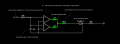
Dual Op Amp Variable Current.png

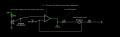
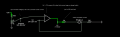
Hey everybody, my name's Kitt. I'm trying to design a variable constant current source for a 10k-30kOhm resistive load that might ocassionally be accidentally shorted. I can do this with one op amp, but my max desired current is 1.5mAmps, which is pretty close to the max current of the op amps I have on hand. I was thinking I could use two op amps in parallel to mitigate this and manage heat. I'm already operating pretty close to the max voltage on these puppies and I'd like to at least give them a break on the current.

Will these op amps attempt to drive one another or will those resistors help prevent that? I've only ever seen those resistors used in conjunction with individual feedback loops per op amp and I'm wondering if those resistors are just moot at this point. Alternatively, how bad is it that those op amps might drive one another?
 

panic mode

Joined Oct 10, 2011
4,864
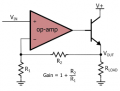
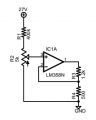
use single OpAmp with transistor as shown above if you need current sink.
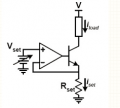
if you need current source, connection is different, something like:
1768595467044.png
note that control voltage is on high side (D1 sets the limit). if the control needs to be referenced to 0V, circuit would need to be adapted.

btw. what opamp you use? max output is 1.5mA? that means in worst case you have transistor dissipate 1.5mA * 36V = 54mW which is rather low. small transistor like 2N3904 or 2N2222 can handle that all day long.
 

Thread Starter

Kitt.Rainbolt

Joined Jan 16, 2026
36
First off - thank you so much for all your help and suggestions. I believe I will just get a bigger opamp in the long run. I underestimated my mA requirements when I ordered these. THAT BEING SAID - I'm running a scaled-down version for testing and I'm genuinely befuddled with the behavior of my circuit:

I'm running this off of (qty 3) 9V batteries in series for now and I tried to build a single opamp version of this circuit just to tinker and make sure that the output voltage actually follows the input voltage.

First mistake, accidentally swapped positive and negative on the batteries. I let the magic smoke out of one of my op amps, it was my first magic smoke, so I celebrated.

This is what I'm working with now:
Single Opamp Breadboard.png

I'm a little confused about the deviation betwen the simulation and reality, which I imagine is pretty common for people just starting out.

(all voltages positive)simulationmeasured with multimeter
Vcontrol3.41mV3.42mV
V1 (output pin)1.2V5.5V*
V2 (feedback pin)3.42mV1.95V*

* = what the heck is going on here? I have the trim inputs completely disconnected. I feel like I'm completely misunderstanding something important about real life opamps vs ideal simulated opamps.

Here's the opamp datasheet:
https://www.ti.com/lit/ds/symlink/ua741.pdf
 

crutschow

Joined Mar 14, 2008
38,321
My LTspice sim results using a 741 model, matches your sim, so I suspect you have a wiring or component error.

Double-check that the connections match the schematic (including the op amp pin numbers) and that the component values are correct.
 

Thread Starter

Kitt.Rainbolt

Joined Jan 16, 2026
36
I messed up a resistor value in the simulation, please see corrected image and table:
Single Opamp Breadboard.png


(all voltages positive)simulationmeasured with multimeter
Vcontrol3.41mV3.42mV
V1 (output pin)7.12V5.5V*
V2 (feedback pin)3.42mV1.95V*
 

dl324

Joined Mar 30, 2015
18,220
This is what I'm working with now
Does that circuit simulator allow you to change colors? I find black on white schematics to be easier to read and more typical.

It's also easier to discuss circuits if you use component designators.

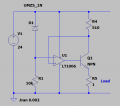
Drawn more conventionally and substituting a better opamp than LM741:
1768606832930.png
 

Thread Starter

Kitt.Rainbolt

Joined Jan 16, 2026
36
Can you recommend anything free that will help me achieve a diagram like that?

Also - do you think this has anything to do with the floating input voltage offset pins that are completely disconnected? I've gone through and verified and tested all inputs and pin numbers, swapped the op amp and I'm still getting comparable results. Thanks again!
 

crutschow

Joined Mar 14, 2008
38,321
Can you recommend anything free that will help me achieve a diagram like that?
I use the free LTspice simulator from Analog Devices.
do you think this has anything to do with the floating input voltage offset pins that are completely disconnected?
No.
Leaving them disconnected should have no effect on the circuit operation.
Make sure they are not accidentally connected to something.

My sim is still the same as yours, so there still seems to be some sort of circuit problem.
 

Thread Starter

Kitt.Rainbolt

Joined Jan 16, 2026
36
I think I know what the problem is. I believe this is because I'm extremely close to the negative rail on my control voltage. If I were to create a "ground" at +14v and operate around that, I could keep my control voltage near the center of the opamp's range. I might be able to choose a different ground that's somewhere between +14V and 0 to mitigate losses from the voltage divider that this ground will require. I'm going to set this circuit up and report back.
 

Thread Starter

Kitt.Rainbolt

Joined Jan 16, 2026
36
Nope. Same problem. Tripled checked everything and I've come to the conclusion that I may have mislabled or otherwise counterfeit Amazon.com op amps.
 

WBahn

Joined Mar 31, 2012
32,703
First off - thank you so much for all your help and suggestions. I believe I will just get a bigger opamp in the long run. I underestimated my mA requirements when I ordered these. THAT BEING SAID - I'm running a scaled-down version for testing and I'm genuinely befuddled with the behavior of my circuit:

I'm running this off of (qty 3) 9V batteries in series for now and I tried to build a single opamp version of this circuit just to tinker and make sure that the output voltage actually follows the input voltage.

First mistake, accidentally swapped positive and negative on the batteries. I let the magic smoke out of one of my op amps, it was my first magic smoke, so I celebrated.

This is what I'm working with now:
View attachment 362192

I'm a little confused about the deviation betwen the simulation and reality, which I imagine is pretty common for people just starting out.

(all voltages positive)simulationmeasured with multimeter
Vcontrol3.41mV3.42mV
V1 (output pin)1.2V5.5V*
V2 (feedback pin)3.42mV1.95V*

* = what the heck is going on here? I have the trim inputs completely disconnected. I feel like I'm completely misunderstanding something important about real life opamps vs ideal simulated opamps.

Here's the opamp datasheet:
https://www.ti.com/lit/ds/symlink/ua741.pdf
The 741 us not intended for single-supply operation. Your inputs need to be at least about 3 V away from either supply rail and you are trying to run them at about 0.3 V away from the negative rail. Don't expect it to behave well.
 

Thread Starter

Kitt.Rainbolt

Joined Jan 16, 2026
36
The 741 us not intended for single-supply operation. Your inputs need to be at least about 3 V away from either supply rail and you are trying to run them at about 0.3 V away from the negative rail. Don't expect it to behave well.
I found this single-supply opamp on some stompbox forums and it seems to be popular, cheap, and exceeds my 27V, 2mA requirements: https://www.digikey.com/en/products/detail/texas-instruments/LM358P/277042

I remember seeing it in some synthesizer forums a while back, too. Seems like it might be a pretty common one for battery powered opamp projects.
 

dl324

Joined Mar 30, 2015
18,220
Can you recommend anything free that will help me achieve a diagram like that?
I use a free version of Eagle.
Also - do you think this has anything to do with the floating input voltage offset pins that are completely disconnected?
It's the common mode input voltage range. LM741 is only guaranteed to be about 3V from the supplies. In single supply mode, the minimum input voltage is 3V.
1768627839879.png
1768627860501.png

LM358 has PNP transistors on the input and ground is included in the input voltage range:
1768627930712.png
 

Thread Starter

Kitt.Rainbolt

Joined Jan 16, 2026
36
It's the common mode input voltage range. LM741 is only guaranteed to be about 3V from the supplies. In single supply mode, the minimum input voltage is 3V.
That actually helps me understand what I'm doing. I'm going to look into common-mode with regards to amplification circuits and learn more. Thank you.
 
Top