Constant Current Constant Voltage Battery Charger

crutschow

Joined Mar 14, 2008
38,529
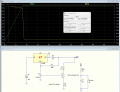
This is the result i got from the simulation of my circuit. Does it mean that it will constantly charge 2.5V in CC
No, it charges at the battery voltage until the battery voltage reaches the set full-charge voltage (looks to be nearly 12V in your sim).
Where did you get 2.5V?
Can you explain how to determine the state of charge by determining the voltage across the battery?
The state of charge is roughly proportional to the battery voltage.
When rested after charging with no load, the full charge voltage is about 12.6V.
During charging it goes up to about 14.6V maximum.
Go to the Battery University website for more info.
 

MrAl

Joined Jun 17, 2014
13,709
Hi Crutschow,

This is the result i got from the simulation of my circuit. Does it mean that it will constantly charge 2.5V in CC and then going to CV. Can you explain how to determine the state of charge by determining the voltage across the battery?
View attachment 339001
Hello again,

The state of charge is only roughly related to the voltage and on top of that it's a sliding scale. Sometimes you will consider 2.5v to be discharged and sometimes 2.4v for example, and on the top end sometimes 4.2v (the max) and other times 4.1v and still other times 4.15v. If you decide to charge to 4.15v then 4.15 will be considered 100 percent for example. Then you have the low end 2.50v, and so the charging range would be 4.15-2.50=1.65 volts. You then divide by 100 to get the SOC in percent, which gives us 0.0165 volts per percent. 50 percent would be 50*0.0165+2.50v which is 3.325v. 60 percent would be 60*0.0165+2.50v which is 3.49v. Since you would have the voltage first in most cases, if you read 3.8v then the SOC is roughly (3.8-2.5)/0.0165=78.8 percent.

The fully charged cell maximum charge will vary over time but the percentage SOC will stay the same, meaning you won't be able to tell when the cell is getting old unless you also track the charge time from some low value to some higher value.
The ideal method is to use what is sometimes called "coulomb counting" which is an odd name for it because it's just the integration of the current over time. That is the ultimate measure though.
In integral form it's the integral of the charge current 'i' over time 't', but in summation form it's the sum of all current values over intervals of time 'dt', then multiplied by 'dt'. Simply put, if you measure 1 amp for 1 hour that's 1 ampere hour put into the battery, and if you like you can apply an acceptance factor. We usually take more measurements than that though over some seconds, so if you measure 1 amp for 1 second, then 1 amp for another second, etc., over 3600 seconds, that's 3600 ampere seconds which is again 1 ampere hour. There is no mistaking what the charge is then as long as you start from a known state of charge which is often just the minimum voltage of 2.5 volts. This kind of measurement is best done with a microcontroller.

The nice thing is, if you care to do both measurements then you can estimate the depreciation (or age) of the cell as well. That's because the percentage method will always give you the same result while the coulomb counting method will vary with the actual state of health (SOH). You can also measure the time it takes to get from say 1 ampere hour to say 2 ampere hours to get the SOH, also in percent of maximum life, or just from say 0 ampere hour to 2 ampere hours. If it takes 1 hour when the cell is new and 1/2 hour when the cell is older, you know the cell capacity went down by about 50 percent.
 

crutschow

Joined Mar 14, 2008
38,529
The ideal method is to use what is sometimes called "coulomb counting" which is an odd name for it because it's just the integration of the current over time
Integration of current over time gives the number of coulombs passed (e.g. 2A for 10 seconds is 20 coulombs), and a battery holds many coulombs of charge, so is would seem "coulomb counting" is not an odd name for that.
 

MrAl

Joined Jun 17, 2014
13,709
Integration of current over time gives the number of coulombs passed (e.g. 2A for 10 seconds is 20 coulombs), and a battery holds many coulombs of charge, so is would seem "coulomb counting" is not an odd name for that.
Yes it just sounds kind of strange to people who hear it for the first time. Maybe because it's not like we are counting anything directly cause we can't see coulombs directly (ha ha). Some books do in fact explain it that way though, as if we had a miniature view of the charge passing by a certain point we happened to be observing.
For another example: We can all guess what "coulomb speed" would refer to :)

It seems that as time goes on technology gets more and more complex, and so does the way some things are named. So we get a sort of double complication rather than just one complication. Microsoft is so famous for this and would you believe they actually made a list of Windows colors by name, such as Forest Green, Medium Slate Blue, and the list is very long.
 

Thread Starter

Arcan3

Joined Nov 19, 2024
28
No, it charges at the battery voltage until the battery voltage reaches the set full-charge voltage (looks to be nearly 12V in your sim).
Where did you get 2.5V?
The state of charge is roughly proportional to the battery voltage.
When rested after charging with no load, the full charge voltage is about 12.6V.
During charging it goes up to about 14.6V maximum.
Go to the Battery University website for more info.
Sorry i read the wrong value. The charging voltage is 1.25V. I want to ask, does this charging voltage enough to charge a 12V Li-ion battery? I read that BMS system is needed to charge Li-ion battery to prevent overheating and overcharging problem. Do I need to implement them?
 

MrAl

Joined Jun 17, 2014
13,709
Sorry i read the wrong value. The charging voltage is 1.25V. I want to ask, does this charging voltage enough to charge a 12V Li-ion battery? I read that BMS system is needed to charge Li-ion battery to prevent overheating and overcharging problem. Do I need to implement them?
If the battery already has a built in BMS system then you don't have to add one unless you want to be more confident in the safety.

Each cell is 4.2v max, so three cells in series is 12.6v max, so of course you need at least 12.6v, but the input to the regulator may have to be as high as 12.6+2.5=15.1 volts. It depends highly on the regulator part number.
 

Thread Starter

Arcan3

Joined Nov 19, 2024
28
If the battery already has a built in BMS system then you don't have to add one unless you want to be more confident in the safety.

Each cell is 4.2v max, so three cells in series is 12.6v max, so of course you need at least 12.6v, but the input to the regulator may have to be as high as 12.6+2.5=15.1 volts. It depends highly on the regulator part number.
Does my circuit comply to the specifications needed?
 

Thread Starter

Arcan3

Joined Nov 19, 2024
28
This is the circuit that i have been using currently. It is more less the same as before but i change the values of the resistors and capacitors to get the output voltage of 12V
 

Attachments

MrAl

Joined Jun 17, 2014
13,709
This is the circuit that i have been using currently. It is more less the same as before but i change the values of the resistors and capacitors to get the output voltage of 12V
Can you post the TL431 mod file, I don't have that one yet.
You want 5 amps output?
 

nsaspook

Joined Aug 27, 2009
16,330
Integration of current over time gives the number of coulombs passed (e.g. 2A for 10 seconds is 20 coulombs), and a battery holds many coulombs of charge, so is would seem "coulomb counting" is not an odd name for that.
I would only say the battery holds an energy roughly (depending on the redox efficiency) equivalent to coulombs of charge at X potential because batteries don't really store charge. Batteries end up with 0 net charge as coulombs are the amount of charge you can transfer around a circuit before you exhaust the ability of one of the electrodes to accept or release electrons during chemical reactions.
 

Thread Starter

Arcan3

Joined Nov 19, 2024
28
Oh ok great. Give me a little while to check this.

Looks like it puts out about 2.7 amps as is. Is that ok or no?
Discuss with my SV to make it 2A current. But does it matter if the current is higher? I have noticed that my circuit utilize 0.6F capacitor which is quite high.
 
Last edited:

MrAl

Joined Jun 17, 2014
13,709
Discuss with my SV to make it 2A current. But does it matter if the current is higher? I have noticed that my circuit utilize 0.6F capacitor which is quite high.
It looks like your circuit works, but because of the somewhat novel regulation scheme and the known sometimes unusual behavior of the 431 chip, it has to be bench tested also.

You ask me if the current can be higher, but that depends on what the battery cell can take. Can it take 1 amp max, or 2 amps max, or 3 amps max, etc. You have to get that from the manufacturer's data sheet for that particular battery.

To get it down to 2 amps you have to increase the 0.45 Ohm resistor.

Is that 0.6F cap for simulating the battery cell? If so, that is not large it's too small.
 

crutschow

Joined Mar 14, 2008
38,529
i change the values of the resistors and capacitors to get the output voltage of 12V
You need more than 12V to charge a "12V" battery.
For example, a 12V lead-acid battery requires about 14.6V for a full charge.
Looks like it puts out about 2.7 amps.
My sim of the circuit shows 2A.
I have noticed that my circuit utilize 0.6F capacitor which is quite high.
That's the simulated battery load.
It's not in the actual circuit.
 

MrAl

Joined Jun 17, 2014
13,709
14V.
Obviously would have to be higher if more than 12V output is needed.

The output was, more precisely, 2.08A.
Ok that probably explains it. I used over 15 volts input because I wanted to make sure the linear regulator would always work right. The charge current most likely depends on that 0.45 Ohm resistor and also the input voltage. When it's not regulating the linear puts out max voltage, which is highly dependent on the input voltage. There are better ways to regulate the current too which are not too difficult to implement.
 
Top