How stable would you expect this constant current circuit to be?

Thread Starter

sirch2

Joined Jan 21, 2013
1,069
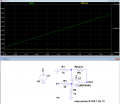
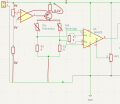
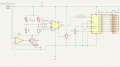
Below is a circuit diagram of an anemometer, the two thermistors form either side of a bridge, one side is 10k the other 100 ohm so more current flows down the low resistance leg and hence heats the thermistor on that side a little. Air flow over that thermistor cools it hence changing the bridge balance.

The bridge is driven with a constant current source formed from U3A and Q1, the issue is that the current source drifts which unbalances the bridge over time. The current starts out at around 27mA and drifts up to around 31mA over a few minutes. How stable should I expect this arrangement to be? Is there a better approach?
1767734625548.png
 

Ian0

Joined Aug 7, 2020
13,097
I wouldn't expect it to work at all.
U3A is connected to force 6V across RV3, which it can't because it only has a 6V power supply.
The non-inverting input should be connected to a voltage reference which is the same as the voltage expected across RV3.
I'm not sure why Q1 is a JFET. Depending on what current is required through RV3, it might need a Vgs which requires the gate to be below the negative supply.
The designed may have chosen a JFET because it is lower noise than a MOSFET, but I'm not sure why as the TLC272 isn't a particularly quiet op-amp, nor is the INA122.
Because the INA122 has a common mode range from 0 to 3.4V, extending to the negative rail but not the positive, I would have expected the constant current source to be in the positive supply, where it is not stealing valuable headroom.

If you need further advice, then specify the actual amounts of current involved, and the amount of temperature difference expected, and the resistance-temperature relationship of the thermistors.

Looking at the bridge circuit, I would have expected it to be driven from a constant voltage source, not a constant current source. What benefit does the current source provide?
 

crutschow

Joined Mar 14, 2008
38,316
Are you at all concerned about linearity of output voltage with change in thermistor resistance, as the bridge output voltage is slightly non-linear with that change?

If so, biasing each thermistor with a separate stable constant current will give a linear change in output voltage with resistance change.

One way to generate the constant-current without using a transistor, is to put each thermistor as the feedback resistance in a non-inverting amp, with a stable, constant voltage on the input resistor, which causes the thermistor current to equal the input resistor current.
The op amp output voltage will thus change linearly with thermistor resistance change.
The circuit inverts the signal, so when operating from a single positive supply voltage, you would connect the input resistor to ground and bias the op amp (+) input with a positive voltage so that the output stays positive over the desired dynamic signal range.
Edit: If the desired thermistor current exceeds the op amp output capability, you can add an NPN transistor buffer at its output.

The outputs from the two constant-current op amps would go to your differential amp.

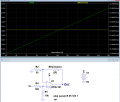
Edit: Below is an example op amp constant-current circuit for a nominal 1kΩ thermistor operating from a single supply:
Note the constant current through the thermistor (yellow trace) and the linear output vs. resistance (green trace).

1767810598723.png
 
Last edited:

ronsimpson

Joined Oct 7, 2019
4,646
Because the INA122 has a common mode range from 0 to 3.4V, extending to the negative rail but not the positive, I would have expected the constant current source to be in the positive supply, where it is not stealing valuable headroom.
I do not like running current through a pot. I put a fixed resistor in the current path and put a pot in the reference source. This assumes the 6V is stable.
The OP-amp needs to be a R-R input and R-R output type. There are many to choose from.
1767745496060.png
 

Thread Starter

sirch2

Joined Jan 21, 2013
1,069
To answer some questions, at the moment its fed from a power supply so the voltage is stable, if I run the finished design from batteries I would use a regulator. I'm using constant current because the resistance of the NTC thermistors obviously changes which would change the current flow through the bridge and potentially run away to some extent.

The component selection may not be the best, I was largely using what I had on hand.

I'm not too bothered about linearity but I might try using the thermistors in the feedback of the op-amps as @crutschow suggests. I'll probably start with @ronsimpson 's suggestion.

Thanks all
 

Ian0

Joined Aug 7, 2020
13,097
To answer some questions, at the moment its fed from a power supply so the voltage is stable, if I run the finished design from batteries I would use a regulator. I'm using constant current because the resistance of the NTC thermistors obviously changes which would change the current flow through the bridge and potentially run away to some extent.

The component selection may not be the best, I was largely using what I had on hand.

I'm not too bothered about linearity but I might try using the thermistors in the feedback of the op-amps as @crutschow suggests. I'll probably start with @ronsimpson 's suggestion.

Thanks all
@crutschow ’s suggestion makes the circuit more linear, but thermistor are not linear. (Assuming you are using NTC, you didn’t say). Actually, a series resistor of a similar value to the thermistor at the temperature you are monitoring gives a short section which is more linear that the thermistor’s normal curve.
Thermistor don’t ”run away” unless you put far too much current through them, and have no series limiting resistor. You would be better off driving from a fixed voltage.
 

crutschow

Joined Mar 14, 2008
38,316
@crutschow ’s suggestion makes the circuit more linear, but thermistor are not linear.
No, of course not.
But having a linear output with thermistor resistance means that it's easier to determine the thermistor temperature from its resistance/temperature curve, since you don't have to compensate for any non-linearity in the sensing circuit.

Edit: Of course, such linearity may not be needed in this application.
 
Last edited:

Thread Starter

sirch2

Joined Jan 21, 2013
1,069
I did a quick prototype of @crutschow 's suggestion and it looks good, nice and stable and getting 10's of mV change on the op amp output for the airflow rates in which I am interested. Thanks
 

Ian0

Joined Aug 7, 2020
13,097
No, of course not.
But having a linear output with thermistor resistance means that it's easier to determine the thermistor temperature from its resistance/temperature curve, since you don't have to compensate for any non-linearity in the sensing circuit.

Edit: Of course, such linearity may not be needed in this application.
My thoughts here. Calculating the temperature from the thermistor equation is complicated enough. The additional complexity of a series resistor is just another column in the spreadsheet that creates the lookup table.

True, linearity may not be necessary for the application. If we're dealing with only small changes, then the linearising effect of the series resistor around a certain temperature value might be useful.

Also, we're only guessing that he's using a NTC thermistor, it could be a platinum sensor which is PTAT, but was are assuming NTC because it is the most common.

A lot of unknowns here.
 

Thread Starter

sirch2

Joined Jan 21, 2013
1,069
If you post the the thermistor resistance values, I could optimize the circuit for you.
I'm using 100 ohm on the sensor side and 10k on the other which is there for temperature compensation. I had around 20mA running through the 100ohm thermistor (which is about 80ohm at room temp) this is the datasheet for the thermistors I am using - https://docs.rs-online.com/70e9/0900766b813c0c43.pdf

Yes, I realise that the 10k has a different beta than the 100R so doesn't provide great temp compensation but in the finished version I'll be using different, probably surface mount thermistors, for lower thermal mass and greater responsiveness.
<ETA> since this approach isn't actually using a bridge I guess the temp compensation side could also use a 100R thermistor with less current flowing through it...
 
Last edited:

Thread Starter

sirch2

Joined Jan 21, 2013
1,069
Also to add, the aim with this is to create a sensitive draft detector for slight drafts, I don't really care about linearity or actual values, just is there air movement and relatively is the draft at one place stronger than at another, hence the output is a bar graph display and I don't mind manually resetting it to balance before taking reaings
 

crutschow

Joined Mar 14, 2008
38,316
I'm using 100 ohm on the sensor side
Below is the single 6V supply op amp circuit optimized for the 100Ω thermistor:
I added a transistor emitter-follower buffer on the op amp output, since many standard op amps can't supply 20mA.
(Edit: The TLC272 appears capable of 20mA output so it shouldn't need the transistor.)

For the designed 20mA thermistor bias current, It has a sensitivity of 20mV per ohm change in the thermistor resistance.

1768059514382.png
 
Last edited:

schmitt trigger

Joined Jul 12, 2010
2,027
It goes without saying, that to detect drafts, the thermistor not only requires a very low thermal mass, but it must be mounted away from the rest of the circuit, on an assembly similar to automobile mass air flow sensors.
 

crutschow

Joined Mar 14, 2008
38,316
Note that if you use the op amp circuit for both thermistors, then the differential output of the two voltages will be relatively insensitive to the power supply (bias) voltage, the same as a bridge would be.
 
Top